


Free Teacher Assistant Cover Letter Templates & Examples
A strong teacher assistant cover letter shows you can support classroom instruction, build positive relationships with students, and keep daily routines organized. Our free examples and practical tips will help you highlight your hands-on skills so hiring teams see your value right away.
Real-World Cover Letters That Get Results
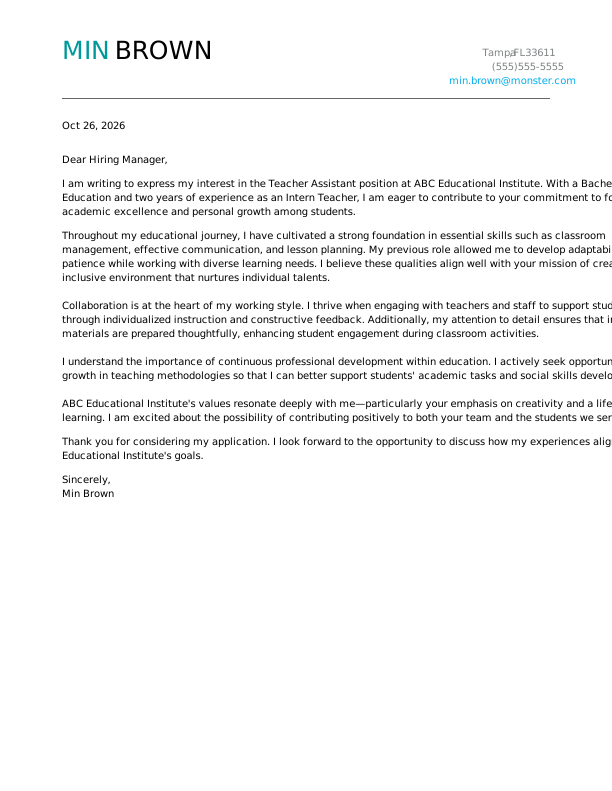
 Free
Teacher Assistant Entry-Level Cover Letter
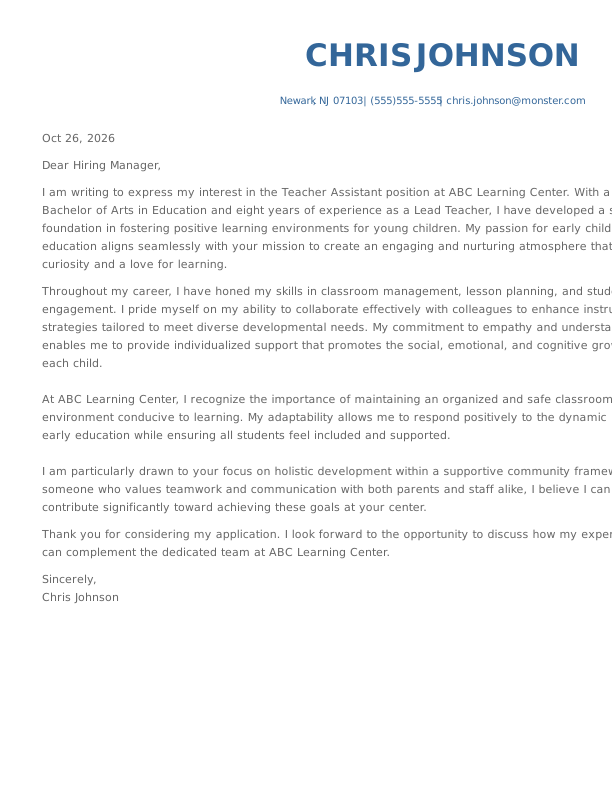
Teacher Assistant Mid-Level Cover Letter
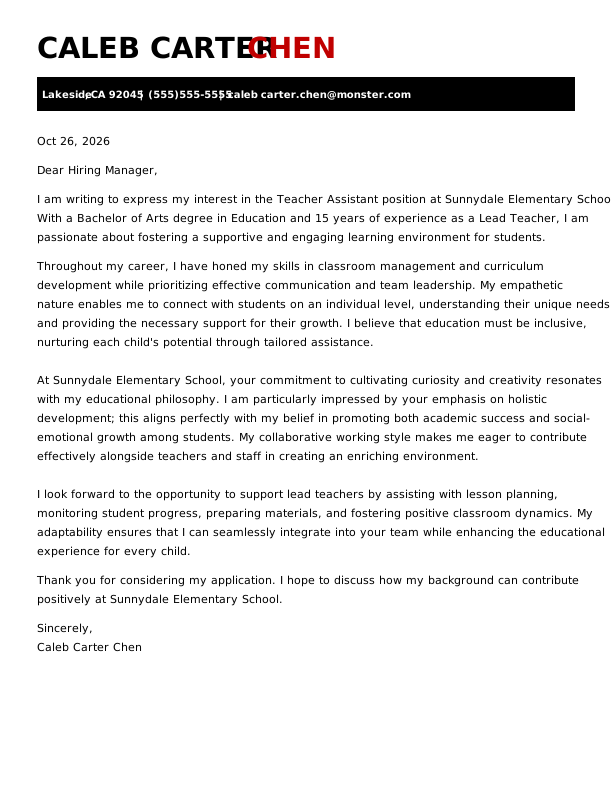
Teacher Assistant Experienced Cover Letter
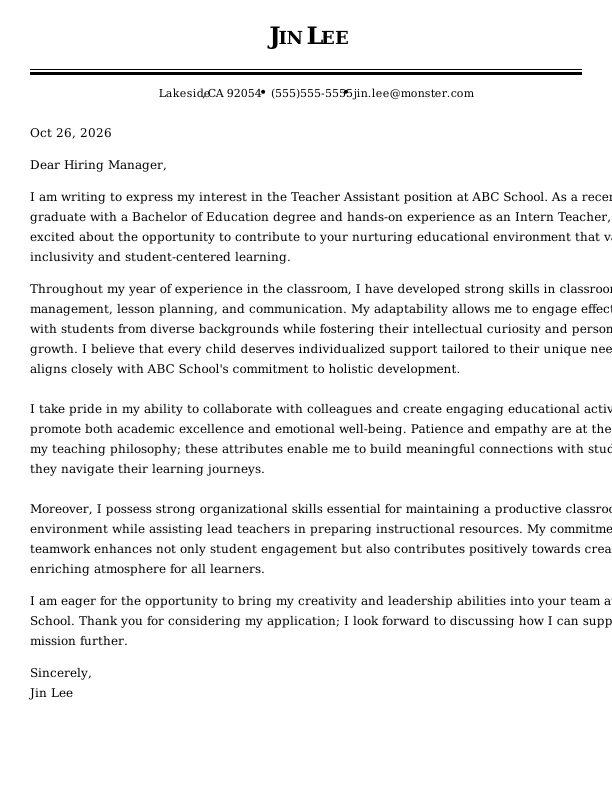
Teacher Assistant Entry-Level Cover Letter
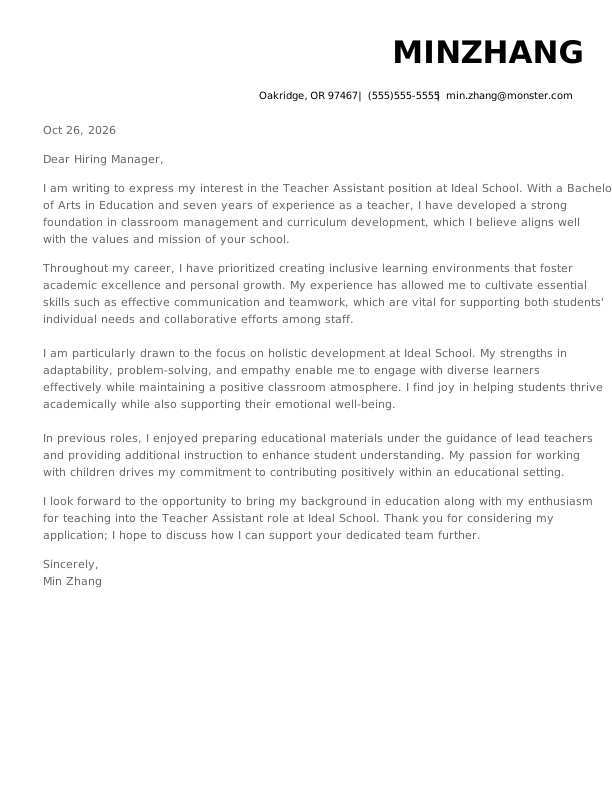
Teacher Assistant Mid-Level Cover Letter
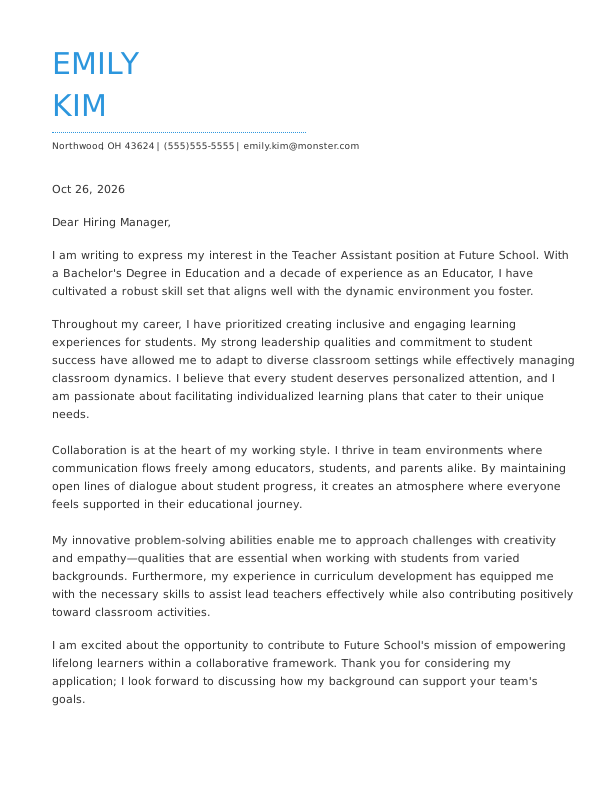
Teacher Assistant Experienced Cover Letter
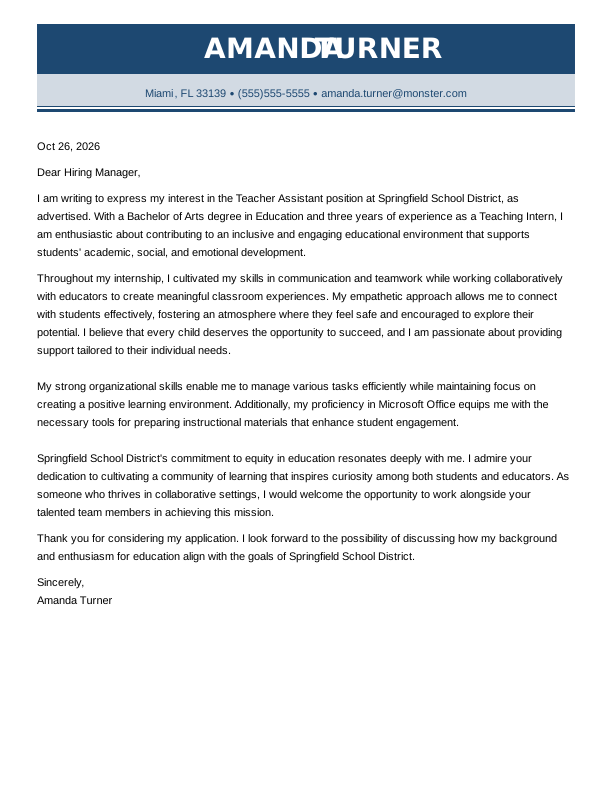
Teacher Assistant Entry-Level Cover Letter
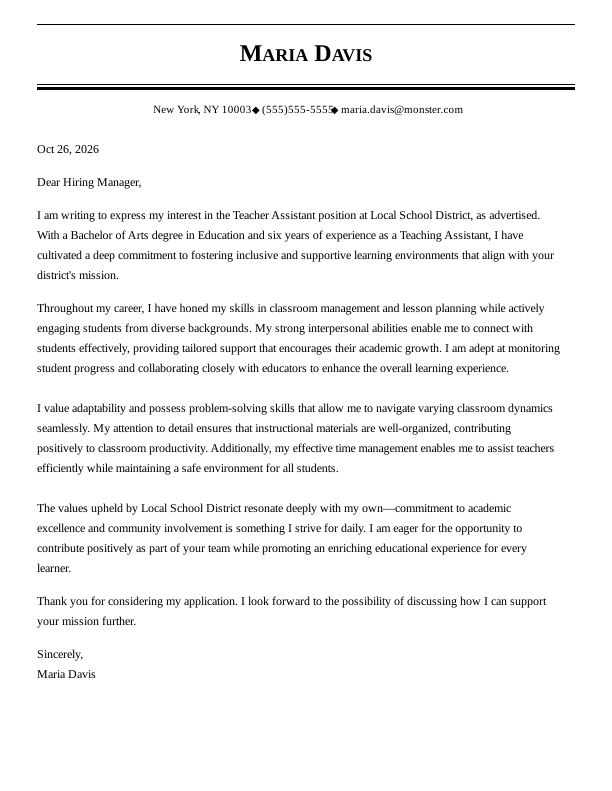
Teacher Assistant Mid-Level Cover Letter
Browse Free Cover Letter Templates
- Academic
- Account Manager
- Accountant
- Accounts Payable
- Administrative Assistant
- Admissions Counselor
- Architecture
- Artist
- Assistant Principal
- Babysitter
- Barista
- Bartender
- Bookkeeper
- Brand Ambassador
- Business Analyst
- Business
- Caregiver
- Chef
- Civil Engineering
- Computer Science
- Construction
- Consulting
- Copywriter
- Cosmetology
- Custodian
- Customer Service
- Customer Service Representative
- Data Analyst
- Data Entry
- Dental Assistant
- Dental Hygienist
- Digital Marketing
- Electrical Engineering
- Emt
- Engineering
- Esthetician
- Event Coordinator
- Executive Assistant
- Fashion Designer
- Finance
- Financial Analyst
- Firefighter
- Flight Attendant
- Graphic Designer
- Hair Stylist
- Healthcare
- Hr Generalist
- Investment Banking
- It
- Janitor
- Journalism
- Lab Technician
- Law Clerk
- Lawyer
- Librarian
- Logistics
- Maintenance Worker
- Makeup Artist
- Manager
- Marketing Coordinator
- Marketing
- Marketing Manager
- Massage Therapist
- Mechanic
- Mechanical Engineer
- Medical Assistant
- Non Profit
- Nursing
- Occupational Therapy
- Office Assistant
- Office Manager
- Operations Manager
- Paralegal
- Personal Trainer
- Pharmacist
- Pharmacy Technician
- Photographer
- Physician Assistant
- Pilot
- Police Officer
- Program Manager
- Project Manager
- Property Manager
- Psychology
- Receptionist
- Research Assistant
- Restaurant Manager
- Retail
- Sales
- Sales Manager
- School Counselor
- Security
- Security Officer
- Social Work
- Software Engineer
- Special Education Teacher
- Starbucks
- Substitute Teacher
- Teacher
- Teaching Assistant
Cover Letter Examples for Teacher Assistants
Cover letter expectations for a teacher assistant change as your career progresses and responsibilities grow. Choose the template that matches your experience level so you can highlight the right classroom support, training, and examples of student outcomes.
Entry-Level Teacher Assistant Cover Letter
This template is great if you are starting your education career or pivoting from another field, helping you highlight foundational skills, relevant training, and your enthusiasm for student support.
Mid-Career Teacher Assistant Cover Letter
This template suits candidates with several years of hands-on classroom experience who are ready to showcase their daily instructional support, behavior management skills, and teamwork with lead educators.
Experienced Teacher Assistant Cover Letter
This template is designed for seasoned professionals with extensive classroom backgrounds who want to emphasize leadership, curriculum support, student progress monitoring, and long-term educational impact.
Teacher Assistant Cover Letter Template (Text)
Copy this teacher assistant cover letter template into your document and customize it with your classroom support experience, specific grade level, and school name.
Sandra Ward
Louisville, KY 40202
(555)555-5555
sandra.ward@monster.com
Oct 26, 2026
Dear Hiring Manager,
I am writing to express my interest in the teacher assistant position at Future Educators Academy. With a Bachelor of Arts in Education and five years of experience as a lead tutor, I am excited about the opportunity to contribute to an institution that values collaboration, innovation, and educational equity.
Throughout my career, I have developed strong skills in classroom management and curriculum development. My passion for education is reflected in my ability to create engaging lesson plans that foster a love for learning among students. I pride myself on being patient and understanding, qualities essential for supporting diverse student populations effectively.
My experience has equipped me with effective communication abilities that allow me to collaborate seamlessly with educators and staff. I thrive in team-oriented environments where ideas are shared freely, and everyone works towards common educational goals. Supporting students individually or in small groups has been particularly rewarding for me; it is fulfilling to witness their growth when provided personalized assistance.
I admire Future Educators Academy’s mission of inspiring future educators through innovative teaching methods and mentorship programs. I share this commitment to nurturing the next generation’s learning experiences while ensuring an inclusive environment where all individuals can thrive.
Thank you for considering my application. I look forward to the possibility of contributing positively to your team at Future Educators Academy by supporting both students’ academic journeys and fostering a collaborative atmosphere among staff members.
Sincerely,
Sandra Ward
How to Write a Teacher Assistant Cover Letter
Translating your hands-on classroom support into clear, relatable stories makes your cover letter stand out. Follow these six steps to tailor your experience to the specific school and role you want.
1. Research & Prepare
Before you start writing, take time to learn what the school values most and how its classrooms operate every day. Find out whether the campus focuses heavily on small-group literacy interventions, social-emotional learning, or specific technology tools. Understanding these priorities helps you choose the most relevant stories from your own background.
Review these key sources to gather helpful details before drafting:
- The job posting: Look for required certifications, grade levels, and specific daily duties the school lists as top priorities.
- The school or district website: Check for campus improvement goals, instructional platforms, and core values that match your background.
- District support guidelines: Look up how the district outlines assistant duties, student privacy rules, and daily classroom routines.
2. Hook the Reader
Start with a lively opening line that shows you understand actual classroom life instead of using a generic greeting like “I am writing to apply for the open position.” Principals and hiring teams read dozens of letters, so mention a specific routine or intervention right away to spark their interest.
Try adapting one of these opening approaches to fit your experience:
- Highlighting daily routines: “During my recent fourth-grade assignment, I led daily reading rotations for 18 students and monitored weekly fluency checks to keep everyone on track.”
- Focusing on student assessments: “After our school rolled out diagnostic testing, I helped the lead teacher group students into three learning tiers and updated intervention notes after every cycle.”
- Supporting positive behavior: “During our campus-wide behavior initiative, I maintained daily tracking logs and used clear de-escalation strategies, helping reduce classroom referrals from 6 to 2 per week.”
3. Tell Your Professional Story
Your resume tells the hiring team where you worked, but your cover letter shows how you helped students learn and grow. Use concrete details and clear numbers whenever possible so administrators can picture you working in their classrooms.
Here are a few ways to show measurable impact in your daily work:
- “Led reading intervention groups for 12 students, helping them raise their average reading scores by 20% over one semester.”
- “Streamlined classroom transitions between subjects, cutting downtime from 6 minutes to 3 minutes across 30-minute learning blocks.”
- “Provided small-group math reteaching for 18 students each week, helping increase unit quiz pass rates from 62% to 78%.”
4. Showcase Your Skills
Rather than listing generic qualities like “patient” or “organized,” tell a quick story about how you handled a real classroom situation. Describing an actual moment where you supported a student or helped a teacher proves your ability far better than buzzwords can.
Connect your key skills to everyday classroom scenarios like these:
- One-on-one intervention: “When a student felt overwhelmed during independent math practice, I broke the prompt into step-by-step visual cues to help them regain confidence and finish the assignment.”
- Instructional preparation: “I organized differentiated practice packets in Google Classroom ahead of time so each reading group had the correct materials ready without interrupting instruction.”
- Partnering with families: “I sent regular, encouraging updates to parents about student progress, making sure families had simple, practical activities to try at home.”
5. Explain Any Special Circumstances
If you have an employment gap, are changing careers, or recently moved to a new city, explain it simply in one or two friendly sentences. Focus on your current certifications, recent classroom training, or relevant volunteer hours so the school knows you are ready to jump in.
Use these brief examples as a guide for addressing your situation:
- “After taking a personal leave to care for family, I renewed my CPR and first aid certifications and have spent the past six months tutoring elementary reading twice a week.”
- “I am transitioning my customer service and organizational background into education by serving as a substitute paraprofessional while completing my state instructional assistant modules.”
- “I recently relocated from Phoenix to Austin, transferred my fingerprint clearance to Texas, and have been supporting science lab activities using shared digital classroom tools.”
6. End With a Professional Goodbye
Wrap up your letter with a polite, enthusiastic closing that invites a conversation. State clearly what you look forward to discussing, thank the reader for their time, and use a standard professional sign-off.
For a natural closing, try phrasing your final paragraph like this:
“I would welcome the chance to discuss how my small-group support and classroom management skills can support your teachers and students this year. Thank you for your time and consideration. Sincerely, [Your Name].”
4 Tips for Formatting Your Cover Letter
Principals and hiring managers review applications between busy schedules, often scanning a cover letter in less than a minute. Clean formatting, balanced spacing, and clear structure ensure they immediately spot your qualifications without getting bogged down by clutter. A well-organized document also demonstrates your natural attention to detail—an essential trait for someone managing classroom materials, attendance logs, and daily instructional schedules.

Use a Professional Font & Layout
Choose clean, readable fonts like Arial, Calibri, or Georgia set between 10 pt and 12 pt. Maintain 1-inch margins on all sides and match the header design of your resume. Keeping a unified look across your application materials signals consistency and neatness, which are both vital for daily classroom management.

Address the Hiring Manager Directly
Check the job listing, school directory, or district staff directory to find the specific administrator or principal leading the hire. Using someone’s name shows genuine initiative and care. If you cannot find a specific name after checking, address your greeting to “Dear Hiring Manager” or “Dear Hiring Team” instead of using outdated phrasing like “To Whom It May Concern.”

Use Bullet Points for Key Achievements
Break up dense paragraphs with three or four concise bullet points highlighting your biggest accomplishments. Bullet points draw the reader’s eye directly to measurable wins, such as student benchmark growth, improved attendance rates, or successful behavior support programs.

Save & Send as a PDF
Always export your final cover letter as a PDF unless the job post specifically asks for a Word file. PDFs lock your fonts and margins in place so your document looks identical on any computer, tablet, or phone. Save the file with a clear, professional name, such as Firstname_Lastname_Cover_Letter.pdf.
Key Takeaways
- Focus your letter on real classroom routines, showing exactly how you support lead teachers and keep students engaged.
- Include clear numbers and specific outcomes to prove how your small-group support helped learners progress.
- Keep your layout clean, brief, and under one page so a busy principal can scan your qualifications easily.
More Cover Letter Examples
Browse Monster’s Resume Templates
Monster also has hundreds of ATS-friendly resume templates for all career levels and industries. Create a matching resume to help you land the interview.
- Art Teacher
- Dance Instructor
- Dance Teacher
- Education
- Elementary School Teacher
- English Teacher
- Esl Teacher
- Flight Instructor
- Kindergarten Teacher
- Math Teacher
- Music Teacher
- Physical Education Teacher
- Preschool Teacher
- Science Teacher
- Social Studies Teacher
- Spanish Teacher
- Special Education Teacher
- Substitute Teacher
- Teacher Assistant
- Teacher
Frequently Asked Questions
Last Update:
Do I really need a cover letter?
You should definitely include a cover letter for a teacher assistant role, even when the school lists it as optional. While your resume lists your work history, a cover letter lets you describe how you connect with children, manage small groups, and support daily classroom routines. Sending one shows the hiring team that you are organized, genuinely interested in the campus, and ready to contribute to its classrooms.
How long should my cover letter be?
Your teacher assistant cover letter should stay on a single page, ideally between 250 and 400 words. School administrators review dozens of applications between meetings and classes, so keeping your message brief and easy to read helps you stand out. Use three or four focused paragraphs to highlight your most relevant classroom experience, key certifications, and enthusiasm for supporting students.
Should my cover letter match my resume?
Your cover letter should match your resume’s visual layout so your application looks like a polished, cohesive package. Use the same font, font sizes, margins, and contact header on both documents. The writing should complement your resume by sharing the story behind a major classroom accomplishment or explaining why the school’s specific mission appeals to you, rather than repeating bullet points word for word.
Can I use AI to write my cover letter?
You can use AI tools to help brainstorm ideas, organize an outline, or polish rough sentences for your teacher assistant cover letter. However, you should always rewrite the text in your own voice and add real classroom examples. School hiring teams want to see your personal warmth, patience, and firsthand experience with students, which automated tools cannot write for you.
How do I write a cover letter for an internal position?
To write a cover letter for an internal teacher assistant position, begin by highlighting your familiarity with the school’s instructional goals, daily schedules, and student community. Mention successful projects you contributed to on campus, such as leading reading groups or supporting school-wide behavior initiatives. Conclude by explaining how moving into this role lets you serve the school’s teachers and students even more effectively.

Elizabeth Muenzen is a Certified Professional Resume Writer (CPRW) and member of the Professional Association of Resume Writers & Career Coaches who empowers job seekers to take control of their career paths using Monster’s comprehensive job search and resume tools.
See More From Elizabeth MuenzenExplore Related Career Advice







How to Write a Cover Letter for Internal Positions or Promotions (Examples & Tips)

Updated:
Apr 23, 2026
|
19 min read


Cover Letter vs Resume: What’s the Difference & Do You Need Both?
Updated:
Apr 23, 2026
|
18 min read