


Free Line Cook Cover Letter Templates & Examples
A strong line cook cover letter shows hiring managers you can handle busy shifts and deliver great dishes fast. Our free examples and guide help you highlight your key skills so a restaurant sees it’s the perfect fit right away.
Real-World Cover Letters That Get Results
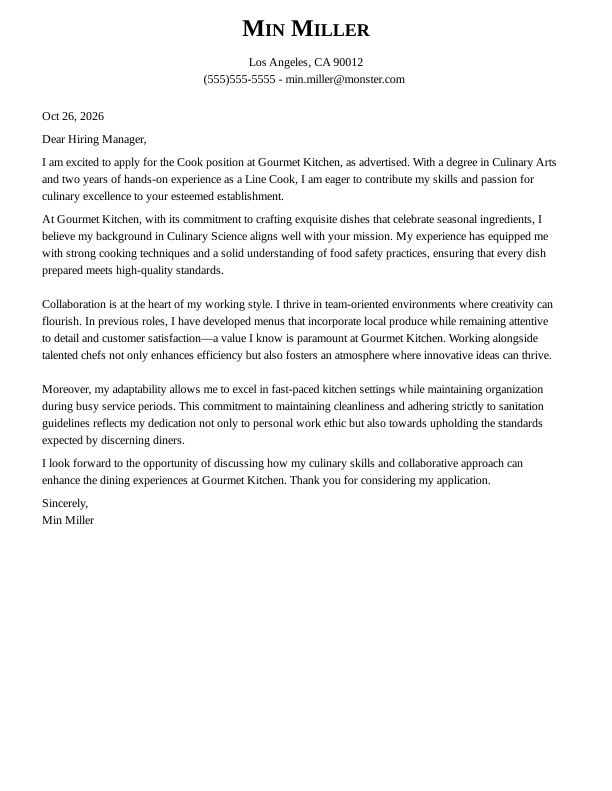
 Free
Cook Entry-Level Cover Letter
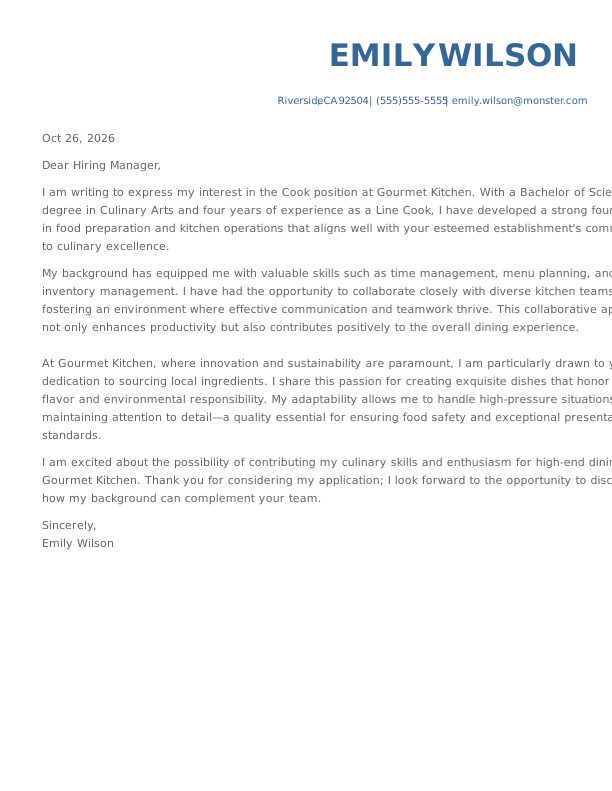
Cook Mid-Level Cover Letter
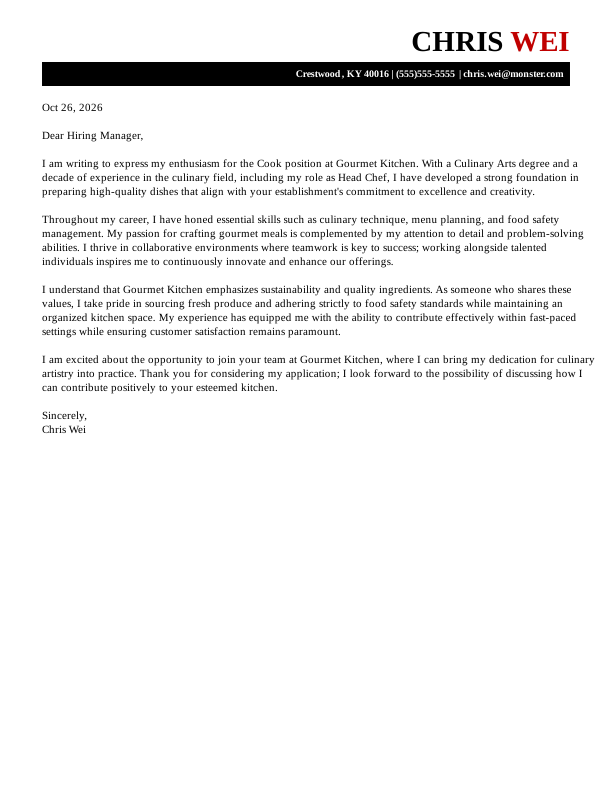
Cook Experienced Cover Letter
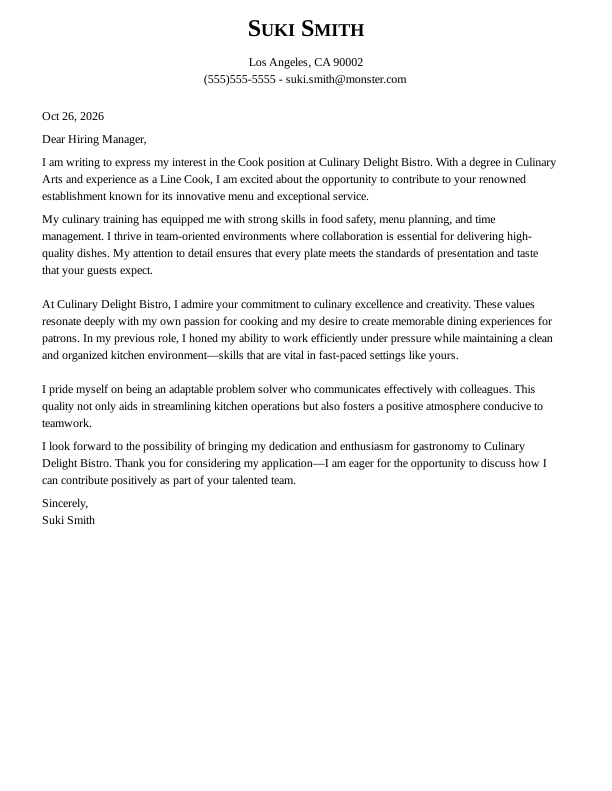
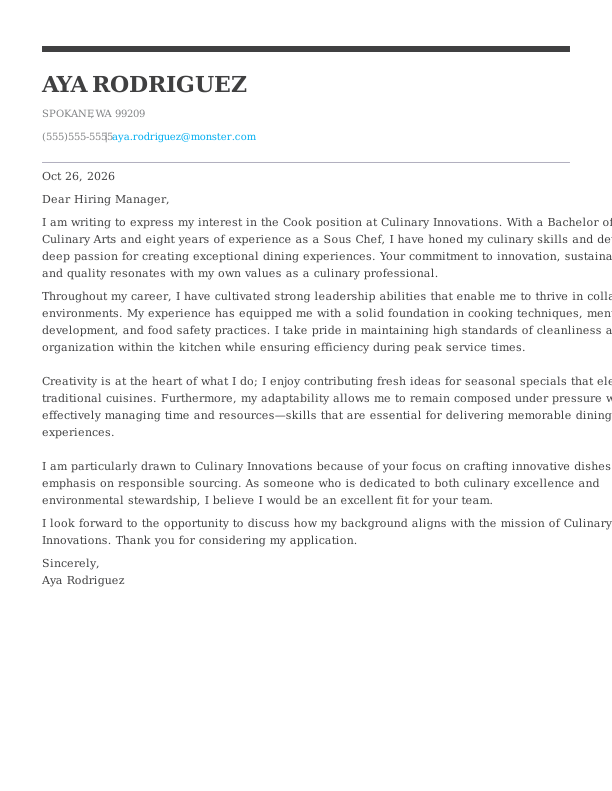
Cook Entry-Level Cover Letter
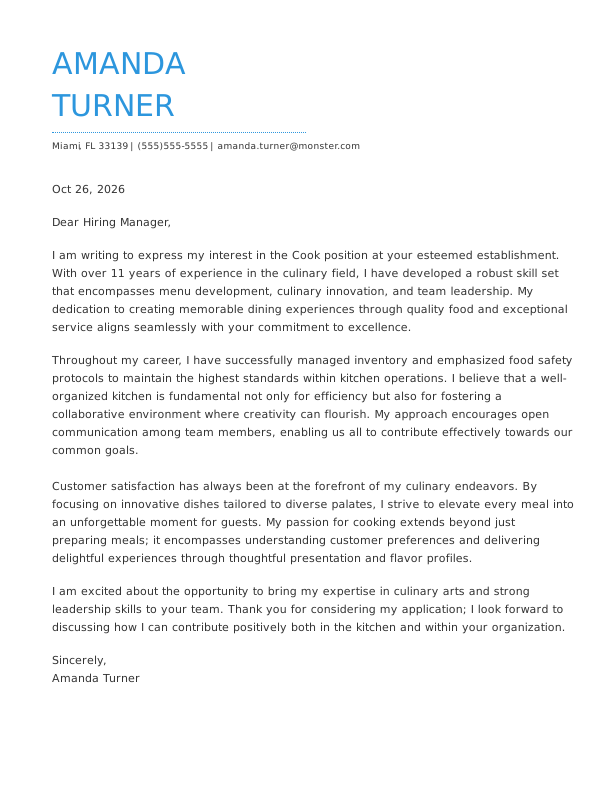
Cook Mid-Level Cover Letter
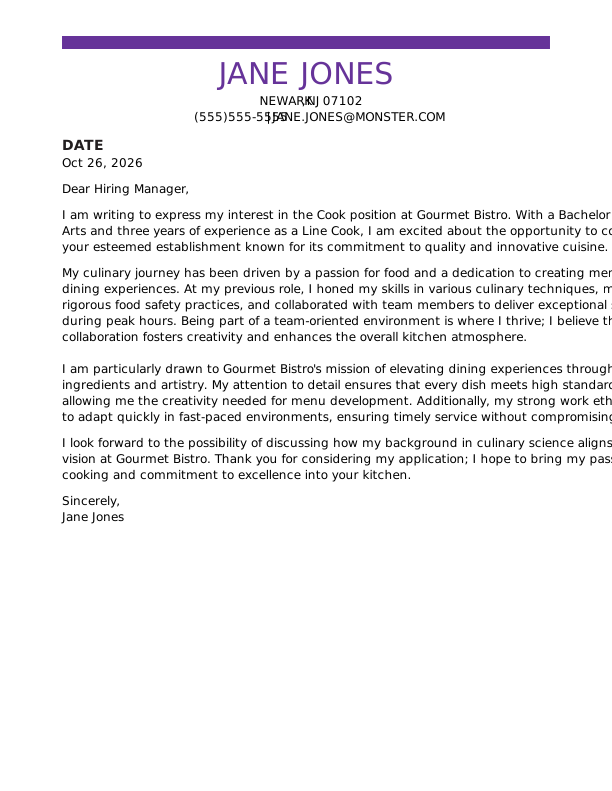
Cook Experienced Cover Letter
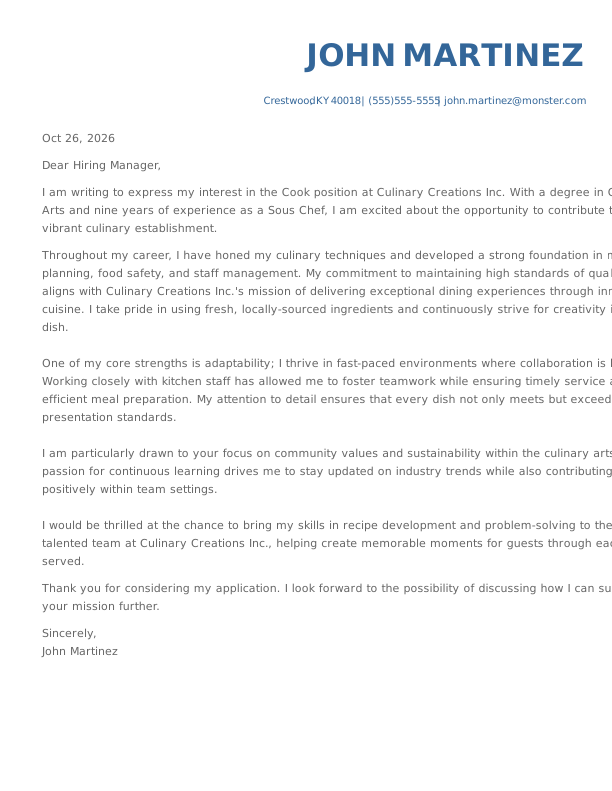
Cook Entry-Level Cover Letter
Cook Mid-Level Cover Letter
Browse Free Cover Letter Templates
- Academic
- Account Manager
- Accountant
- Accounts Payable
- Administrative Assistant
- Admissions Counselor
- Architecture
- Artist
- Assistant Principal
- Babysitter
- Barista
- Bartender
- Bookkeeper
- Brand Ambassador
- Business Analyst
- Business
- Caregiver
- Chef
- Civil Engineering
- Computer Science
- Construction
- Consulting
- Copywriter
- Cosmetology
- Custodian
- Customer Service
- Customer Service Representative
- Data Analyst
- Data Entry
- Dental Assistant
- Dental Hygienist
- Digital Marketing
- Electrical Engineering
- Emt
- Engineering
- Esthetician
- Event Coordinator
- Executive Assistant
- Fashion Designer
- Finance
- Financial Analyst
- Firefighter
- Flight Attendant
- Graphic Designer
- Hair Stylist
- Healthcare
- Hr Generalist
- Investment Banking
- It
- Janitor
- Journalism
- Lab Technician
- Law Clerk
- Lawyer
- Librarian
- Logistics
- Maintenance Worker
- Makeup Artist
- Manager
- Marketing Coordinator
- Marketing
- Marketing Manager
- Massage Therapist
- Mechanic
- Mechanical Engineer
- Medical Assistant
- Non Profit
- Nursing
- Occupational Therapy
- Office Assistant
- Office Manager
- Operations Manager
- Paralegal
- Personal Trainer
- Pharmacist
- Pharmacy Technician
- Photographer
- Physician Assistant
- Pilot
- Police Officer
- Program Manager
- Project Manager
- Property Manager
- Psychology
- Receptionist
- Research Assistant
- Restaurant Manager
- Retail
- Sales
- Sales Manager
- School Counselor
- Security
- Security Officer
- Social Work
- Software Engineer
- Special Education Teacher
- Starbucks
- Substitute Teacher
- Teacher
- Teaching Assistant
Cover Letter Examples for Line Cooks
Cover letter expectations change as a line cook advances from early station training to leading prep or managing service pace. Choose the template that matches your career stage to highlight the right skills, such as speed and ticket accuracy, menu prep experience, or shift leadership.
Entry-Level Line Cook Cover Letter
Ideal if you are starting your culinary journey or changing careers, this entry-level option helps you present foundational kitchen readiness and enthusiasm for the role.
Mid-Career Line Cook Cover Letter
Designed for cooks with a few years of hands-on experience, this mid-career template focuses on proven station reliability, consistent service quality, and teamwork.
Experienced Line Cook Cover Letter
Best suited for seasoned culinary professionals, this template emphasizes high-level line performance, mentorship, and operational efficiency during peak service.
Line Cook Cover Letter Template (Text)
Copy this line cook cover letter template, paste it into your document, and swap in your kitchen experience, menu prep skills, and the restaurant name.
Hiro Patel
Eastside, WA 98013
(555)555-5555
hiro.patel@monster.com
Oct 26, 2026
Dear Hiring Manager,
I am writing to express my interest in the Line Cook position at Culinary Innovations. With a Bachelor of Science in Culinary Arts and six years of experience as a Sous Chef, I have developed a strong foundation in culinary techniques and kitchen operations. My passion for food, coupled with my commitment to excellence, aligns seamlessly with the innovative spirit that Culinary Innovations embodies.
Throughout my career, I have honed skills in menu development and food safety practices while ensuring efficient kitchen operations. I thrive in collaborative environments where teamwork is essential for delivering exceptional dining experiences. My adaptability and creativity allow me to contribute meaningful ideas during menu planning and special events.
In addition to my technical abilities, I pride myself on maintaining an organized workspace that adheres to sanitation guidelines—a crucial aspect of any successful kitchen. My attention to detail ensures that each dish prepared meets the high standards expected by both the team and our guests.
Culinary Innovations’ commitment to quality ingredients and sustainable practices resonates deeply with me as it reflects values I hold dear throughout my culinary journey. I am excited about the opportunity to join your talented team where innovation meets passion for gastronomy.
Thank you for considering my application. I look forward to the possibility of contributing positively at Culinary Innovations.
Sincerely,
Hiro Patel
How to Write a Line Cook Cover Letter
A great line cook cover letter connects your kitchen experience directly to the daily demands of the line, such as managing prep lists, maintaining station workflow, and keeping ticket times tight. Follow the step-by-step breakdown below to organize your work history into a compelling pitch tailored for any kitchen opening.
1. Research & Prepare
Take time to learn how the restaurant operates and what the chef expects from the kitchen crew. Look closely at their menu, ingredient sourcing, and daily service style so you can highlight relevant station experience, prep habits, and kitchen speed.
Here are three practical steps to help you gather key details before drafting your letter:
- Read the job post carefully to identify main station responsibilities, required prep skills, and peak volume expectations.
- Check the online menu to learn their primary cooking methods, specialty ingredients, and core dish styles.
- Review customer reviews to see what diners say about food consistency, service speed, and presentation standards.
2. Hook the Reader
In your letter, show how you handle real service pressure with ease. Skip generic openings and focus immediately on concrete proof of your work on the grill, sauté, or prep line.
These opening examples show how to highlight your station readiness from the very first line:
- Pacing under pressure: “During Friday dinner rushes averaging 120 covers, I kept ticket wait times under 8 minutes by completing pre-shift mise en place and organizing batch prep efficiently.”
- Technical station work: “I manage the protein station using precise temp holds at 130°F and finishing orders on the broiler within 60 seconds to hit exact kitchen specs.”
- Line coordination: “I stay in constant communication with the expeditor by calling out fire times clearly, which helped reduce plate remakes from 6 to under 1 per week.”
3. Tell Your Professional Story
Use the body of your cover letter to explain how you keep a line running smoothly. Clear numbers and facts help the head chef visualize your speed, shift capacity, and work ethic during busy rushes.
Use measurable examples like these to demonstrate your real impact on kitchen operations:
- Reduced average ticket wait times from 14 minutes to 9 minutes during weekend service by setting up stations logically and speeding up call-outs.
- Cut weekly station food waste by 22% over three months by standardizing sauce portions and following strict daily par lists.
- Prepped and plated an average of 120 main dishes per shift while maintaining consistent presentation across two busy sauté stations.
4. Showcase Your Skills
Avoid vague statements about being reliable or fast. Instead, pull core requirements from the job posting and back them up with brief, real-world examples that show how you handle food safety, prep tasks, and teamwork on the line.
Consider these clear examples to highlight your essential kitchen abilities:
- Food safety standards: “I maintained precise temperature logs for hot and cold holding stations to ensure full compliance with health regulations.”
- Station organization: “I rotated prep items using strict FIFO guidelines before every shift to guarantee that all ingredients stayed fresh throughout service.”
- Teamwork and communication: “When ticket changes came from the pass, I gave immediate call-backs and adjusted cook times to keep plate timing synchronized.”
5. Explain Any Special Circumstances
If you have a gap in employment, are changing careers, or recently relocated, explain it briefly in one or two clear sentences. Kitchen managers focus mainly on your current knife skills, station experience, and ability to handle busy shifts.
Review these straightforward ways to address common career situations:
- Work gaps: “After taking six months off for family care, I maintained my knife speed and technique by working weekend prep shifts and practicing timed cuts at home.”
- Role transitions: “Moving from dishwashing to line cook work, I earned my food handler certification and cross-trained on grill and sauté during live shifts.”
- Relocations: “After moving to Austin, I joined a high-volume restaurant team where I quickly adapted to their prep lists and ticket timing standards.”
6. End With a Professional Goodbye
Close your letter with a clear call to action and a warm thank you. Keep this final section brief so your line experience remains the main focus, avoiding passive language that leaves next steps uncertain.
Suggest a specific topic for discussion in your closing, such as: “I would welcome the chance to discuss how my station prep habits, line communication, and rush speed can support your kitchen team. Thank you for your time and consideration.” End with a standard sign-off like “Best regards,” followed by your full name.
4 Tips for Formatting Your Cover Letter
Kitchen managers and chefs review applications between busy shifts, so a clean presentation, scannable format, and tight organization are essential to making an immediate impression. Clear layout choices let hiring managers quickly spot your station experience, shift readiness, and core skills.

Keep It to One Page
Chefs check applications fast, so keep your letter to 250–400 words across three or four short paragraphs. Focus on your line experience, speed, and prep work so your key strengths stand out at a glance.

Address the Hiring Manager Directly
Find the name of the head chef or kitchen manager using the job post or team website. If you cannot find a name, use “Dear Hiring Manager” rather than outdated greetings.

Balance Spacing & Margins
Use 0.75-inch to 1-inch margins and set line spacing between 1.0 and 1.15. Add a blank line between paragraphs so the page remains easy to scan on screens or printouts.

Save & Send as a PDF
Save your file as a PDF to preserve your formatting across different devices. Use a clear file name like Firstname_Lastname_Cover_Letter.pdf for a professional submission.
Key Takeaways
- Highlight your ability to keep ticket times steady and maintain consistency during busy shifts.
- Use clear metrics like tickets served per hour or food waste reductions to prove your efficiency.
- Tailor your experience to show you match the specific speed and precision standards of the kitchen.
More Cover Letter Examples
Browse Monster’s Resume Templates
Monster also has hundreds of ATS-friendly resume templates for all career levels and industries. Create a matching resume to help you land the interview.
- Agriculture
- Baker
- Banquet Server
- Bar Manager
- Barback
- Barista
- Bartender
- Busser
- Cake Decorator
- Catering
- Chef
- Cook
- Dietary Aide
- Dishwasher
- Executive Chef
- Fast Food
- Fine Dining Server
- Food And Beverage Director
- Food And Beverage Manager
- Food Runner
- Hostess
- Kitchen Manager
- Line Cook
- Mcdonald's
- Meat Cutter
- Pastry Chef
- Prep Cook
- Private Chef
- Restaurant General Manager
- Restaurant Manager
- Restaurant
- Restaurant Server
- Shift Leader
- Sommelier
- Sous Chef
- Starbucks
- Waiter
- Waitress
Frequently Asked Questions
Last Update:
Do I really need a cover letter?
You definitely need a cover letter for a line cook role, even when the posting lists it as optional. While your resume highlights your work history and station shifts, a cover letter lets you share your food philosophy, specific prep strengths, and enthusiasm for the kitchen. Taking the extra step to write one immediately shows hiring managers your strong work ethic and genuine initiative.
How long should my cover letter be?
Your line cook cover letter should stay under one page, ideally between 250 and 400 words. Chefs and kitchen managers review applications quickly during busy shifts, so keep it brief. Stick to three or four short paragraphs that highlight your strongest accomplishments, line speed, and food-safety prep without overloading the reader with filler.
Should my cover letter match my resume?
Yes, your cover letter should match your resume visually to present a polished application. Keep the same fonts, header layout, and color accents so both documents look like a matched set. Beyond appearance, your cover letter should expand on your key accomplishments and explain your interest in the position rather than simply repeating your resume bullet points.
Should I mention salary expectations in my cover letter?
Mention salary expectations in your line cook cover letter only if the job description specifically asks for them. If required, provide a flexible target range based on local market standards for culinary roles. Note that you are open to discussing the full compensation package, including shift differentials or health benefits, during your interview.
How do I write a cover letter for an internal position?
When writing a cover letter for an internal line cook role, focus on your familiarity with the restaurant’s workflow, station standards, and team dynamic. Highlight key achievements you have already made in the kitchen, such as lowering ticket times or training new prep staff. Expressing your commitment to stepping up demonstrates leadership while ensuring you complete all formal application requirements.

Vicki Salemi is a nationally recognized career expert who helps professionals navigate the hiring landscape and find the right fit on Monster. With over 15 years of experience in corporate recruiting and HR, she offers expert guidance on job search strategies, interview preparation, and career development to help candidates land their next role.
See More From Vicki SalemiExplore Related Career Advice







How to Write a Cover Letter for Internal Positions or Promotions (Examples & Tips)

Updated:
Apr 23, 2026
|
19 min read


Cover Letter vs Resume: What’s the Difference & Do You Need Both?

Updated:
Apr 23, 2026
|
18 min read