


Free LVN Cover Letter Templates & Examples
A strong LVN cover letter shows you can provide safe, gentle patient care while keeping clear charts and following safety rules. Our free examples and easy step-by-step guidance will help you write a clear intro that highlights your nursing skills so hiring managers notice you right away.
Real-World Cover Letters That Get Results
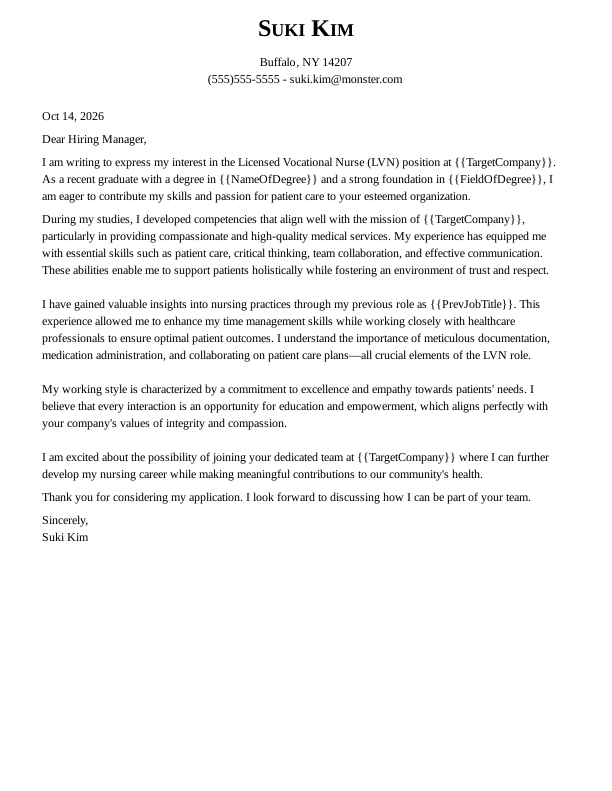
 Free
LVN Entry-Level Cover Letter
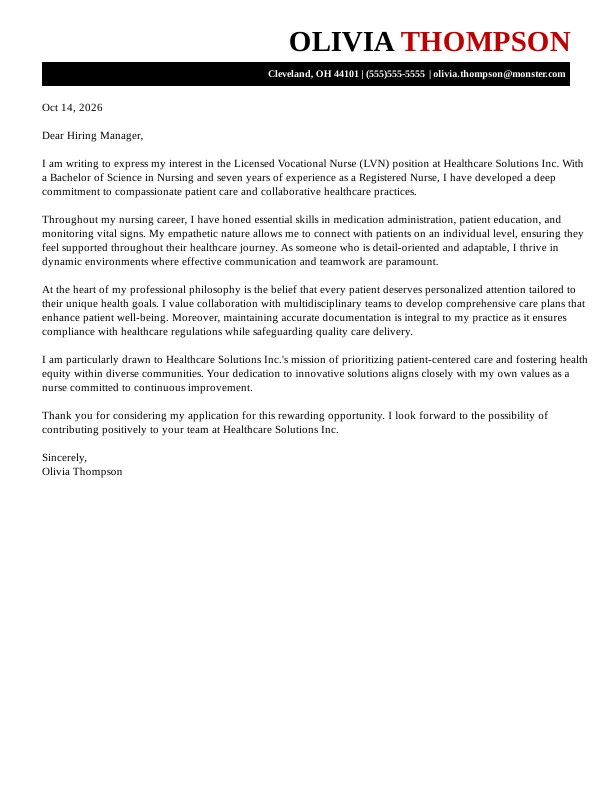
LVN Mid-Level Cover Letter
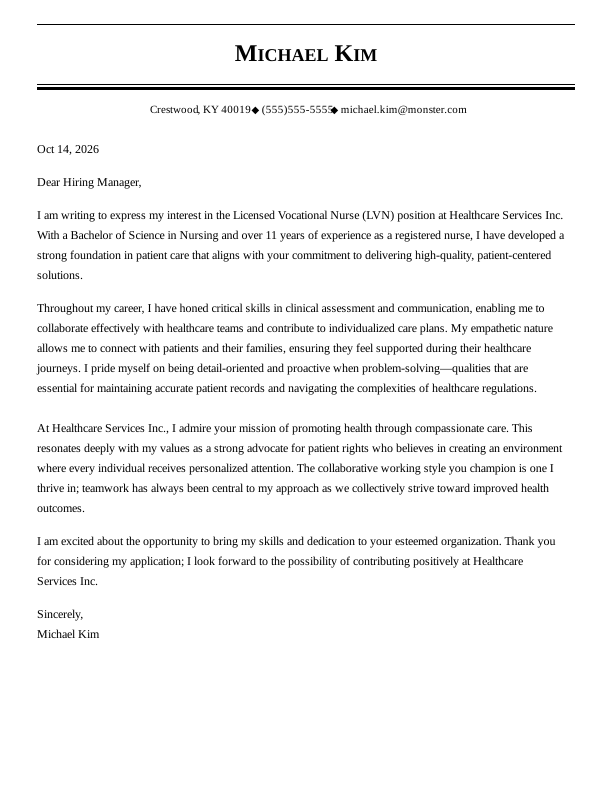
LVN Experienced Cover Letter
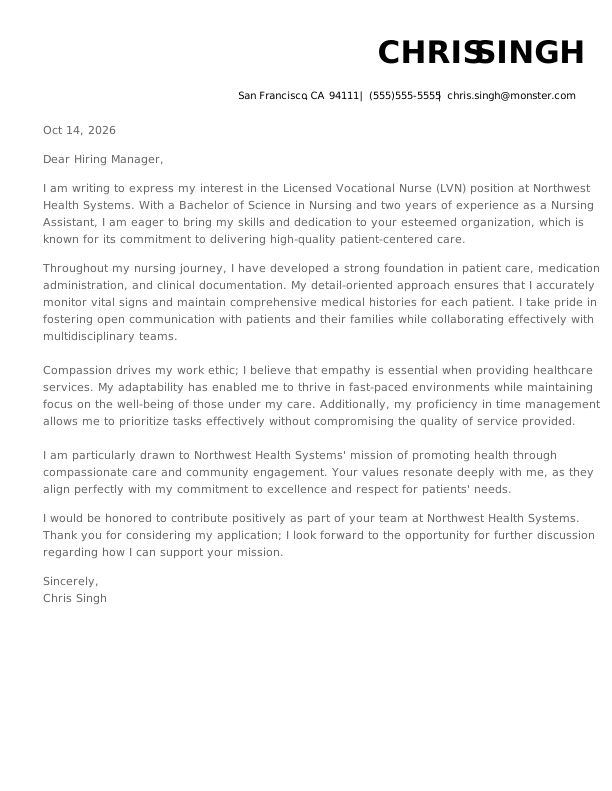
LVN Entry-Level Cover Letter
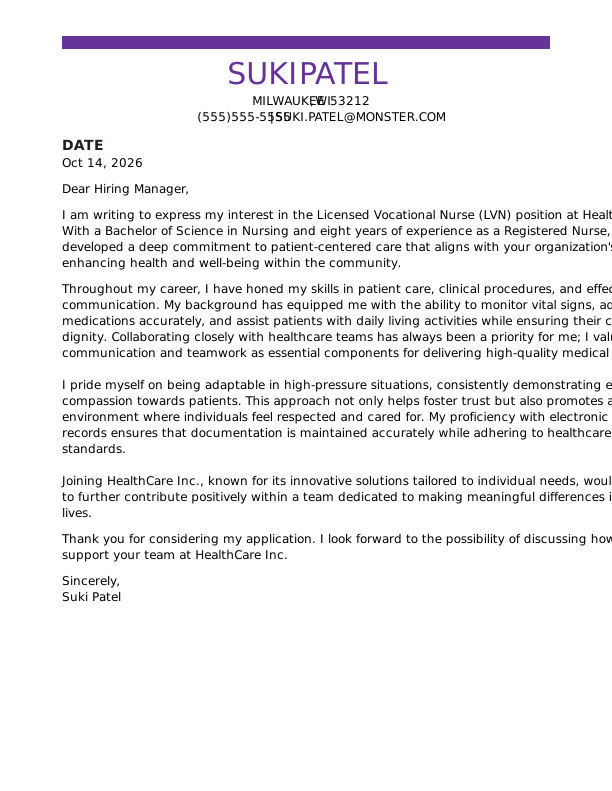
LVN Mid-Level Cover Letter
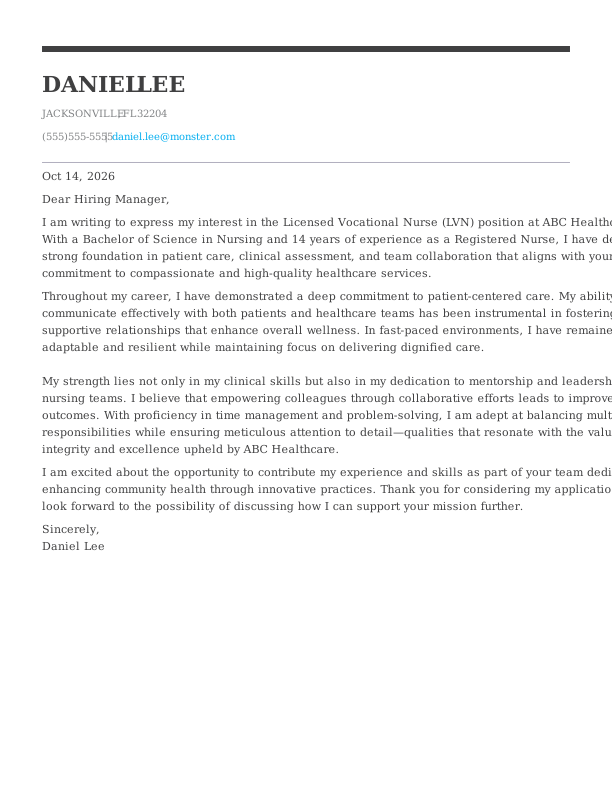
LVN Experienced Cover Letter
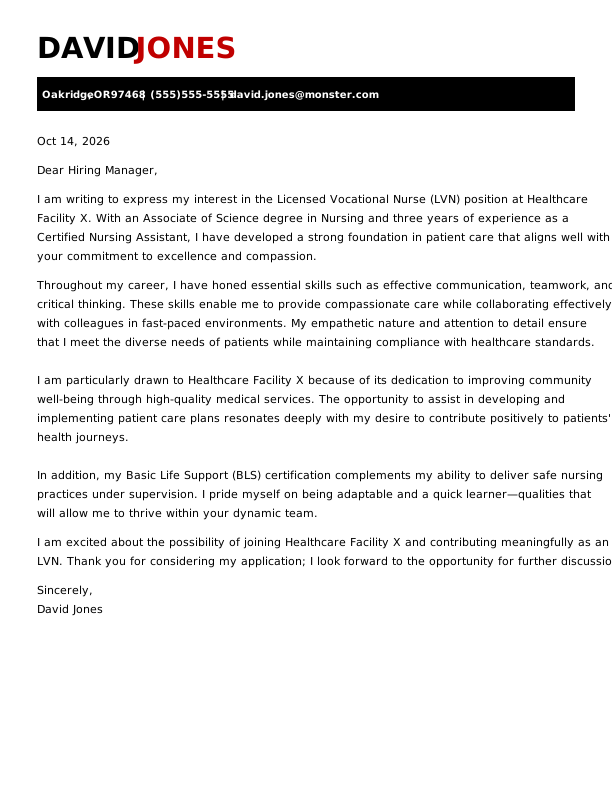
LVN Entry-Level Cover Letter
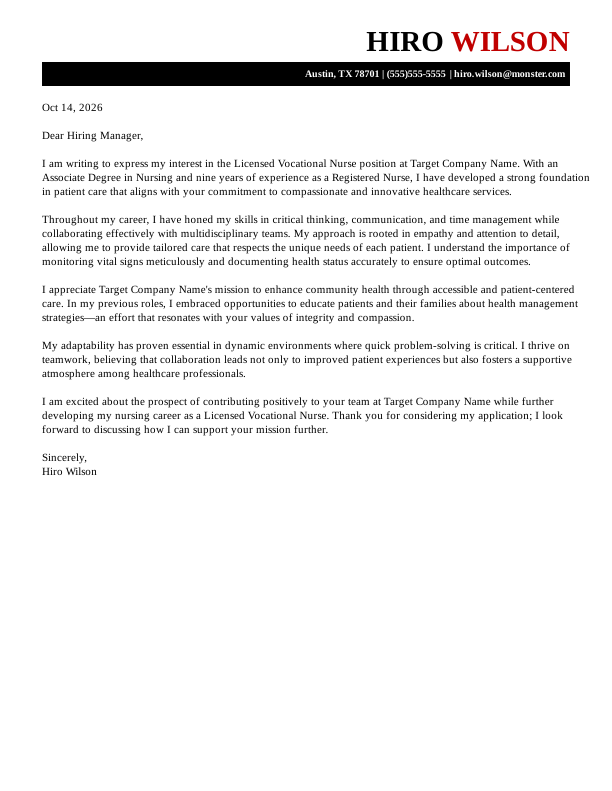
LVN Mid-Level Cover Letter
Browse Free Cover Letter Templates
- Academic
- Account Manager
- Accountant
- Accounts Payable
- Administrative Assistant
- Admissions Counselor
- Architecture
- Artist
- Assistant Principal
- Babysitter
- Barista
- Bartender
- Bookkeeper
- Brand Ambassador
- Business Analyst
- Business
- Caregiver
- Chef
- Civil Engineering
- Computer Science
- Construction
- Consulting
- Copywriter
- Cosmetology
- Custodian
- Customer Service
- Customer Service Representative
- Data Analyst
- Data Entry
- Dental Assistant
- Dental Hygienist
- Digital Marketing
- Electrical Engineering
- Emt
- Engineering
- Esthetician
- Event Coordinator
- Executive Assistant
- Finance
- Financial Analyst
- Firefighter
- Flight Attendant
- Graphic Designer
- Hair Stylist
- Healthcare
- Hr Generalist
- Investment Banking
- It
- Janitor
- Journalism
- Lab Technician
- Law Clerk
- Lawyer
- Librarian
- Logistics
- Makeup Artist
- Manager
- Marketing Coordinator
- Marketing
- Marketing Manager
- Massage Therapist
- Mechanic
- Mechanical Engineer
- Medical Assistant
- Non Profit
- Nursing
- Occupational Therapy
- Office Assistant
- Office Manager
- Operations Manager
- Paralegal
- Personal Trainer
- Pharmacist
- Pharmacy Technician
- Photographer
- Physician Assistant
- Pilot
- Police Officer
- Program Manager
- Project Manager
- Property Manager
- Psychology
- Receptionist
- Research Assistant
- Restaurant Manager
- Retail
- Sales
- Sales Manager
- School Counselor
- Security Officer
- Social Work
- Software Engineer
- Special Education Teacher
- Starbucks
- Substitute Teacher
- Teacher
- Teaching Assistant
- Truck Driver
- Vet Tech
- Veterinary Assistant
Cover Letter Examples for LVNs
Cover letter requirements evolve as an LVN’s career progresses, especially as responsibilities expand from basic bedside care to more complex coordination. Select the template that matches your experience level so you can highlight the right clinical training, certifications, and patient outcomes.
Entry-Level LVN Cover Letter
Great for new graduates or career changers entering nursing. Use this template to highlight your clinical training, core certifications, and passion for compassionate bedside patient care.
Mid-Career LVN Cover Letter
Built for nurses with a few years of experience. Use this layout to showcase your charge nurse skills, peer mentoring, and unit-based clinical strengths.
Experienced LVN Cover Letter
Ideal for seasoned LVNs with years of clinical practice. Use this option to highlight complex patient care plans, teamwork, and strong documentation standards.
LVN Cover Letter Template (Text)
Copy this LVN cover letter text, paste it into your document, and swap in your license details, patient-care experience, and clinic or hospital name.
Li Wang
Louisville, KY 40208
(555)555-5555
li.wang@monster.com
Oct 14, 2026
Dear Hiring Manager,
I am writing to express my interest in the Licensed Vocational Nurse (LVN) position at Healthcare Solutions Inc. With a Bachelor of Science in Nursing and four years of experience as a Staff Nurse, I have developed strong clinical skills and a compassionate approach to patient care that aligns with your organization’s commitment to enhancing health outcomes through innovative healthcare services.
My background has equipped me with essential skills in patient care, medication administration, and the development of comprehensive care plans. I take pride in my ability to engage meaningfully with patients and their families, ensuring they feel supported throughout their healthcare journey. Collaboration is integral to my working style; I thrive when working alongside interdisciplinary teams to achieve optimal patient outcomes while maintaining a focus on safety and efficiency.
At Healthcare Solutions Inc., I admire your dedication to patient-centered care and continuous improvement. I share your values of integrity and compassion, which guide my interactions within the healthcare environment. My adaptability allows me to navigate the fast-paced demands that come with providing quality nursing services.
I am eager for the opportunity to contribute positively as part of your team at Healthcare Solutions Inc., where I can leverage my skills in providing direct patient care under supervision while continuing to grow professionally within an organization dedicated to excellence.
Thank you for considering my application. I look forward to discussing how my experiences can benefit your team.
Sincerely,
Li Wang
How to Write a LVN Cover Letter
Writing a great cover letter means turning your daily nursing work into clear examples. Use these simple steps to match your background to the job you want.
1. Research & Prepare
Before you start typing, learn a little about the facility and the specific care unit. Look at the types of patients they treat and the electronic chart systems they use every day. Mentioning these details shows hiring managers that you understand their environment and are ready to step right in.
- Review the job posting to confirm license requirements, BLS needs, and chart systems.
- Check the employer site to see their safety goals and patient care programs.
- Look at your state board rules to make sure your license details are up to date.
2. Hook the Reader
Start your letter with an opening line that grabs attention. Skip plain openings like “I am writing to apply.” Instead, open with a line that highlights your hands-on clinical care, safety focus, or teamwork from day one.
- Medication safety focus: “As a med-surg LVN, I double-check all medication orders during shift handoffs to keep patient charts completely accurate.”
- Quality patient care: “During skin care rounds, I regularly track risk scores and report any quick changes to the unit team.”
- Team collaboration: “I assist urgent calls by gathering patient vitals quickly and sharing updates with the lead nurse right away.”
3. Tell Your Professional Story
Use the middle part of your letter to talk about real moments from your nursing work. Adding simple numbers helps show your workload and achievements far better than general phrases.
- Cared for up to 12 patients per shift while maintaining high medication administration accuracy.
- Lowered patient call light response times by setting up structured hourly check-in rounds.
- Organized unit supply closets to reduce wasted materials and keep dressing supplies ready.
4. Showcase Your Skills
Instead of just listing skills like “attentive” or “hardworking,” give a quick story that proves it. Pick a key skill from the job listing and explain how you used it to help a patient or support your nursing team.
- Medication administration: “I check charts carefully before giving medicine and verify readings whenever a patient’s levels look unusual.”
- EHR charting: “I enter care notes into the system immediately so the care team always has current info.”
- Patient communication: “I explain treatments simply to nervous patients so they feel comfortable and safe during care.”
5. Explain Any Special Circumstances
If you have an employment gap, a recent move, or are changing specialties, explain it in one or two clear sentences. Focus on your active license and ongoing training so hiring managers feel confident in your current skills.
- After time away for caregiving, I kept my license active and completed a refresher course in infection control.
- I am moving into direct patient care after completing BLS renewal and updated medication training.
- I recently relocated across state lines, and my new state LVN license is active and ready for work.
6. End With a Professional Goodbye
Close your cover letter by inviting them to talk and thanking them for their time. Keep this short and polite so it leaves a great final impression.
Offer a friendly next step like, “I would welcome the chance to talk about how my clinical experience can support your patient care team.” Then finish with a polite thank you and a standard closing like “Best regards.”
4 Tips for Formatting Your Cover Letter
Hiring teams often scan letters quickly between patient duties. Clear layout makes your nursing license, experience, and clinical skills easy to read right away.

Address the Hiring Manager Directly
Try to find the name of the nurse manager or recruiter on the job post or facility website. If you cannot find a specific name, opening with “Dear Hiring Manager” works great and keeps things professional.

Match Your Header to Your Resume
Use the same header layout, fonts, and contact info on both your cover letter and resume. Matching designs help your application materials look neat and organized as one set.

Use Bullet Points for Key Achievements
Use three or four bullet points to highlight your top clinical successes, such as patient care improvements, accurate medication passes, or high safety scores. Bullets draw the eye to your biggest strengths fast.

Save & Send as a PDF
Save your final letter as a PDF file to keep your spacing and formatting neat across all screen sizes. Name the file clearly, like Firstname_Lastname_Cover_Letter.pdf, so recruiters can organize it easily.
Key Takeaways
- Highlight safe patient care and medication pass accuracy with at least one clear real-world example.
- Include simple metrics like patient counts, chart accuracy rates, or fast response times to show your impact.
- Tailor your letter to match the specific setting, whether that is a busy hospital unit or a long-term facility.
More Cover Letter Examples
- Certified Nursing Assistant
- Medical
- Medical Receptionist
- Medical Scribe
- Nurse Practitioner
- Nursing Student
- Phlebotomist
- Registered Nurse
Browse Monster’s Resume Templates
Monster also has hundreds of ATS-friendly resume templates for all career levels and industries. Create a matching resume to help you land the interview.
- Aesthetic Nurse
- Certified Nursing Assistant
- Dialysis Nurse
- Director Of Nursing
- Entry-Level Nurse
- Er Nurse
- Family Nurse Practitioner
- Home Health Nurse
- Hospice Nurse
- Icu Nurse
- Labor And Delivery Nurse
- Licensed Practical Nurse
- Lvn
- Mds Coordinator
- Med-Surg Nurse
- New Grad Nurse
- Nurse Case Manager
- Nurse Educator
- Nurse Manager
- Nurse Practitioner
- Nursing Home
- Nursing Instructor
- Nursing
- Nursing Student
- Oncology Nurse
- Operating Room Nurse
- Pacu Nurse
- Pediatric Nurse
- Psychiatric Nurse Practitioner
- Psychiatric Nurse
- Registered Nurse
- Travel Nursing
- Travel Rn
- Utilization Review Nurse
Frequently Asked Questions
Last Update:
Do I really need a cover letter?
Yes, you really need a cover letter for an LVN position because it lets you share your clinical story beyond basic resume dates. A cover letter highlights your bedside care skills, communication style, and genuine interest in the facility. It also provides space to explain career changes or gap periods smoothly, giving you an extra edge with hiring managers.
How long should my cover letter be?
Your cover letter should be strictly one page long, usually between 250 and 400 words. Nurse managers review job applications very quickly during busy shifts, so short paragraphs are best. Keeping your message brief and focused on key nursing skills ensures the employer reads your top achievements without losing interest or missing critical details.
Should my cover letter match my resume?
Yes, your cover letter should match your resume in fonts, colors, and header styling to create a clean, unified application package. Using matching visuals shows attention to detail and professionalism. While the look stays consistent, ensure your letter expands on key clinical wins rather than simply repeating the exact bullet points listed on your resume.
What should I include in my cover letter header?
In your cover letter header, include your full name along with your LVN credentials, phone number, email address, and general location like city and state. Follow that with the current date and the recipient’s name, title, and healthcare facility details. Matching this section to your resume header makes your paperwork look completely organized.
Should I mention salary expectations in my cover letter?
You should only mention salary expectations in your cover letter if the job listing explicitly asks you to provide them. When requested, give a flexible salary range based on local market rates for LVNs rather than a single fixed number. Mention that you look forward to discussing the full benefits package and compensation during an interview.

Megan Dawkins is a career industry editor who empowers job seekers to take control of their career paths using Monster’s comprehensive job search and resume tools. She specializes in helping job seekers navigate the flexible job market.
See More From Megan DawkinsExplore Related Career Advice







How to Write a Cover Letter for Internal Positions or Promotions (Examples & Tips)

Updated:
Apr 23, 2026
|
19 min read


Cover Letter vs Resume: What’s the Difference & Do You Need Both?

Updated:
Apr 23, 2026
|
18 min read