


Free Animal Care Cover Letter Templates & Examples
A great animal care cover letter proves you can handle daily feeding, safe restraint, and health monitoring with calm confidence. It bridges the gap between your resume and real-world duties, showing employers that you have the practical skills to keep animals thriving.
Real-World Cover Letters That Get Results
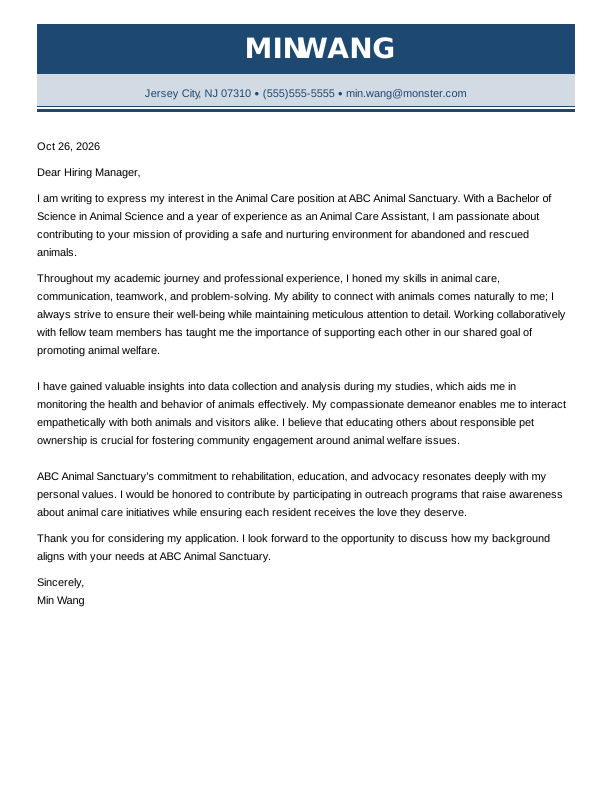
 Free
Animal Care Entry-Level Cover Letter
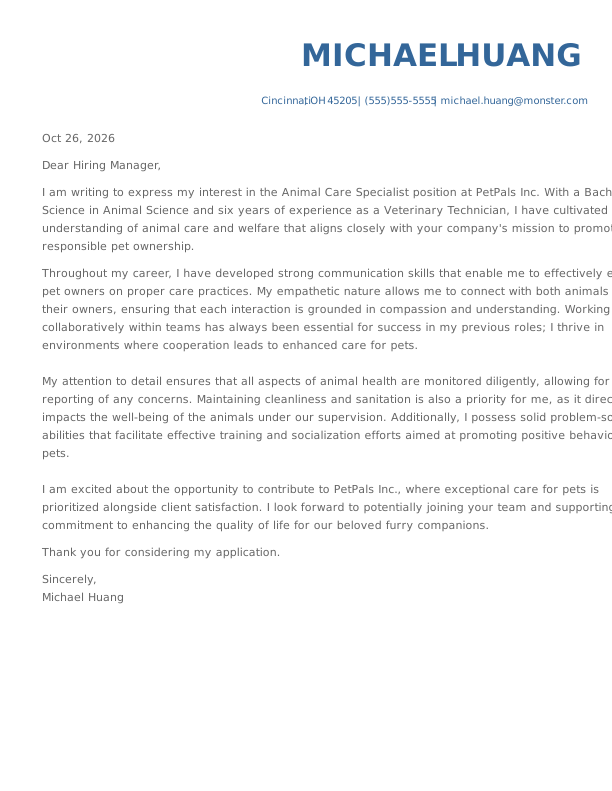
Animal Care Mid-Level Cover Letter
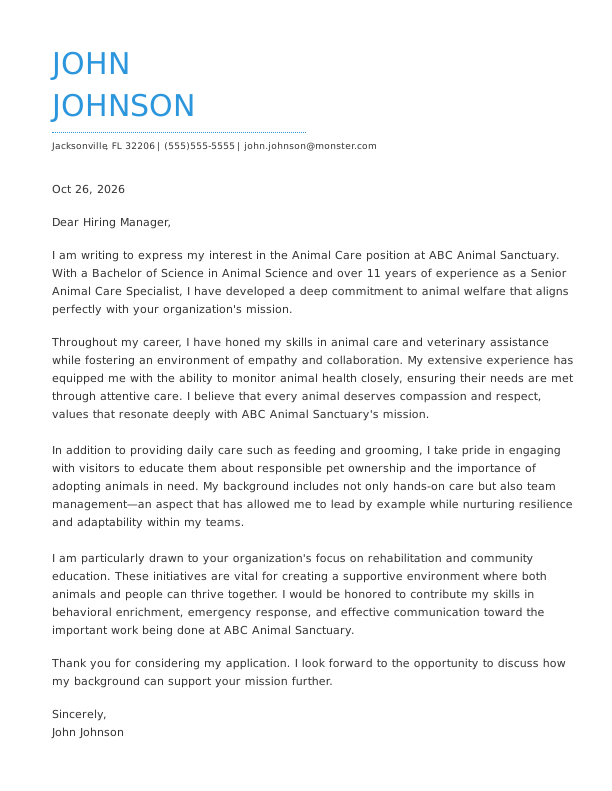
Animal Care Experienced Cover Letter
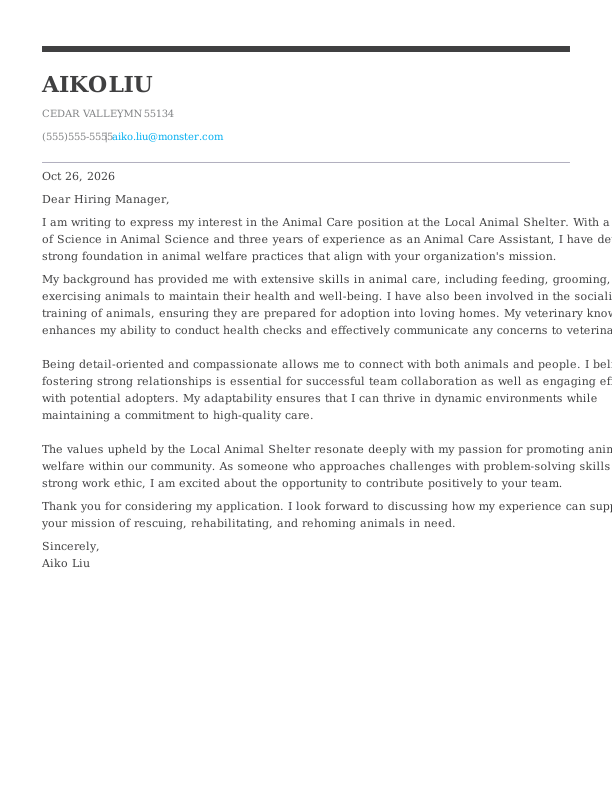
Animal Care Entry-Level Cover Letter
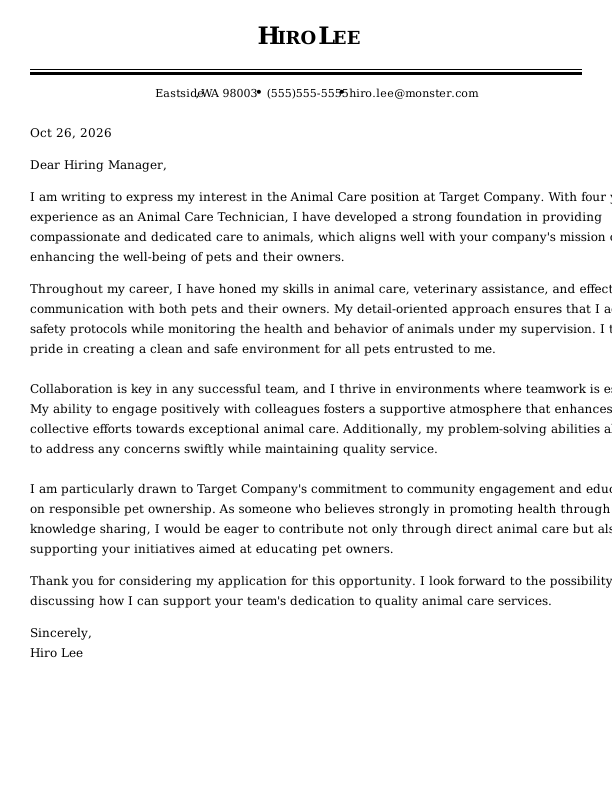
Animal Care Mid-Level Cover Letter
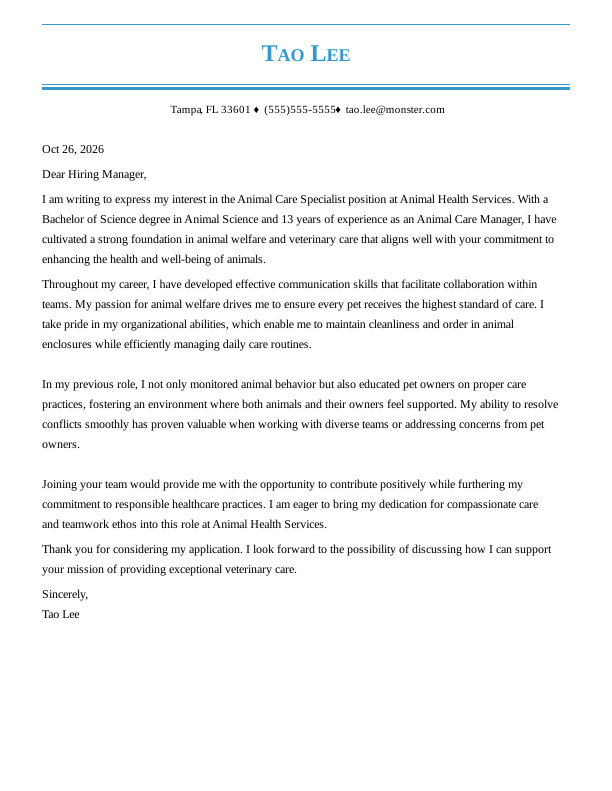
Animal Care Experienced Cover Letter
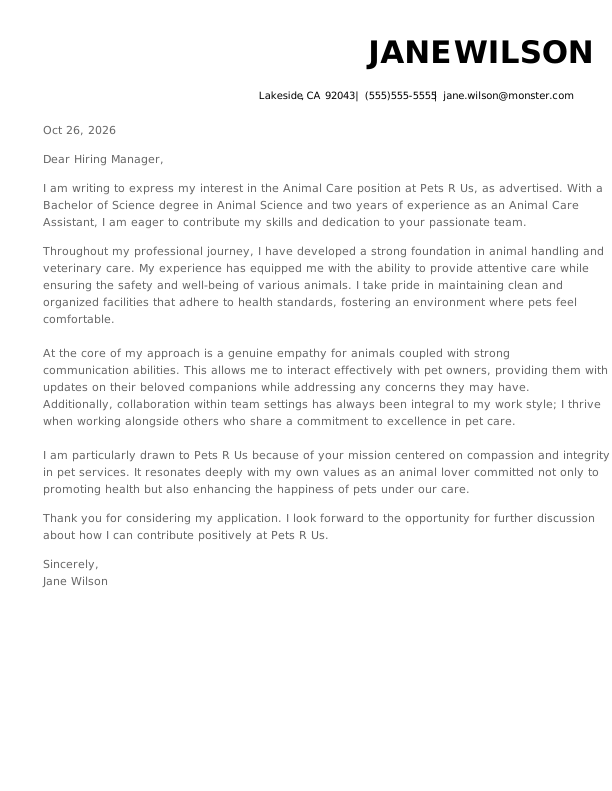
Animal Care Entry-Level Cover Letter
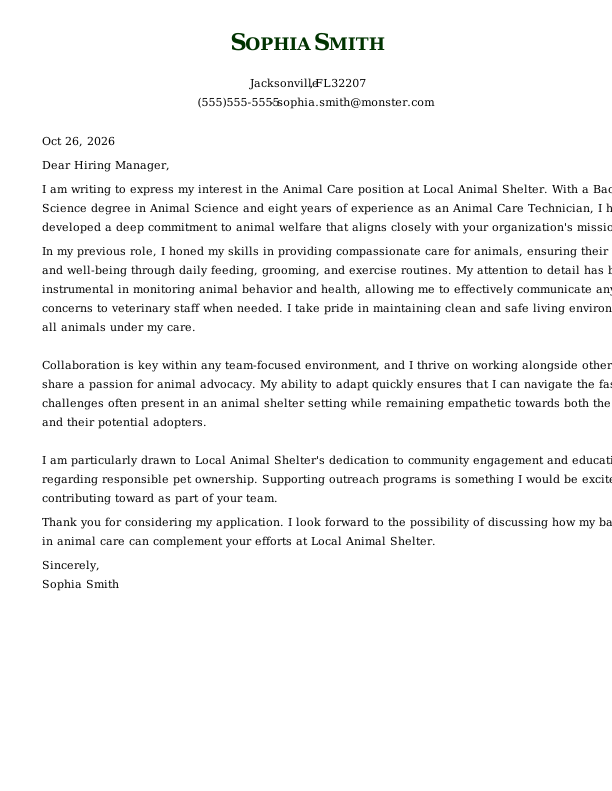
Animal Care Mid-Level Cover Letter
Browse Free Cover Letter Templates
- Academic
- Account Manager
- Accountant
- Accounts Payable
- Administrative Assistant
- Admissions Counselor
- Architecture
- Artist
- Assistant Principal
- Babysitter
- Barista
- Bartender
- Bookkeeper
- Brand Ambassador
- Business Analyst
- Business
- Caregiver
- Chef
- Civil Engineering
- Computer Science
- Construction
- Consulting
- Copywriter
- Cosmetology
- Custodian
- Customer Service
- Customer Service Representative
- Data Analyst
- Data Entry
- Dental Assistant
- Dental Hygienist
- Digital Marketing
- Electrical Engineering
- Emt
- Engineering
- Esthetician
- Event Coordinator
- Executive Assistant
- Fashion Designer
- Finance
- Financial Analyst
- Firefighter
- Flight Attendant
- Graphic Designer
- Hair Stylist
- Healthcare
- Hr Generalist
- Investment Banking
- It
- Janitor
- Journalism
- Lab Technician
- Law Clerk
- Lawyer
- Librarian
- Logistics
- Maintenance Worker
- Makeup Artist
- Manager
- Marketing Coordinator
- Marketing
- Marketing Manager
- Massage Therapist
- Mechanic
- Mechanical Engineer
- Medical Assistant
- Non Profit
- Nursing
- Occupational Therapy
- Office Assistant
- Office Manager
- Operations Manager
- Paralegal
- Personal Trainer
- Pharmacist
- Pharmacy Technician
- Photographer
- Physician Assistant
- Pilot
- Police Officer
- Program Manager
- Project Manager
- Property Manager
- Psychology
- Receptionist
- Research Assistant
- Restaurant Manager
- Retail
- Sales
- Sales Manager
- School Counselor
- Security
- Security Officer
- Social Work
- Software Engineer
- Special Education Teacher
- Starbucks
- Substitute Teacher
- Teacher
- Teaching Assistant
Cover Letter Examples for Animal Care Workers
Cover letter expectations for animal care roles shift as your experience grows, from hands-on learning to independent responsibility. Choose the template that matches your career stage so you can highlight relevant training, daily husbandry work, and any leadership or specialized care experience.
Entry-Level Animal Care Cover Letter
If you are starting out or switching fields, this template helps you spotlight foundational training, core handling skills, and your genuine dedication to animal welfare.
Mid-Career Animal Care Cover Letter
Ideal for professionals with several years in shelters or clinics, this template emphasizes hands-on execution, reliable care routines, and your ability to work smoothly across care teams.
Experienced Animal Care Cover Letter
Designed for seasoned caregivers, this template highlights senior-level strengths like team guidance, protocol management, and maintaining high welfare standards across complex care environments.
Animal Care Cover Letter Template (Text)
Paste this animal care cover letter template into your document, then copy and customize it with your own volunteer hours, certifications, and the shelter or clinic name.
John Anderson
Crestwood, KY 40014
(555)555-5555
john.anderson@monster.com
Oct 26, 2026
Dear Hiring Manager,
I am writing to express my interest in the animal care specialist position at Wildlife Sanctuary. With a Bachelor of Science degree in Animal Science and nine years of experience as an animal care technician, I have developed a strong foundation in animal care and rehabilitation that aligns well with the mission and values of your organization.
Throughout my career, I have cultivated a compassionate approach towards animal welfare, ensuring that each creature receives the attention it deserves. My previous role involved providing daily care for various species, administering medications, and collaborating closely with veterinary teams to monitor health. This hands-on experience has honed my skills in record-keeping and problem-solving while reinforcing my commitment to conservation efforts.
I believe deeply in the importance of educating our communities about wildlife conservation. Engaging with visitors has allowed me to share knowledge about biodiversity and habitat preservation effectively. I thrive in team-oriented environments where collaboration is key to achieving common goals.
My attention to detail and adaptability enable me to handle both the physical demands of caring for wildlife as well as the emotional challenges that may arise from working with injured or orphaned animals. I am excited about the opportunity to contribute positively at Wildlife Sanctuary by participating actively in enrichment activities that enhance animal well-being.
Thank you for considering my application. I look forward to discussing how my background can support your mission of compassionately caring for native wildlife while fostering community engagement.
Sincerely,
John Anderson
How to Write an Animal Care Cover Letter
Writing an animal care cover letter means translating hands-on experience into clear stories about safe handling, feeding routines, and reliable health monitoring. Follow these steps to organize your background and show a clinic or shelter that you can handle its day-to-day workload.
1. Research & Prepare
Before you write, learn what the employer values most in its daily operations. A municipal shelter, a high-volume veterinary clinic, and a private rescue sanctuary operate under very different pressures. Check its website and social media to see which species it houses, its daily adoption or medical workflows, and any current initiatives it highlights. Reviewing these details helps you speak directly to its daily reality.
Here are three key areas to investigate before writing:
- Look over the job posting for specific software, record-keeping tools, or medical charting platforms the facility uses to log daily care.
- Check the organization’s website for its primary welfare priorities, such as fear-free handling, behavioral enrichment plans, or disease-prevention protocols.
- Search local news to see if the facility is managing recent changes, like a kennel expansion, increased intake volume, or community outreach events.
2. Hook the Reader
Start with a strong opening line that shows you understand the operational demands of animal care. Most applicants rely on generic phrases about loving pets, which hiring managers quickly skip past. Grab attention right away by mentioning concrete duties like managing intake, tracking clinical behaviors, or supporting daily medical care.
These sample hooks demonstrate how to start with practical operational value:
- Intake and triage focus: “During my last role at the county shelter, I processed up to 25 intakes per shift, documenting behavioral cues and health markers so our medical team could triage exams efficiently.”
- Enrichment and behavior focus: “At Oak Valley Rescue, I coordinated daily enrichment rotations for 40 dogs, using scent work and structured play sessions to reduce kennel stress behaviors.”
- Clinical support focus: “Working alongside our veterinary team, I set up low-stress exam spaces and logged vital signs every two hours in our practice software to monitor post-surgery recovery.”
3. Tell Your Professional Story
While your resume lists past job duties, your cover letter should explain how your everyday care decisions improved animal well-being and kept facilities running smoothly. Whenever possible, include simple numbers to help the hiring manager picture your typical workload, consistency, and attention to detail.
These sample bullet points show how to highlight measurable results:
- Maintained a 98% on-time completion rate across daily sanitation, feeding, and medication checklists for a 35-kennel facility.
- Lowered feeding errors from 4 per month to zero across two quarters by updating diet clipboards and training weekend volunteers.
- Helped boost adoption matches by updating pet behavior profiles and medical summaries within 12 hours of completed evaluations.
4. Showcase Your Skills
Replace vague personality traits with specific moments that demonstrate how you handle real situations. Instead of simply stating that you are patient, attentive, or dependable, describe the exact steps you take when an animal shows signs of distress, illness, or behavioral changes.
The examples below illustrate how to ground core competencies in clear actions:
- Health monitoring and logs: “I charted appetite, hydration levels, and stool consistency after each morning walk, alerting the veterinary team right away if an animal showed subtle signs of lethargy.”
- Low-stress handling: “When an anxious dog resisted leash walking, I paused, gave it space, and used positive reinforcement to build trust rather than forcing movement.”
- Client and adopter guidance: “I reviewed feeding schedules and medication routines with new adopters, giving them clear written instructions so they felt confident continuing care at home.”
5. Explain Any Special Circumstances
If you have an employment gap, are changing careers, or recently relocated, address it briefly in one or two sentences. Animal care managers care most about whether your handling skills are sharp and your relevant certifications are current. A quick, honest explanation keeps the focus squarely on your qualifications.
Here are a few ways to explain common career situations clearly:
- Employment gap: “After taking four months off to care for family, I kept my skills sharp by volunteering weekly at our local shelter and renewing my pet first aid certification.”
- Career change: “I am transitioning from grooming to shelter care to focus more on animal welfare, bringing strong handling skills, breed knowledge, and fresh low-stress restraint training.”
- Relocation: “I recently moved to Denver and have already updated my state certifications, meaning I can step into your daily care shifts without delay.”
6. End With a Professional Goodbye
Wrap up your letter with a polite, confident closing that suggests a conversation. Keep it to two or three short sentences so it is easy to read. Thank the hiring manager for their time and mention the specific operational areas you would like to discuss in an interview.
Here is an example of a simple, effective closing:
“I would welcome the chance to discuss how my handling skills, feeding routines, and dedication to animal welfare can support your team at ABC Sanctuary. Thank you for your time and consideration. Sincerely, [Your Name].”
4 Tips for Formatting Your Cover Letter
Hiring managers in shelters and veterinary clinics spend most of their days on their feet managing animals, medical schedules, and staff. When they sit down to review applications, they often scan each document in just a few seconds. A clean, well-spaced layout helps them immediately spot your handling background, medical experience, and reliable work history without squinting through dense paragraphs or awkward layouts.

Use a Professional Font & Layout
Stick to clean, standard fonts like Arial, Calibri, or Georgia set between 10 and 12 points. These fonts render clearly whether a coordinator reads your letter on a phone, a desktop monitor, or a quick printout in the kennel office. Use standard 1-inch margins to keep the page neat, balanced, and easy to read.

Match Your Header to Your Resume
Use the exact same header styling, font, and contact details that appear on your resume. When your documents share a matching layout, they look like a complete, professional application package. It also helps the hiring manager quickly confirm your contact details when pulling your file.

Use Bullet Points for Key Achievements
Break up your text by placing three or four bullet points in the middle of your letter. Bullets naturally draw the eye and make it easy to spot achievements, like how many animals you cared for per shift, your record with medication schedules, or your daily sanitation consistency.

Balance Spacing & Margins
Keep your line spacing set between single and 1.15, and always leave a blank line between paragraphs. Dense walls of text are hard to read, especially for a busy shelter manager. Clean spacing and consistent margins give the page breathing room and prevent your key accomplishments from getting lost.
Top-Paying States for Animal Care Roles
Knowing what animal care professionals earn across the country helps you compare offers and plan your next steps. The data below comes from the U.S. Bureau of Labor Statistics (BLS) and uses the latest nationwide averages.
Your pay can vary based on where you work, your experience level, and the type of setting, such as shelters, veterinary clinics, or research facilities. Specialized experience and certifications may also make a difference. If demand is higher in your area, employers may offer stronger compensation to attract qualified staff.
| Alabama | $31,240 |
| Alaska | $39,950 |
| Arizona | $39,460 |
| Arkansas | $33,340 |
| California | $46,500 |
| Connecticut | $46,350 |
| Delaware | $37,710 |
| District of Columbia | $45,340 |
| Florida | $37,460 |
| Georgia | $34,530 |
| Hawaii | $39,230 |
| Idaho | $35,460 |
| Illinois | $38,890 |
| Indiana | $34,860 |
| Iowa | $34,410 |
| Kansas | $33,870 |
| Kentucky | $33,830 |
| Louisiana | $31,130 |
| Maine | $46,790 |
| Maryland | $44,880 |
| Massachusetts | $47,460 |
| Michigan | $37,580 |
| Minnesota | $41,880 |
| Mississippi | $30,440 |
| Missouri | $34,890 |
| Montana | $36,660 |
| Nebraska | $34,560 |
| Nevada | $37,130 |
| New Hampshire | $35,930 |
| New Jersey | $44,460 |
| New Mexico | $35,320 |
| New York | $43,300 |
| North Carolina | $37,510 |
| North Dakota | $37,400 |
| Ohio | $35,850 |
| Oklahoma | $32,180 |
| Oregon | $42,500 |
| Pennsylvania | $38,070 |
| Rhode Island | $44,050 |
| South Carolina | $36,240 |
| South Dakota | $32,290 |
| Tennessee | $36,510 |
| Texas | $33,170 |
| Utah | $36,980 |
| Vermont | $36,510 |
| Virginia | $37,410 |
| Washington | $43,330 |
| West Virginia | $31,720 |
| Wisconsin | $35,010 |
| Wyoming | $34,360 |
| Puerto Rico | $25,530 |
| Virgin Islands | $27,510 |
Key Takeaways
- Hiring managers look for safe handling and attentive health monitoring first, so highlight specific moments where you recognized distress or illness early.
- Include clear numbers like kennel counts, medication accuracy, or feeding schedules to show how you manage daily care routines.
- Match your letter to the employer’s focus, whether that means fast clinic turnaround, shelter intake management, or sanctuary enrichment protocols.
More Cover Letter Examples
Browse Monster’s Resume Templates
Monster also has hundreds of ATS-friendly resume templates for all career levels and industries. Create a matching resume to help you land the interview.
Frequently Asked Questions
Last Update:
Do I really need a cover letter?
An animal care cover letter is well worth including, even when a job post lists it as optional. Your resume lists your job history, but your cover letter lets you explain your daily handling habits, your reliability, and your connection to the facility’s welfare mission. It gives you the space to show how your background fits the role.
How long should my cover letter be?
Your animal care cover letter should stay on a single page, ideally between 250 and 400 words. Clinic supervisors and shelter managers have busy schedules, so keeping your message brief and focused helps them review your qualifications quickly. Stick to three or four short paragraphs covering your handling experience, core care routines, and enthusiasm for the position.
Should my cover letter match my resume?
Yes, your animal care cover letter should match your resume’s visual design. Using the same font, margin sizes, and header layout makes your application look polished and organized. While the visual style should match, use your letter to share the story behind your resume bullets, such as how you handled an anxious animal or improved daily kennel routines.
Can I use AI to write my cover letter?
You can use AI tools to help write your animal care cover letter, especially for brainstorming outlines or organizing your thoughts. Just be sure to rewrite the draft in your own words. Adding real personal stories about animal handling, feeding schedules, or medication administration ensures your letter sounds genuine and memorable to the reader.
How do I write a cover letter for an internal position?
When writing a cover letter for an internal animal care position, start by highlighting your proven familiarity with your facility’s daily care routines and handling standards. Mention concrete ways you have supported your current team, such as speeding up kennel prep or mentoring volunteers, and explain how you plan to take on expanded responsibilities in the new role.

Kirsten Chorpenning is a career advice writer who empowers job seekers to take control of their career paths using Monster’s comprehensive job search and resume tools. She specializes in helping job seekers find rewarding jobs in today’s dynamic work environment.
See More From Kirsten ChorpenningExplore Related Career Advice







How to Write a Cover Letter for Internal Positions or Promotions (Examples & Tips)
Updated:
Apr 23, 2026
|
19 min read


Cover Letter vs Resume: What’s the Difference & Do You Need Both?

Updated:
Apr 23, 2026
|
18 min read