


Free Assistant Editor Cover Letter Templates & Examples
A strong assistant editor cover letter shows you can polish clear, accurate writing while meeting tight deadlines and collaborating with writers. Our free templates and step-by-step guidance help you highlight your editing strengths so hiring managers can quickly see your value.
Real-World Cover Letters That Get Results
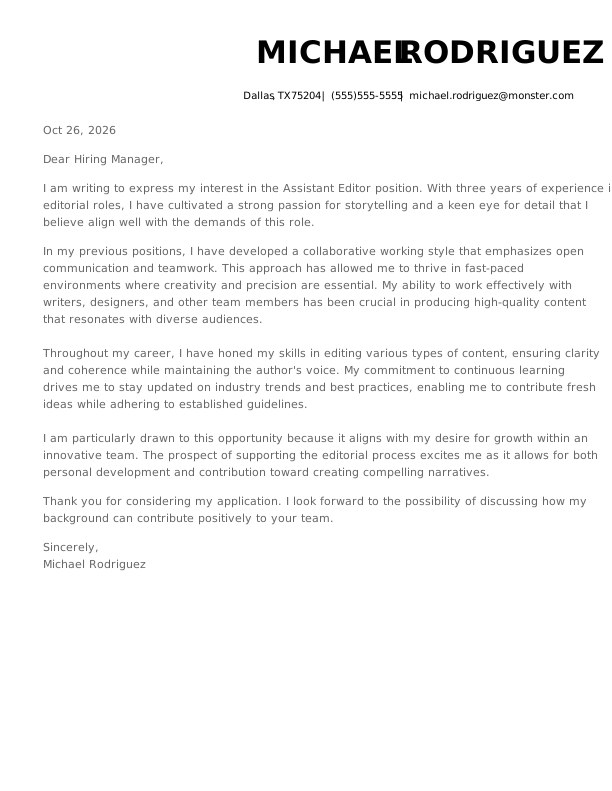
 Free
Assistant Editor Entry-Level Cover Letter
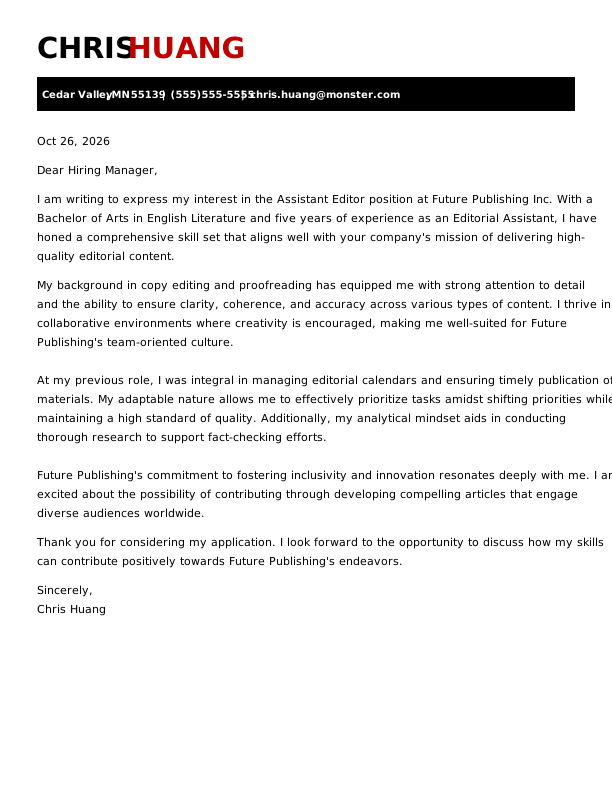
Assistant Editor Mid-Level Cover Letter
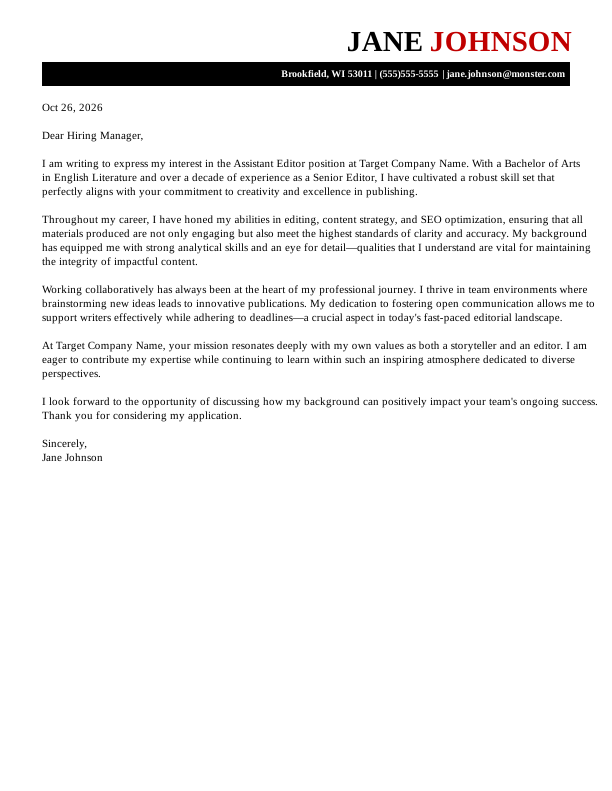
Assistant Editor Experienced Cover Letter
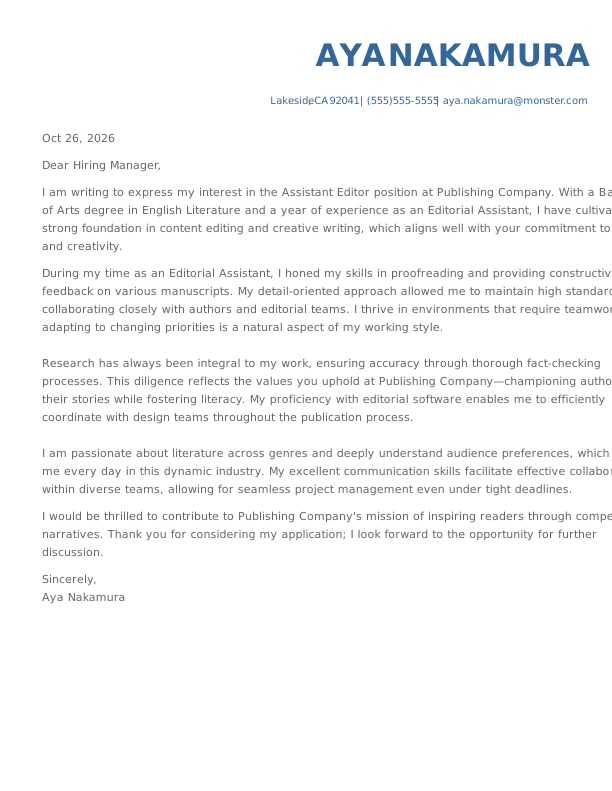
Assistant Editor Entry-Level Cover Letter
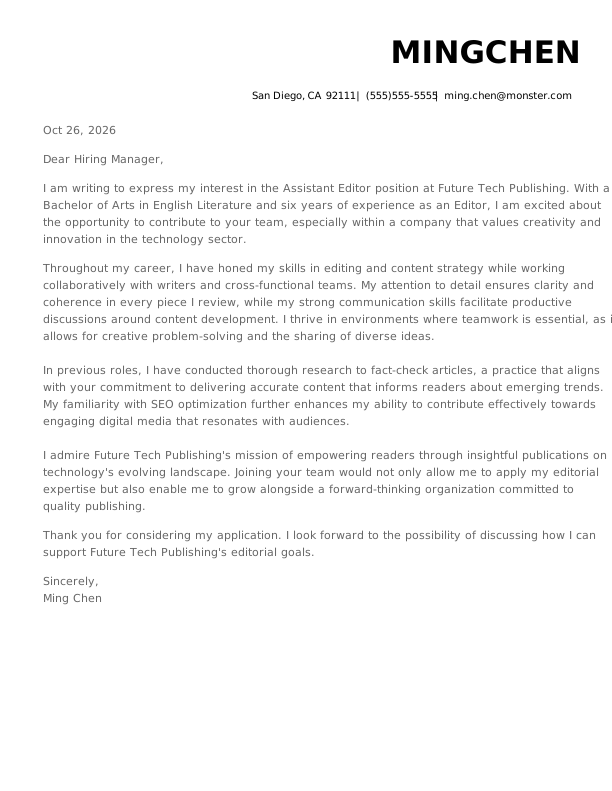
Assistant Editor Mid-Level Cover Letter
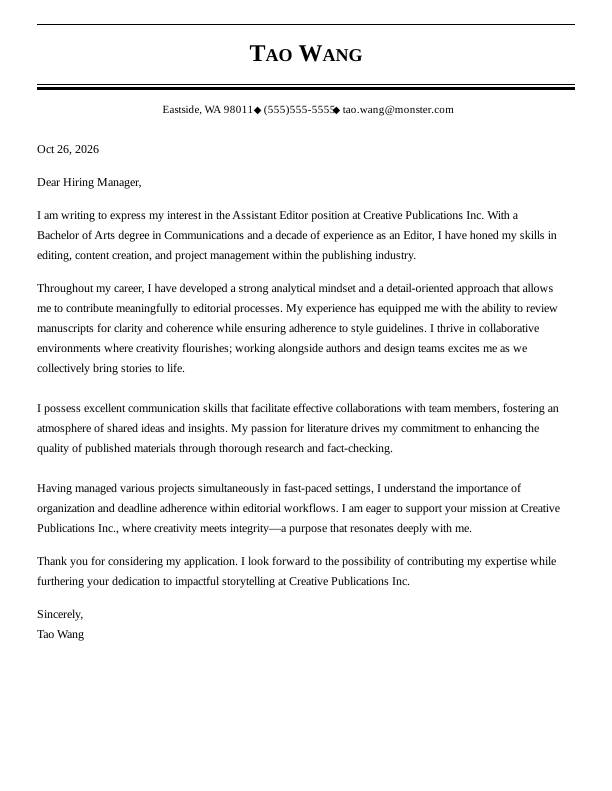
Assistant Editor Experienced Cover Letter
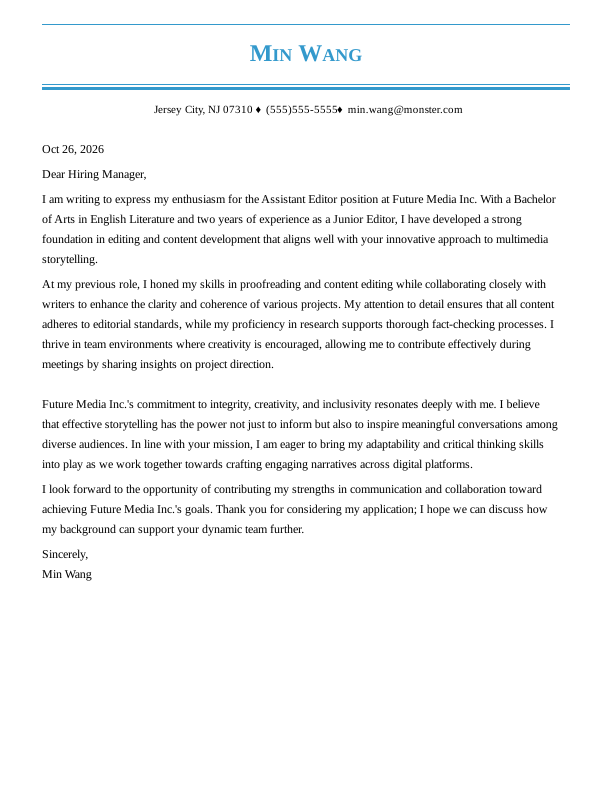
Assistant Editor Entry-Level Cover Letter
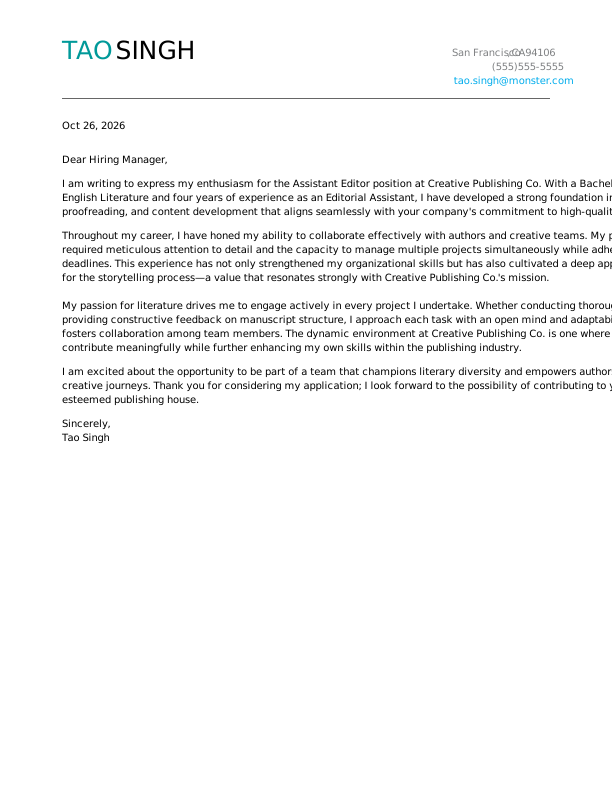
Assistant Editor Mid-Level Cover Letter
Browse Free Cover Letter Templates
- Academic
- Account Manager
- Accountant
- Accounts Payable
- Administrative Assistant
- Admissions Counselor
- Architecture
- Artist
- Assistant Principal
- Babysitter
- Barista
- Bartender
- Bookkeeper
- Brand Ambassador
- Business Analyst
- Business
- Caregiver
- Chef
- Civil Engineering
- Computer Science
- Construction
- Consulting
- Copywriter
- Cosmetology
- Custodian
- Customer Service
- Customer Service Representative
- Data Analyst
- Data Entry
- Dental Assistant
- Dental Hygienist
- Digital Marketing
- Electrical Engineering
- Emt
- Engineering
- Esthetician
- Event Coordinator
- Executive Assistant
- Fashion Designer
- Finance
- Financial Analyst
- Firefighter
- Flight Attendant
- Graphic Designer
- Hair Stylist
- Healthcare
- Hr Generalist
- Investment Banking
- It
- Janitor
- Journalism
- Lab Technician
- Law Clerk
- Lawyer
- Librarian
- Logistics
- Maintenance Worker
- Makeup Artist
- Manager
- Marketing Coordinator
- Marketing
- Marketing Manager
- Massage Therapist
- Mechanic
- Mechanical Engineer
- Medical Assistant
- Non Profit
- Nursing
- Occupational Therapy
- Office Assistant
- Office Manager
- Operations Manager
- Paralegal
- Personal Trainer
- Pharmacist
- Pharmacy Technician
- Photographer
- Physician Assistant
- Pilot
- Police Officer
- Program Manager
- Project Manager
- Property Manager
- Psychology
- Receptionist
- Research Assistant
- Restaurant Manager
- Retail
- Sales
- Sales Manager
- School Counselor
- Security
- Security Officer
- Social Work
- Software Engineer
- Special Education Teacher
- Starbucks
- Substitute Teacher
- Teacher
- Teaching Assistant
Cover Letter Examples for Assistant Editors
Cover letter expectations evolve as you advance through different career stages. Select the cover letter sample that best matches your overall experience level to showcase the right skills, workflow strengths, and accomplishments for your target role.
Entry-Level Assistant Editor Cover Letter
Explore this entry-level cover letter example to learn how to present your foundational skills, academic training, and enthusiasm when starting your editorial career.
Mid-Career Assistant Editor Cover Letter
Review this mid-career cover letter example to see how to highlight your growing project ownership, independent editing capabilities, and core workflow management experience.
Experienced Assistant Editor Cover Letter
Use this experienced cover letter example to understand how to emphasize senior-level content strategy, high-level editorial oversight, and proven industry expertise.
Assistant Editor Cover Letter Template (Text)
Copy this assistant editor cover letter template into your document, then swap in your editing credits and metrics like turnaround time or publication volume.
Daniel Wilson
Milwaukee, WI 53203
(555)555-5555
daniel.wilson@monster.com
Oct 26, 2026
Dear Hiring Manager,
I am writing to express my interest in the Assistant Editor position at XYZ Publishing. With a Bachelor of Arts in English Literature and seven years of experience as an Editorial Assistant, I have developed a deep appreciation for storytelling and the editorial process that aligns with your organization’s mission to inspire and empower readers.
In my previous role, I honed my skills in editing, proofreading, and collaborating with diverse teams to enhance content quality. My attention to detail ensures that all manuscripts undergo thorough reviews, maintaining high standards of accuracy and engaging narratives. I thrive in collaborative environments where creativity flourishes, enabling me to contribute effectively to content strategies and project timelines.
At XYZ Publishing, I am particularly drawn to your commitment to innovation and excellence within various genres. My strong work ethic drives me to deliver impactful results while adapting seamlessly to new challenges. I believe that effective communication is essential for fostering productive relationships between authors and the editorial team; thus, managing these interactions is one of my key strengths.
Furthermore, my analytical thinking enables me to conduct precise research and fact-checking necessary for producing quality literary works. As someone who values literature deeply, I am excited about the opportunity to support marketing initiatives that showcase new publications.
Thank you for considering my application. I look forward to the possibility of contributing my passion for literature along with my editorial expertise at XYZ Publishing.
Sincerely,
Daniel Wilson
How to Write an Assistant Editor Cover Letter
Writing a standout assistant editor cover letter requires showing how your editorial skills, attention to detail, and workflow management align with the publication’s goals.
Follow these step-by-step guidelines to craft a compelling, tailored letter that grabs a hiring manager’s attention.
1. Research & Prepare
Thorough preparation helps you tailor your cover letter to the publisher’s specific style and expectations. Researching the outlet’s workflow and standards ensures your letter speaks directly to its needs.
Here are three practical ways to research the publication before writing:
- Pull the house style guide or submission standards from the publisher’s website.
- Read the latest editorial guidelines on the organization’s newsroom or contributors page to find their required verification steps.
- Scan recent issue credits in a public archive or index to see which tools and departments shaped prior stories.
2. Hook the Reader
A strong opening sentence grabs the hiring manager’s interest immediately by highlighting a real achievement rather than generic enthusiasm. Showcasing measurable results right away sets a professional tone.
Consider these opening approaches tailored to different editing achievements:
- Accuracy check workflow: “Reduced substantive copy edits by 18% by tightening the fact-check checklist and running every draft through AP style plus a source log.”
- Style system and revision speed: “Updated house style rules for 3 recurring sections and cut turnaround time from 5 days to 3 by using tracked changes templates in Word and a version naming convention.”
- Editorial collaboration with stakeholders: “When the managing editor flagged inconsistencies across guest bios, coordinated with marketing on the bio sheet and delivered final copy after two rounds of revisions within the publication calendar.”
3. Tell Your Professional Story
Your cover letter should elaborate on your resume by showing how your editing directly improved project outcomes. Connecting your daily tasks to clear metrics demonstrates your impact and reliability.
Use bullet points like these to showcase quantified achievements:
- Reduced first-draft rewrite requests by 22% after standardizing house style and running consistency checks across 18 client reports.
- Edited 40-page technical manuscripts while maintaining a 0.5% typo rate, down from about 2% before the new proofreading checklist.
- Saved editors an average of 6 hours per week by building an annotated change log template for tracked revisions and author queries.
4. Showcase Your Skills
Rather than simply listing skills, describe specific instances where your editorial judgment added value to a piece. Giving concrete context makes your capabilities tangible and memorable.
Here are examples of how to highlight core editorial strengths:
- Copyediting: “Tightened a confusing intro by fixing tense and removing duplicate lines so the article read cleanly from start to finish.”
- Style guide use: “Applied AP style consistently across headlines and captions after finding mismatched capitalization in the draft.”
- Collaboration: “Asked the author targeted questions about their sources during revisions, then summarized agreed changes in my comments.”
5. Explain Any Special Circumstances
If you have a career gap, industry shift, or relocation, address it briefly and positively in one or two sentences. Keeping the focus on your current readiness reassures the reader.
Refer to these examples for framing special background circumstances:
- “After taking six months off to handle caregiving, I returned by editing nonfiction manuscripts for submission-ready copy in the Chicago Manual of Style and tracking changes end to end.”
- “Pivoting from technical writing into assistant editor work because I now edit long-form articles with fact-checking support and have been using Adobe Acrobat Comment tools weekly.”
- “Relocated to Austin last fall, and my professional editing workflow has stayed consistent since I subscribed to Proofreading services and use AP Style updates while collaborating on remote edits.”
6. End With a Professional Goodbye
Conclude your cover letter with a polite, proactive closing that encourages next steps without being overly pushy. State your readiness to discuss how your editorial skills can support the team, thank the reader for their time, and close with a classic formal sign-off such as “Sincerely.”
For an assistant editor, use a concrete offer tied to their workflow: “I’d be glad to walk you through how I tighten story structure while protecting your voice and style guide.” Then add “Thank you for your time.” Finish with “Best regards” or “Sincerely.”
4 Tips for Formatting Your Cover Letter
A well-formatted cover letter ensures your application looks polished, organized, and easy to read during a rapid initial screening. Proper formatting and a clean visual structure help a hiring manager scan your qualifications effortlessly and focus entirely on your editorial achievements.

Keep It to One Page
Keeping your cover letter to a single page demonstrates conciseness and respects the hiring manager’s time. Aim for 250–400 words spread across three to four structured paragraphs, focusing strictly on your most relevant editorial achievements and style guide expertise.

Match Your Header to Your Resume
Matching your cover letter header to your resume creates a clean, cohesive application package. Using identical fonts, spacing, and contact info blocks across both documents creates a unified brand that helps hiring managers easily organize your materials.

Use Bullet Points for Key Achievements
Using bullet points allows you to break up dense text and call attention to key metrics. Highlight three or four major achievements, such as turnaround time improvements or error rate reductions, so readers immediately grasp your professional impact.

Balance Spacing & Margins
Balancing spacing and margins prevents your document from looking cramped or sparse. Set line spacing between 1 and 1.15, leave blank lines between paragraphs, and keep standard 1-inch margins to ensure comfortable readability on screen or paper.
Key Takeaways
- Demonstrate your editorial judgment by sharing concrete examples of how you revised content for clarity, tone, and house style alignment.
- Quantify your achievements using specific metrics like turnaround speed, manuscript volume, and error reduction rates to prove your impact.
- Tailor every letter to the target outlet by aligning your highlighted skills with its specific publishing focus, medium, and workflow expectations.
More Cover Letter Examples
Browse Monster’s Resume Templates
Monster also has hundreds of ATS-friendly resume templates for all career levels and industries. Create a matching resume to help you land the interview.
Frequently Asked Questions
Last Update:
Do I really need a cover letter?
Including an assistant editor cover letter is strongly recommended because it lets you showcase your editorial voice, attention to detail, and communication style in ways a standard resume cannot.
A tailored cover letter explains how you handle manuscript revisions, collaborate with authors, and maintain style guide consistency under tight production schedules, making your application stand out to hiring managers.
How long should my cover letter be?
Your assistant editor cover letter should be strictly one page long, ideally ranging between 250 and 400 words spread across three or four paragraphs.
Keeping your letter concise ensures busy hiring managers can easily scan your qualifications while gaining a full, impactful picture of your editing achievements, style guide proficiency, and software skills.
Should my cover letter match my resume?
Matching your assistant editor cover letter to your resume is essential for creating a cohesive, professional application package. You should use identical headers, typography, margin widths, and color accents across both documents.
While the visual design should match, your cover letter text should expand upon the deeper context behind your major editorial achievements.
How do I address my cover letter if I don’t know the hiring manager’s name?
Addressing your cover letter when you do not know the hiring manager’s name starts with checking the publication’s online masthead, job listing, or staff directory for the managing editor.
If you still cannot find a specific name, use professional greetings like “Dear Hiring Manager” or “Dear Editorial Team” to maintain a polite tone throughout your letter.
What should I include in my cover letter header?
In your assistant editor cover letter header, you should include your full name, phone number, professional email address, location, submission date, and recipient contact details.
Making sure your personal contact block matches your resume header exactly in font and layout helps establish a clean, consistent visual identity across all submission materials.

Toni Frana is a Certified Professional Resume Writer (CPRW), member of the Professional Association of Resume Writers & Career Coaches, and career expert who empowers job seekers to take control of their career paths using Monster’s comprehensive job search and resume tools.
See More From Toni FranaExplore Related Career Advice







How to Write a Cover Letter for Internal Positions or Promotions (Examples & Tips)

Updated:
Apr 23, 2026
|
19 min read


Cover Letter vs Resume: What’s the Difference & Do You Need Both?

Updated:
Apr 23, 2026
|
18 min read