


Free Labor and Delivery Nurse Cover Letter Templates & Examples
A strong labor and delivery nurse cover letter highlights your clinical background, certifications, and communication skills in clear, conversational language. Showing how your experience aligns with unit needs helps hiring managers quickly see your value and fit for their team.
Real-World Cover Letters That Get Results
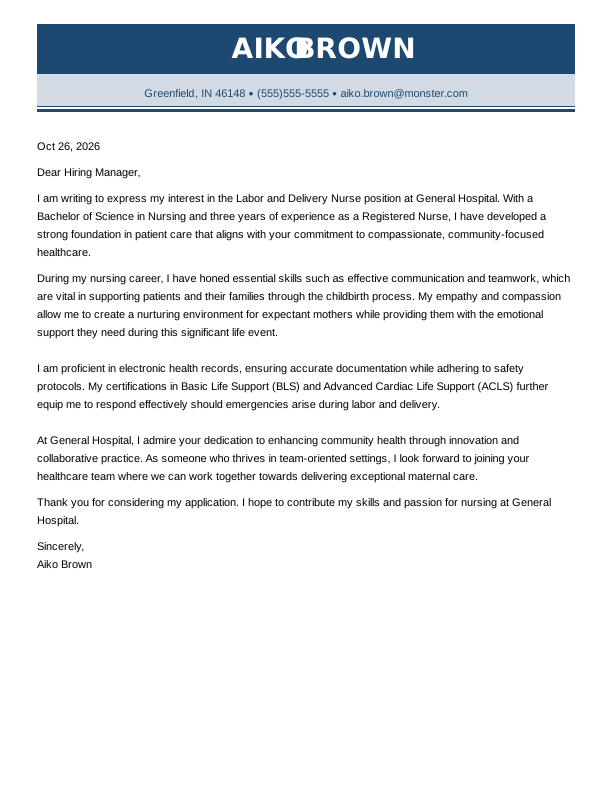
 Free
Labor And Delivery Nurse Entry-Level Cover Letter
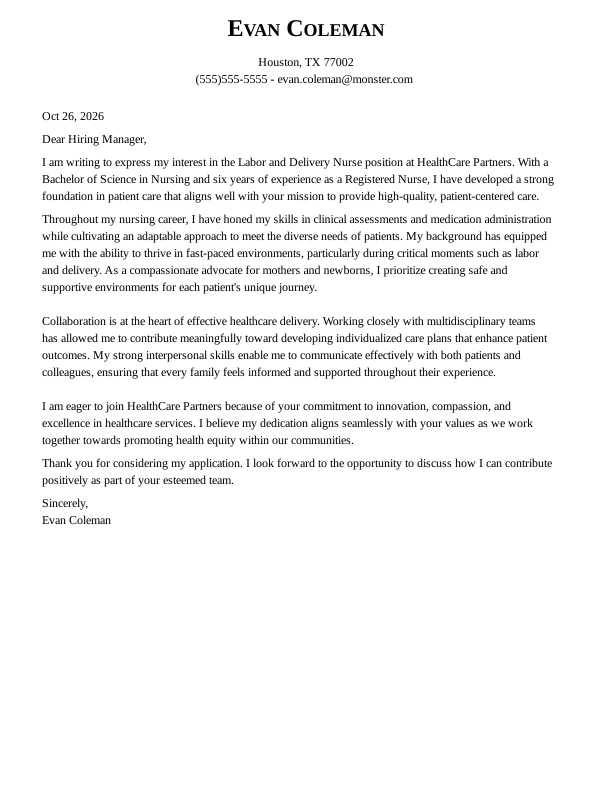
Labor And Delivery Nurse Mid-Level Cover Letter
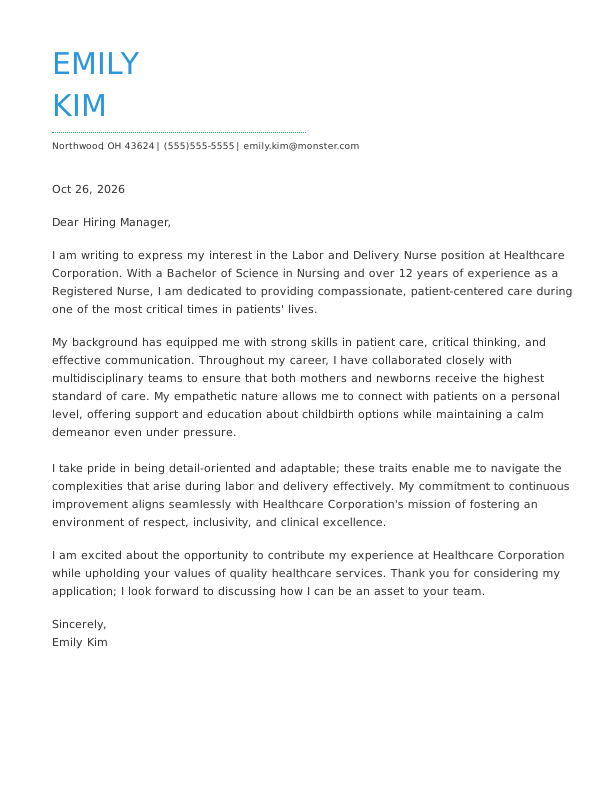
Labor And Delivery Nurse Experienced Cover Letter
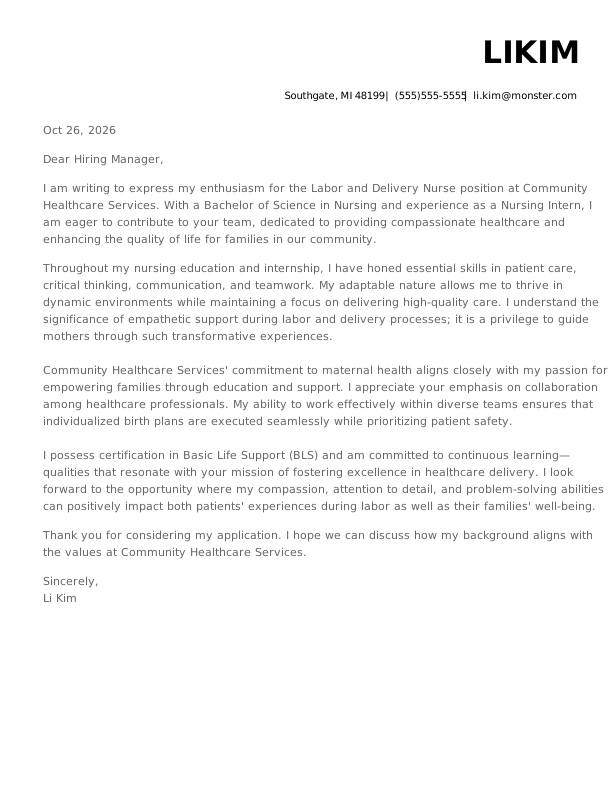
Labor And Delivery Nurse Entry-Level Cover Letter
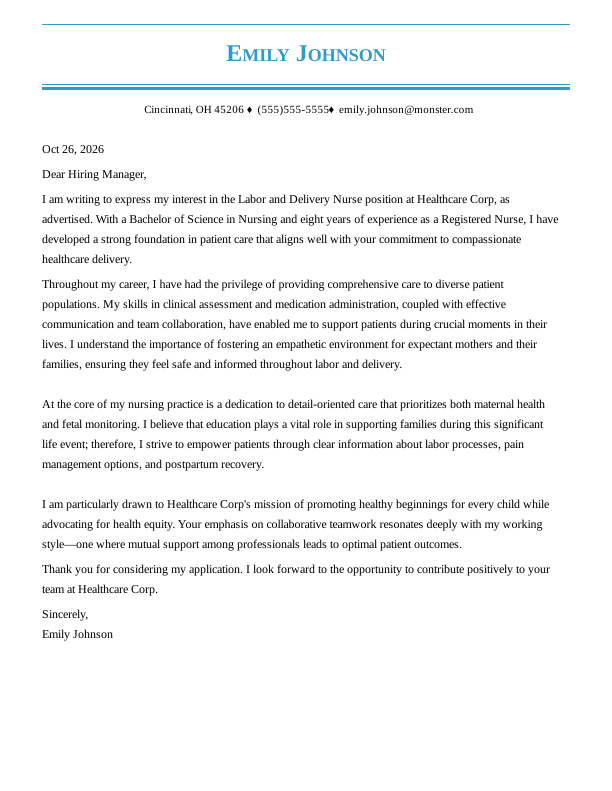
Labor And Delivery Nurse Mid-Level Cover Letter
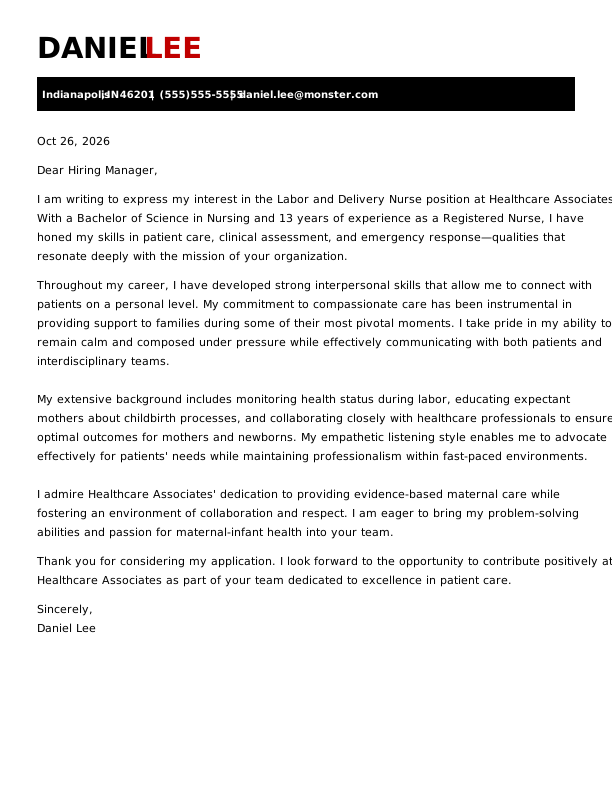
Labor And Delivery Nurse Experienced Cover Letter
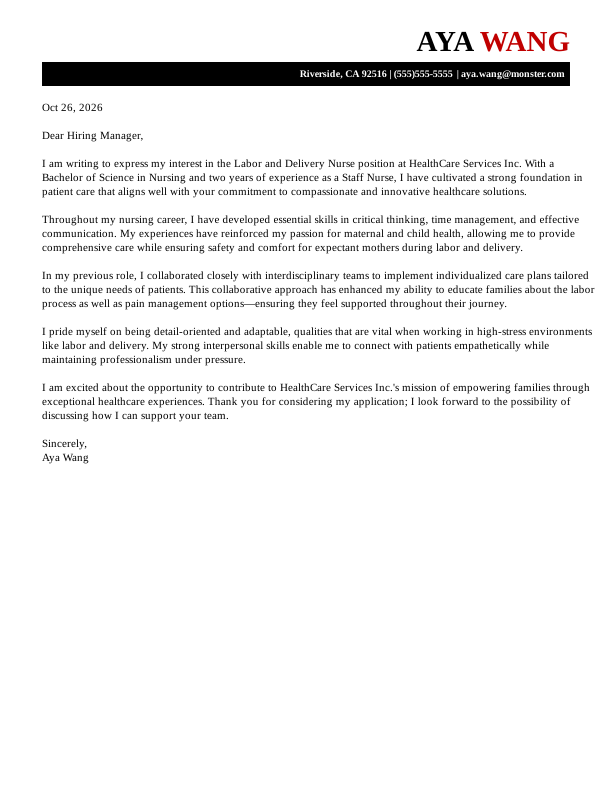
Labor And Delivery Nurse Entry-Level Cover Letter
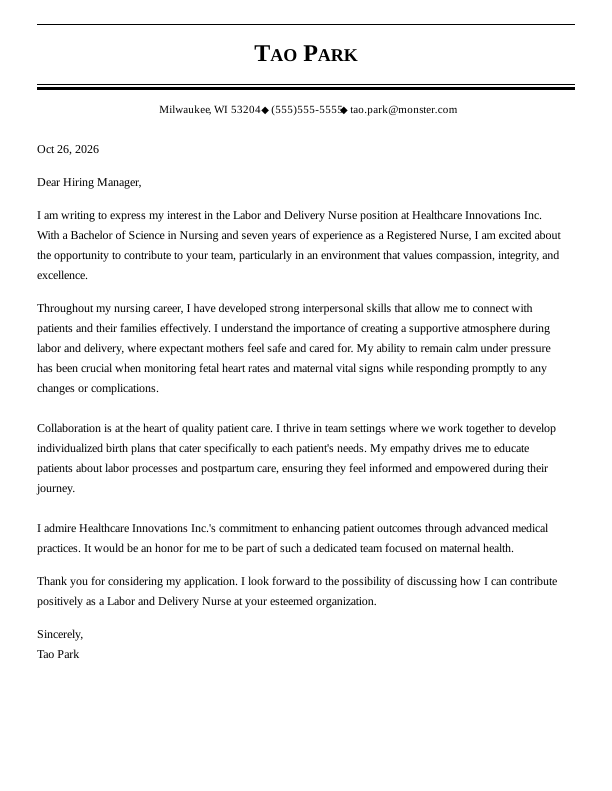
Labor And Delivery Nurse Mid-Level Cover Letter
Browse Free Cover Letter Templates
- Academic
- Account Manager
- Accountant
- Accounts Payable
- Administrative Assistant
- Admissions Counselor
- Architecture
- Artist
- Assistant Principal
- Babysitter
- Barista
- Bartender
- Bookkeeper
- Brand Ambassador
- Business Analyst
- Business
- Caregiver
- Chef
- Civil Engineering
- Computer Science
- Construction
- Consulting
- Copywriter
- Cosmetology
- Custodian
- Customer Service
- Customer Service Representative
- Data Analyst
- Data Entry
- Dental Assistant
- Dental Hygienist
- Digital Marketing
- Electrical Engineering
- Emt
- Engineering
- Esthetician
- Event Coordinator
- Executive Assistant
- Fashion Designer
- Finance
- Financial Analyst
- Firefighter
- Flight Attendant
- Graphic Designer
- Hair Stylist
- Healthcare
- Hr Generalist
- Investment Banking
- It
- Janitor
- Journalism
- Lab Technician
- Law Clerk
- Lawyer
- Librarian
- Logistics
- Maintenance Worker
- Makeup Artist
- Manager
- Marketing Coordinator
- Marketing
- Marketing Manager
- Massage Therapist
- Mechanic
- Mechanical Engineer
- Medical Assistant
- Non Profit
- Nursing
- Occupational Therapy
- Office Assistant
- Office Manager
- Operations Manager
- Paralegal
- Personal Trainer
- Pharmacist
- Pharmacy Technician
- Photographer
- Physician Assistant
- Pilot
- Police Officer
- Program Manager
- Project Manager
- Property Manager
- Psychology
- Receptionist
- Research Assistant
- Restaurant Manager
- Retail
- Sales
- Sales Manager
- School Counselor
- Security
- Security Officer
- Social Work
- Software Engineer
- Special Education Teacher
- Starbucks
- Substitute Teacher
- Teacher
- Teaching Assistant
Cover Letter Examples for Labor And Delivery Nurses
Cover letter expectations change as you advance in your nursing career. Select the template that matches your current experience level to present your skills, background, and clinical strengths effectively to prospective employers.
Entry-Level Labor and Delivery Nurse Cover Letter
Designed for nurses starting out in labor and delivery, this cover letter template helps you introduce your clinical training, enthusiasm for maternal care, and foundational nursing skills effectively.
Mid-Career Labor and Delivery Nurse Cover Letter
Ideal for nurses with a few years of clinical experience, this template helps you showcase your growing patient-care responsibilities, teamwork, and readiness to support a busy labor and delivery unit.
Experienced Labor and Delivery Nurse Cover Letter
Tailored for seasoned clinicians, this template highlights advanced clinical expertise, unit leadership, and a track record of supporting families and mentoring colleagues in high-acuity environments.
Labor and Delivery Nurse Cover Letter Template (Text)
Copy this labor and delivery nurse cover letter template, paste it into your document, and swap in your unit experience, certifications like BLS/ACLS, and employer name.
Hiro Lee
Eastside, WA 98003
(555)555-5555
hiro.lee@monster.com
Oct 26, 2026
Dear Hiring Manager,
I am writing to express my interest in the Labor and Delivery Nurse position at Healthcare Innovations Inc. With a Bachelor of Science in Nursing and five years of experience as a Registered Nurse, I am eager to contribute my skills and passion for maternal and child health to your esteemed organization.
Throughout my nursing career, I have developed strong clinical assessment abilities and have honed my capacity for patient education. My background includes providing compassionate care to diverse populations, ensuring that each patient feels supported during their labor journey. I take pride in being detail-oriented while collaborating effectively within multidisciplinary teams, aligning with Healthcare Innovations Inc.’s commitment to patient-centered approaches.
My adaptability allows me to thrive in fast-paced environments where emotional intelligence is crucial. I understand the importance of remaining calm under pressure while maintaining a focus on delivering high-quality care. The values of compassion, integrity, and excellence that your organization embodies resonate deeply with me; they mirror my approach to nursing.
As an advocate for continuous learning, I am passionate about enhancing maternal-fetal health outcomes through innovative practices. My Basic Life Support certification underscores my dedication to safety protocols while caring for expectant mothers.
I am excited about the opportunity to join Healthcare Innovations Inc., contributing not only my skills but also my unwavering commitment to empowering families during such an important time in their lives. Thank you for considering my application; I look forward to the possibility of discussing how I can be a valuable addition to your team.
Sincerely,
Hiro Lee
How to Write a Labor and Delivery Nurse Cover Letter
Writing a great cover letter means turning your bedside experience into clear, practical examples of patient care and teamwork. Review the job posting carefully, then use these straightforward steps to write a letter that shows healthcare employers you are ready for their unit.
1. Research & Prepare
Take time to research the hospital before writing so you can match your cover letter to its specific clinical environment and care priorities. Gather the following details to prepare:
- Pull the unit’s required certifications, shift expectations, and EHR name from the job posting.
- Review the hospital’s quality or safety page for L&D priorities like hemorrhage bundles or sepsis screening.
- Check CMS Hospital Compare to see recent maternal health performance measures tied to obstetric care.
2. Hook the Reader
Start your cover letter with a strong line that highlights your clinical focus and enthusiasm for patient care right away. Here are a few ways to start your opening paragraph:
- Fetal monitoring precision: “Led bedside trend reviews on nights when the hospital has rising variable decels using our EFM charting workflow and helped reduce category II tracing episodes by 15% over two shifts.”
- Rapid response mindset: “Coordinated uterine massage and bimanual response during postpartum hemorrhage drills with TXA timing under our hemorrhage protocol, working from the unit’s simulation checklist with charge nurse oversight.”
- Family-centered communication: “Used a quiet-room script to coach parents through induction education and pain options, including epidural prep with anesthesia liaison updates within 30 minutes of consult.”
3. Tell Your Professional Story
Use body paragraphs to describe real care situations and specific achievements from your previous roles. Sharing metrics helps hiring managers picture your daily impact and workload, as shown in these examples:
- Reduced postpartum hemorrhage documentation delays by 25% after revising L&D handoff steps for hourly rounding.
- Assisted with 42 deliveries per month on average while maintaining a 97% compliance rate with FHR monitoring checks.
- Coordinated discharge teaching for 18 to 22 postpartum patients weekly, cutting call-backs within 72 hours from 11% to 6%.
4. Showcase Your Skills
Showcase how your practical clinical skills address the key requirements listed in the job post. Consider these examples of presenting core competencies clearly:
- Fetal monitoring interpretation: “When the tracing showed concerning decelerations, reassessed immediately, repositioned the patient, and notified the provider with clear findings so we could act fast.”
- Medication administration safety: “Verified the medication order against the MAR and patient identifiers before giving oxytocin, double-checking pump settings and documenting each step as I went.”
- Patient and family communication: “Coached a partner through breathing cues during contractions and explained what to expect next in simple terms so they felt prepared for each change.”
5. Explain Any Special Circumstances
Briefly explain any employment gaps, career changes, or relocations so employers understand your situation. The following examples show how to address these circumstances simply and directly:
- “After a nine-month break from bedside nursing, I kept my skills current by completing BLS and ACLS renewal and doing per diem shifts in postpartum at a women’s hospital.”
- “Pivoting into labor and delivery from the ICU because I want antepartum and intrapartum care as my focus, and I completed NIHSS training plus practiced fetal monitoring during orientation in a high-volume triage unit.”
- “Relocated from Texas to California last spring, and my compact RN status is active while I finish the CA board verification for my employer’s credentialing.”
6. End With a Professional Goodbye
Wrap up your letter with a brief, professional closing statement that reiterates your interest in joining the unit. Express gratitude for the hiring team’s time and invite them to reach out for an interview.
For example, you can write: “I would welcome the chance to discuss how my clinical background and dedication to maternal health can support your labor and delivery team. Thank you for your time and consideration.” Sign off politely using a standard sign-off like “Sincerely” or “Best regards.”
4 Tips for Formatting Your Cover Letter
A well-formatted cover letter makes a strong first impression by allowing hiring managers and nurse recruiters to review your qualifications quickly. Clear layout, neat spacing, and standard fonts help highlight your certifications and experience during a fast scan.

Keep It to One Page
Keep your cover letter to a single page, ideally between 250 and 400 words across three to four concise paragraphs. Nurse managers review applications quickly between clinical duties, so a focused letter ensures your key qualifications stand out right away.

Use a Professional Font & Layout
Select a clear, easy-to-read font such as Arial, Calibri, or Georgia set between 10 pt and 12 pt size. Standard 1-inch margins and tidy line spacing make your text pleasant to read during fast scans by hiring teams.

Match Your Header to Your Resume
Use the exact same contact header, font styles, and layout formatting as your resume. Matching your document headers creates a unified presentation that looks polished and well-organized.

Save & Send as a PDF
Save your finished cover letter as a PDF file before uploading or sending it. Saving as a PDF preserves your formatting, margins, and layout so it displays consistently on any device or applicant tracking system.
Key Takeaways
- Tailor your cover letter to highlight relevant clinical skills and certifications that match the specific labor and delivery unit requirements.
- Include concrete metrics and care examples to show your clinical impact, patient volume management, and team collaboration strengths.
- Keep the layout tidy, easy to scan, and formatted consistently with your resume to leave a professional impression on hiring teams.
More Cover Letter Examples
- Certified Nursing Assistant
- LVN
- Nurse Educator
- Nurse Practitioner
- Nursing Student
- Pediatric Nurse
- Physician
- Registered Nurse
Browse Monster’s Resume Templates
Monster also has hundreds of ATS-friendly resume templates for all career levels and industries. Create a matching resume to help you land the interview.
- Aesthetic Nurse
- Certified Nursing Assistant
- Dialysis Nurse
- Director Of Nursing
- Entry-Level Nurse
- Er Nurse
- Family Nurse Practitioner
- Home Health Nurse
- Hospice Nurse
- Icu Nurse
- Labor And Delivery Nurse
- Licensed Practical Nurse
- Lvn
- Mds Coordinator
- Med-Surg Nurse
- New Grad Nurse
- Nurse Case Manager
- Nurse Educator
- Nurse Manager
- Nurse Practitioner
- Nursing Home
- Nursing Instructor
- Nursing
- Nursing Student
- Oncology Nurse
- Operating Room Nurse
- Pacu Nurse
- Pediatric Nurse
- Psychiatric Nurse Practitioner
- Psychiatric Nurse
- Registered Nurse
- Travel Nursing
- Travel Rn
- Utilization Review Nurse
Frequently Asked Questions
Last Update:
Do I really need a cover letter?
Including a cover letter for a labor and delivery nurse role helps you stand out by explaining your clinical motivation and communication strengths beyond basic resume bullet points. It gives you a great space to connect your past experiences directly to the needs of the unit.
How long should my cover letter be?
Your labor and delivery nurse cover letter should be one page long and around 250 to 400 words. Keeping your text concise ensures hiring managers can easily read your main qualifications and certifications during brief review periods between clinical shifts.
Should my cover letter match my resume?
Your cover letter should match your resume in visual style, header format, and font selection to present a cohesive application set. Using identical styling across both files shows attention to detail and gives your materials a neat, professional appearance.
What should I include in my cover letter header?
Your cover letter header should feature your full name, nursing credentials, phone number, professional email address, location, current date, and employer contact information. Matching this header to your resume creates a clean, organized look across your documents.
Should I mention salary expectations in my cover letter?
You should only mention salary expectations in your cover letter if the job posting explicitly asks for them. If requested, share a realistic pay range based on local market standards for labor and delivery nurses, while noting your flexibility regarding overall benefits.

Kirsten Chorpenning is a career advice writer who empowers job seekers to take control of their career paths using Monster’s comprehensive job search and resume tools. She specializes in helping job seekers find rewarding jobs in today’s dynamic work environment.
See More From Kirsten ChorpenningExplore Related Career Advice







How to Write a Cover Letter for Internal Positions or Promotions (Examples & Tips)
Updated:
Apr 23, 2026
|
19 min read


Cover Letter vs Resume: What’s the Difference & Do You Need Both?

Updated:
Apr 23, 2026
|
18 min read