


Free Pediatric Nurse Cover Letter Templates & Examples
A strong pediatric nurse cover letter shows you can provide gentle bedside care, monitor symptoms closely, and partner with families. Our examples and advice help you write a warm, clear letter that highlights your skills and connects with hiring teams.
Real-World Cover Letters That Get Results
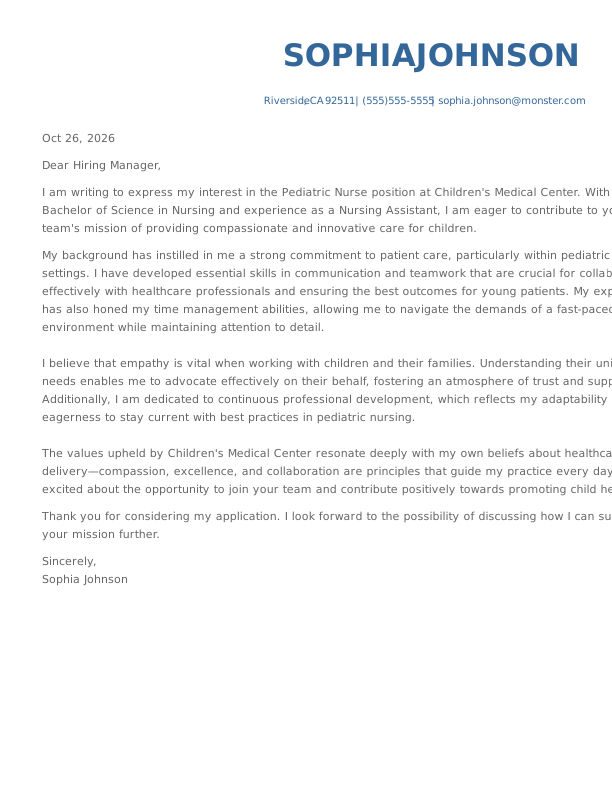
 Free
Pediatric Nurse Entry-Level Cover Letter
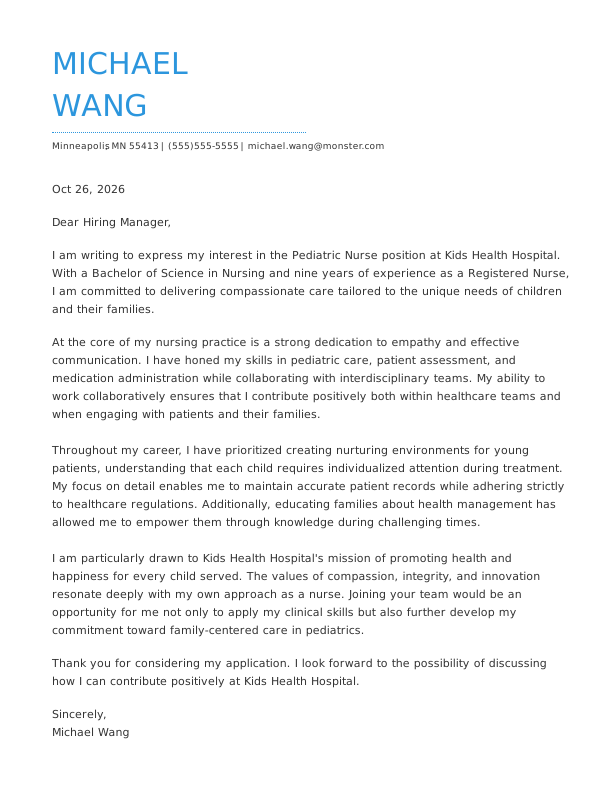
Pediatric Nurse Mid-Level Cover Letter
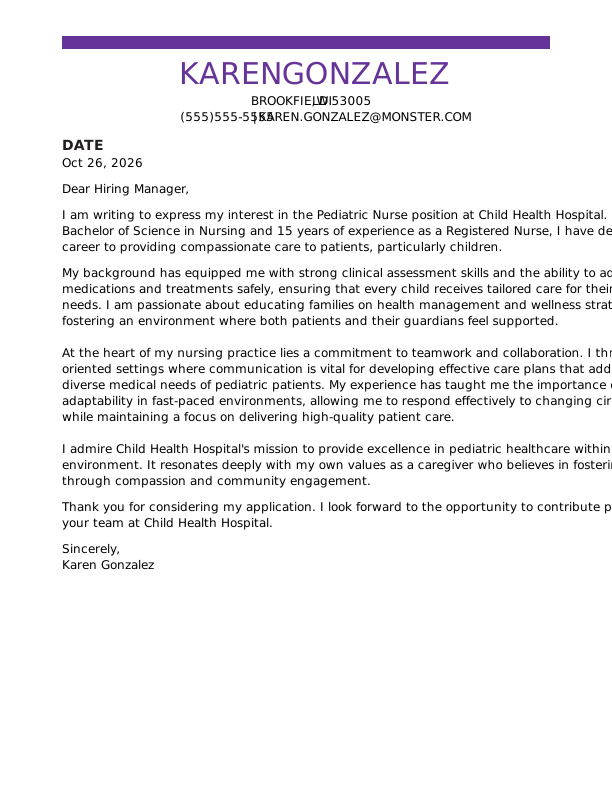
Pediatric Nurse Experienced Cover Letter
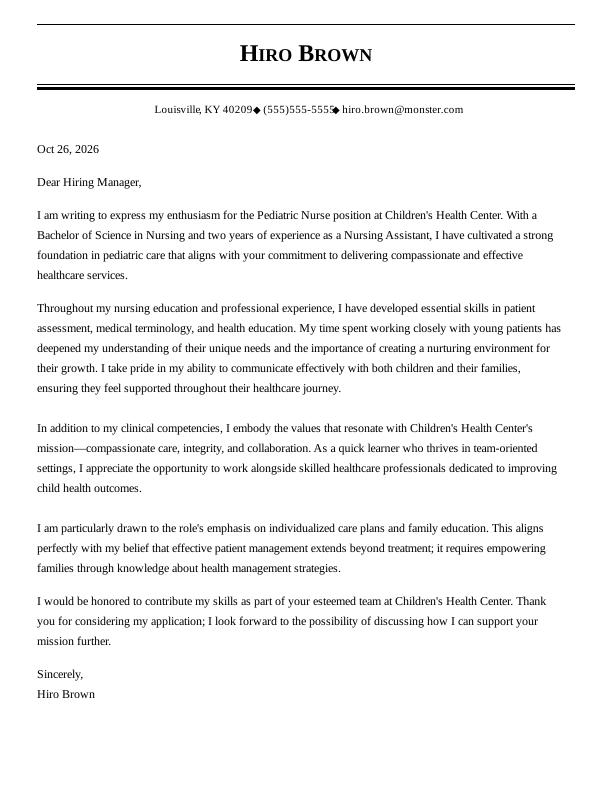
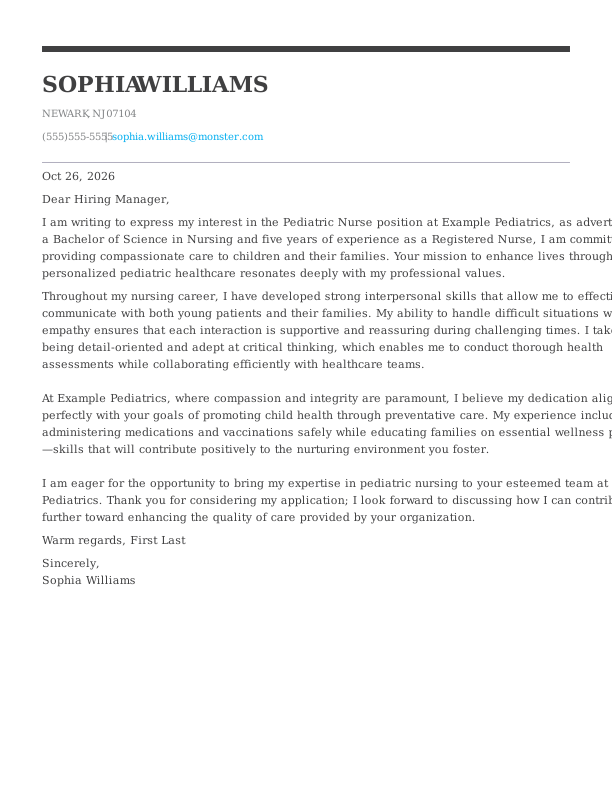
Pediatric Nurse Entry-Level Cover Letter
Pediatric Nurse Mid-Level Cover Letter
Pediatric Nurse Experienced Cover Letter
Pediatric Nurse Entry-Level Cover Letter
Pediatric Nurse Mid-Level Cover Letter
Browse Free Cover Letter Templates
- Academic
- Account Manager
- Accountant
- Accounts Payable
- Administrative Assistant
- Admissions Counselor
- Architecture
- Artist
- Assistant Principal
- Babysitter
- Barista
- Bartender
- Bookkeeper
- Brand Ambassador
- Business Analyst
- Business
- Caregiver
- Chef
- Civil Engineering
- Computer Science
- Construction
- Consulting
- Copywriter
- Cosmetology
- Custodian
- Customer Service
- Customer Service Representative
- Data Analyst
- Data Entry
- Dental Assistant
- Dental Hygienist
- Digital Marketing
- Electrical Engineering
- Emt
- Engineering
- Esthetician
- Event Coordinator
- Executive Assistant
- Fashion Designer
- Finance
- Financial Analyst
- Firefighter
- Flight Attendant
- Graphic Designer
- Hair Stylist
- Healthcare
- Hr Generalist
- Investment Banking
- It
- Janitor
- Journalism
- Lab Technician
- Law Clerk
- Lawyer
- Librarian
- Logistics
- Maintenance Worker
- Makeup Artist
- Manager
- Marketing Coordinator
- Marketing
- Marketing Manager
- Massage Therapist
- Mechanic
- Mechanical Engineer
- Medical Assistant
- Non Profit
- Nursing
- Occupational Therapy
- Office Assistant
- Office Manager
- Operations Manager
- Paralegal
- Personal Trainer
- Pharmacist
- Pharmacy Technician
- Photographer
- Physician Assistant
- Pilot
- Police Officer
- Program Manager
- Project Manager
- Property Manager
- Psychology
- Receptionist
- Research Assistant
- Restaurant Manager
- Retail
- Sales
- Sales Manager
- School Counselor
- Security
- Security Officer
- Social Work
- Software Engineer
- Special Education Teacher
- Starbucks
- Substitute Teacher
- Teacher
- Teaching Assistant
Cover Letter Examples for Pediatric Nurses
Cover letter requirements evolve as a pediatric nurse moves from early clinical rotations to broader responsibilities. Choose the template that matches your experience level so you can highlight the right training, patient care outcomes, and any unit leadership or specialty work.
Entry-Level Pediatric Nurse Cover Letter
Perfect for recent nursing graduates and career changers, this template highlights foundational clinical skills, transferable caregiving experience, and an eagerness to learn pediatric care.
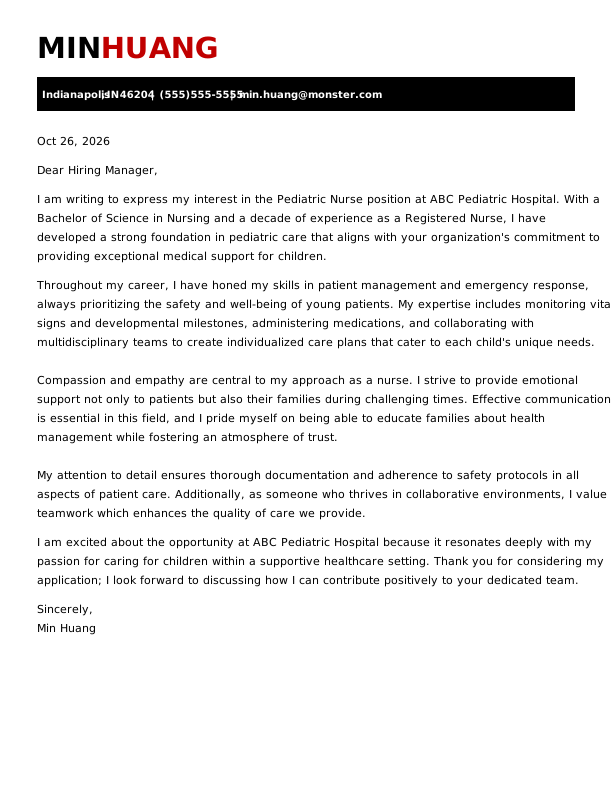
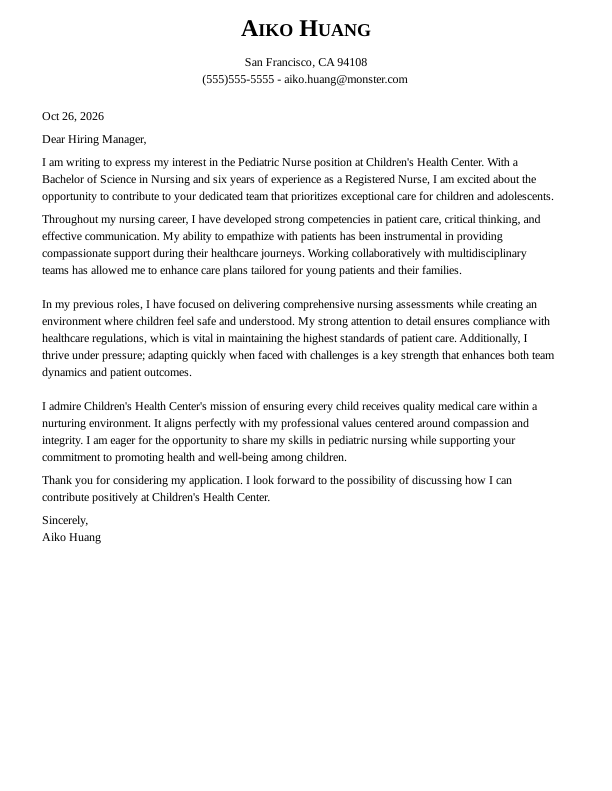
Mid-Career Pediatric Nurse Cover Letter
Designed for nurses with several years under their belt, this template focuses on solid clinical skills, family education, and smooth teamwork across busy hospital shifts.
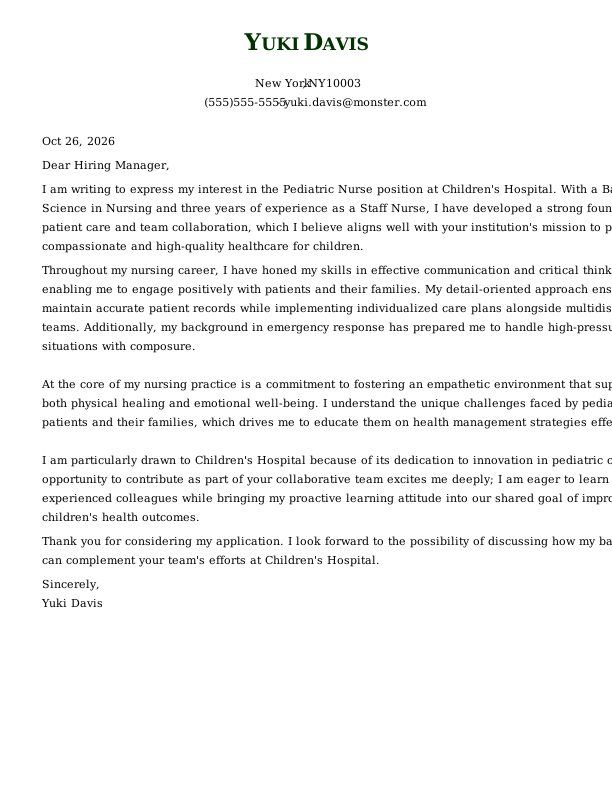
Experienced Pediatric Nurse Cover Letter
Built for veteran nurses with extensive clinical backgrounds, this template highlights advanced assessment skills, collaborative care planning, and the ability to mentor and guide teams.
Pediatric Nurse Cover Letter Template (Text)
Copy this pediatric nurse cover letter template into your document, then swap in your unit experience, patient outcomes metrics, and the hospital or clinic you’re targeting.
Yuki Lee
Cincinnati, OH 45203
(555)555-5555
yuki.lee@monster.com
Oct 26, 2026
Dear Hiring Manager,
I am writing to express my interest in the pediatric nurse position at Children’s Health Center. With a Bachelor of Science in Nursing and four years of experience as a registered nurse (RN), I have developed a strong foundation in pediatric care, focusing on the health and well-being of children and their families.
My background includes comprehensive patient assessment and effective communication skills, which I consider essential when engaging with young patients and their families. I am dedicated to fostering an environment that emphasizes empathy and support, ensuring that families feel informed and involved in their children’s healthcare journeys.
Throughout my career, I have collaborated closely with interdisciplinary teams to create individualized care plans that address the unique needs of each child. My attention to detail allows me to maintain accurate patient records while managing multiple tasks efficiently within fast-paced settings.
At Children’s Health Center, where compassion meets innovation in pediatric care, I believe my values align seamlessly with your mission. I am particularly drawn to your commitment to family-centered healthcare—a principle that has always guided my nursing practice.
I would be honored to bring my strong work ethic, adaptability, and collaborative spirit to your esteemed team. Thank you for considering my application; I look forward to the opportunity for further discussion about how I can contribute positively as part of your dedicated staff.
Sincerely,
Yuki Lee
How to Write a Pediatric Nurse Cover Letter
Writing a strong pediatric nurse cover letter comes down to sharing real bedside moments, showing how you partner with worried families, and demonstrating your commitment to safe patient care. Follow these six steps to build a clear, compelling letter that highlights your clinical strengths.
1. Research & Prepare
Before you start writing, take some time to learn what the specific pediatric unit or clinic cares about most right now. Look into the electronic health record system it uses, its patient population, and its current quality or safety goals. When you understand the team’s day-to-day priorities, it’s much easier to show how your background fits its current staffing needs.
Here are a few quick ways to gather useful background details before writing:
- Read the job posting carefully to spot must-have clinical certifications and specific pediatric competencies.
- Check the organization’s website or public community reports to learn about its recent safety goals and patient care initiatives.
- Look up local community health trends to see the common illnesses or health challenges affecting kids in that service area.
2. Hook the Reader
Skip overused openers like “I am writing to apply” or “I’ve always loved working with kids.” Instead, start with a line that shows your clinical awareness and your connection to patient care right from the first shift.
Here are three ways you can hook the reader using real clinical priorities:
- Family-centered education: “During my time on a 4-bed pediatric step-down unit, I used the teach-back method with parents during discharge planning, which helped raise documented caregiver comprehension from 68% to 91%.”
- Medication and patient safety: “By standardizing weight-based dosing checks in Epic and verifying high-risk medications with a second nurse, I helped our floor reduce IV infiltration events by 25%.”
- Specialty care initiatives: “As part of our unit’s rapid response team, I helped lower our average time-to-antibiotic delivery for pediatric sepsis cases from 78 minutes down to 52 minutes.”
3. Tell Your Professional Story
Your resume lists where you worked, but your cover letter tells the story of how you actually care for patients and support families. Adding clear numbers and everyday context helps hiring managers see the direct impact of your bedside care.
Consider these examples of how to frame your daily impact:
- Cut 7-day unplanned readmissions for pediatric asthma from 6.5% to 4.1% by creating a clearer discharge checklist and helping families book follow-up visits before leaving.
- Sped up medication reconciliation times during admissions by 25% by using a structured parent interview guide to confirm accurate weight-based doses.
- Cared for an average of 10 to 12 pediatric patients per shift while completing daily wound care for six patients without missing a single charting deadline.
4. Showcase Your Skills
Instead of simply telling the employer you have great bedside manner, describe a real situation where your clinical instincts and communication made a positive difference. Showing your actions in real time proves your readiness far better than a list of adjectives.
Here is how you can turn standard nursing requirements into real-world moments:
- Pediatric assessment: “When a parent mentioned their toddler’s breathing sounded slightly different, I immediately reassessed lung sounds, noted early retractions, and alerted the provider to adjust the treatment plan.”
- EHR documentation: “I make it a rule to chart pain scores and medication times in Epic immediately after administration so the next nurse has a completely transparent record to work from.”
- Compassionate communication: “Before placing an IV, I sit down at eye level with the child and their caregiver, walk them through each step in simple terms, and ask what helps comfort them most.”
5. Explain Any Special Circumstances
If you have a gap in your work history, are switching specialties, or are moving across state lines, address it in one or two direct, positive sentences. Pediatric nurse managers mainly want to know that your clinical license is active and your bedside skills are sharp.
You can adapt these practical examples to explain your current situation:
- “After taking four months off to care for family, I refreshed my BLS and PALS certifications and completed a pediatric physical assessment course before re-entering bedside care.”
- “After five years in adult med-surg, I am transitioning into pediatrics by volunteering at a local youth clinic and earning my pediatric emergency credentials.”
- “I recently relocated from Dallas to Seattle, and my multi-state compact RN license is active while I complete clinical onboarding at my current facility.”
6. End With a Professional Goodbye
Finish your letter with a polite statement of gratitude and a clear, forward-looking closing sentence. Keep it warm and direct rather than using generic sign-offs that do not connect to the job.
For example, you might write: “I would welcome the opportunity to discuss how my background in pediatric triage and family-centered education can support your clinic’s daily flow. Thank you for your time and consideration.” Then close with “Sincerely” or “Best regards,” followed by your full name and credentials.
4 Tips for Formatting Your Cover Letter
When your cover letter is clean, well-spaced, and easy to read, hiring managers can quickly spot your credentials, certifications, and clinical background in just a few seconds. Good formatting shows that you value clarity and attention to detail—qualities that matter deeply when charting patient care and communicating on a busy pediatric unit.
Follow these tips to ensure a clean presentation and that your letter doesn’t end up on the reject pile:

Use a Professional Font & Layout
Stick with clean, easy-to-read fonts like Arial, Calibri, or Georgia set between 10 and 12 points. Use standard one-inch margins all around so your letter looks balanced on the page. Keeping the font and header style consistent with your nursing resume helps your entire application feel like one polished, professional packet.

Address the Hiring Manager Directly
Try to find the actual name of the pediatric nurse manager, unit director, or clinical recruiter by checking the job post, the hospital’s staff directory, or LinkedIn. If you can’t locate a specific name after looking, use “Dear Pediatric Hiring Team” or “Dear Hiring Manager.” Steer clear of “To Whom It May Concern,” as it feels stiff and impersonal.

Balance Spacing & Margins
Keep your line spacing between 1.0 and 1.15, and always leave a blank line between paragraphs so your text has room to breathe. Using margins between 0.75 and 1 inch keeps your letter from feeling crowded on screen, while ensuring it prints neatly if a clinical team takes it into an in-person interview.

Save & Send as a PDF
Always export your completed letter as a PDF unless the job application portal specifically asks for a Word document. A PDF locks your margins, fonts, and layout in place so the file looks clean on any screen or applicant tracking system. Save the file with a clear title like Jane_Doe_Pediatric_Nurse_Cover_Letter.pdf.
Key Takeaways
- Show how your sharp clinical assessments and quick communication protect young patients during shifts.
- Use concrete numbers to highlight your success with medication safety, patient education, or unit workflow.
- Tailor your letter directly to the setting, whether that is a high-acuity children’s hospital, an outpatient clinic, or an urgent care center.
More Cover Letter Examples
- Certified Nursing Assistant
- Labor And Delivery Nurse
- LVN
- Nurse Educator
- Nurse Practitioner
- Nursing Student
- Physician
- Registered Nurse
Browse Monster’s Resume Templates
Monster also has hundreds of ATS-friendly resume templates for all career levels and industries. Create a matching resume to help you land the interview.
- Aesthetic Nurse
- Certified Nursing Assistant
- Dialysis Nurse
- Director Of Nursing
- Entry-Level Nurse
- Er Nurse
- Family Nurse Practitioner
- Home Health Nurse
- Hospice Nurse
- Icu Nurse
- Labor And Delivery Nurse
- Licensed Practical Nurse
- Lvn
- Mds Coordinator
- Med-Surg Nurse
- New Grad Nurse
- Nurse Case Manager
- Nurse Educator
- Nurse Manager
- Nurse Practitioner
- Nursing Home
- Nursing Instructor
- Nursing
- Nursing Student
- Oncology Nurse
- Operating Room Nurse
- Pacu Nurse
- Pediatric Nurse
- Psychiatric Nurse Practitioner
- Psychiatric Nurse
- Registered Nurse
- Travel Nursing
- Travel Rn
- Utilization Review Nurse
Frequently Asked Questions
Last Update:
Do I really need a cover letter?
You should definitely submit a cover letter for a pediatric nurse job, even when an employer lists it as optional. While your resume outlines your degrees and past jobs, your cover letter lets you show your bedside manner, your clinical judgment, and how you communicate with worried parents. It also gives you a dedicated space to explain why you want to join that specific unit, helping your application stand out from the stack.
How long should my cover letter be?
Your pediatric nurse cover letter should be kept to a single page, ideally between 250 and 400 words. Busy nurse managers review applications quickly between patient care duties, so they appreciate clear, focused writing. Stick to three or four short paragraphs that highlight your strongest clinical moments, specialty certifications, and dedication to family-centered care without burying the reader in unnecessary details.
Should my cover letter match my resume?
Your cover letter should match your resume’s visual design, but it shouldn’t just repeat the same text. Use the identical header, font style, and margins on both documents so your application looks cohesive and organized. In the body of your letter, expand on a meaningful clinical experience or patient outcome rather than simply re-listing the duties already outlined on your resume.
How do I address my cover letter if I don’t know the hiring manager’s name?
When you don’t know the hiring manager’s name, start by checking the hospital’s staff directory, LinkedIn, or the job posting for the unit manager. If you still can’t find a name, address your letter to “Dear Pediatric Hiring Team” or “Dear Hiring Manager.” Avoid using “To Whom It May Concern,” since it feels outdated and disconnected from modern clinical teams.
How do I write a cover letter for an internal position?
To write a cover letter for an internal pediatric position, speak directly to your familiar knowledge of the unit’s protocols, care teams, and daily patient flow. Highlight your recent contributions on the floor, like mentoring newer nurses or helping cut discharge delays, and outline how you hope to grow in the new role. Keep your tone professional and thank leadership for considering your internal transfer.

Elizabeth Muenzen is a Certified Professional Resume Writer (CPRW) and member of the Professional Association of Resume Writers & Career Coaches who empowers job seekers to take control of their career paths using Monster’s comprehensive job search and resume tools.
See More From Elizabeth MuenzenExplore Related Career Advice







How to Write a Cover Letter for Internal Positions or Promotions (Examples & Tips)

Updated:
Apr 23, 2026
|
19 min read


Cover Letter vs Resume: What’s the Difference & Do You Need Both?
Updated:
Apr 23, 2026
|
18 min read