


Free Nurse Educator Cover Letter Templates & Examples
A strong nurse educator cover letter shows how you turn clinical knowledge into safe, supportive training while improving learner outcomes. Our free cover letter examples and step-by-step guidance help you spotlight your teaching experience and earn the attention of hiring managers.
Real-World Cover Letters That Get Results
 Free
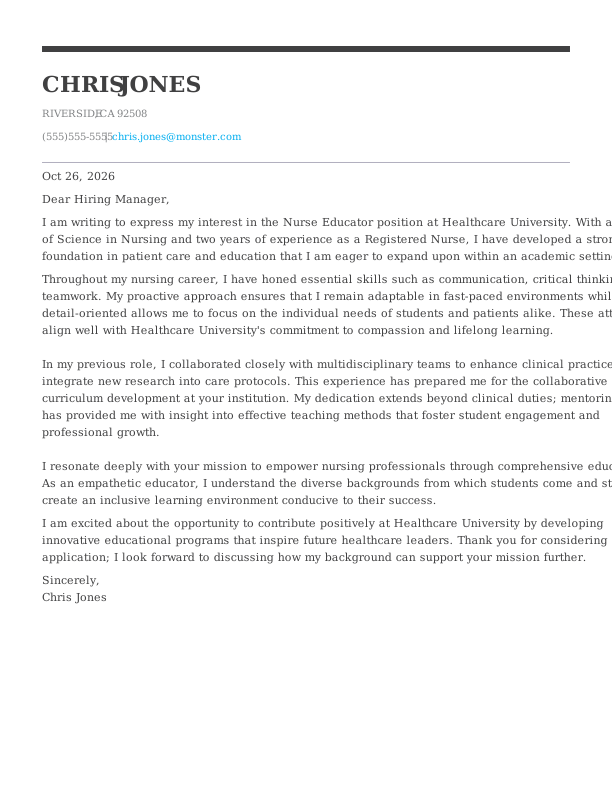
Nurse Educator Entry-Level Cover Letter
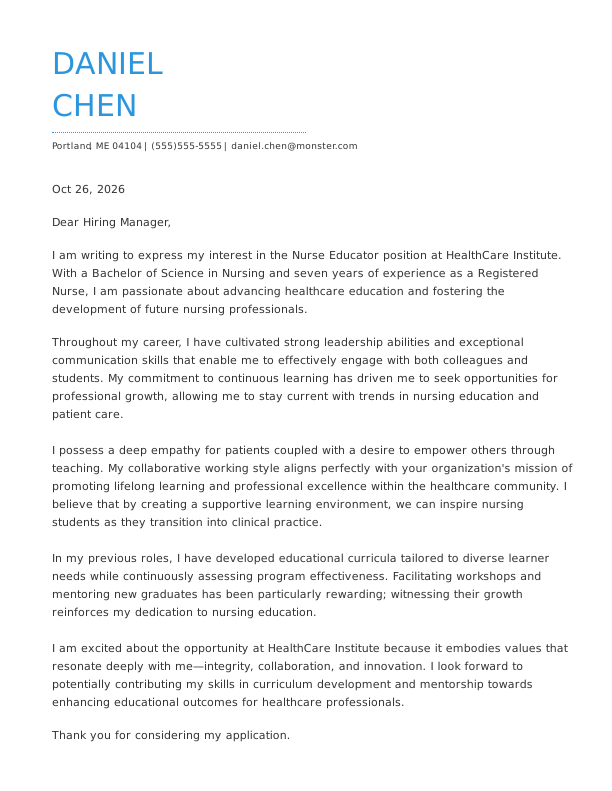
Nurse Educator Mid-Level Cover Letter
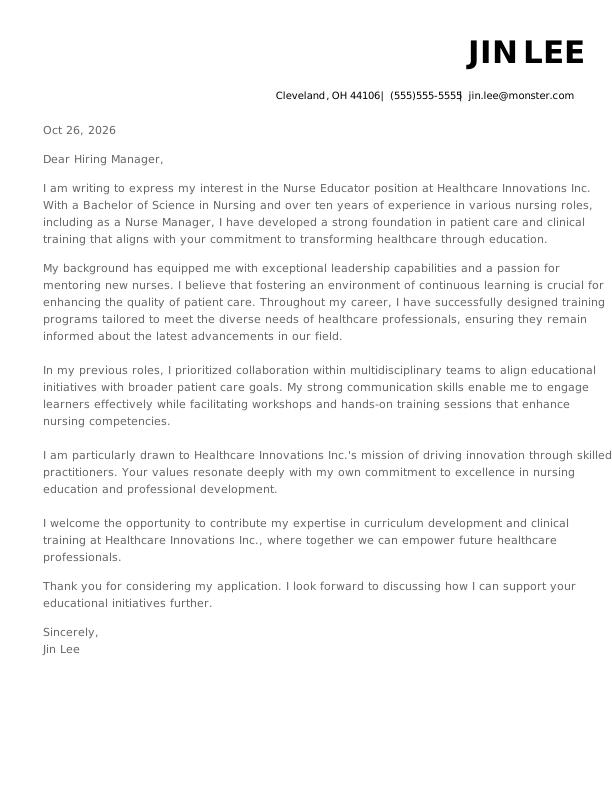
Nurse Educator Experienced Cover Letter
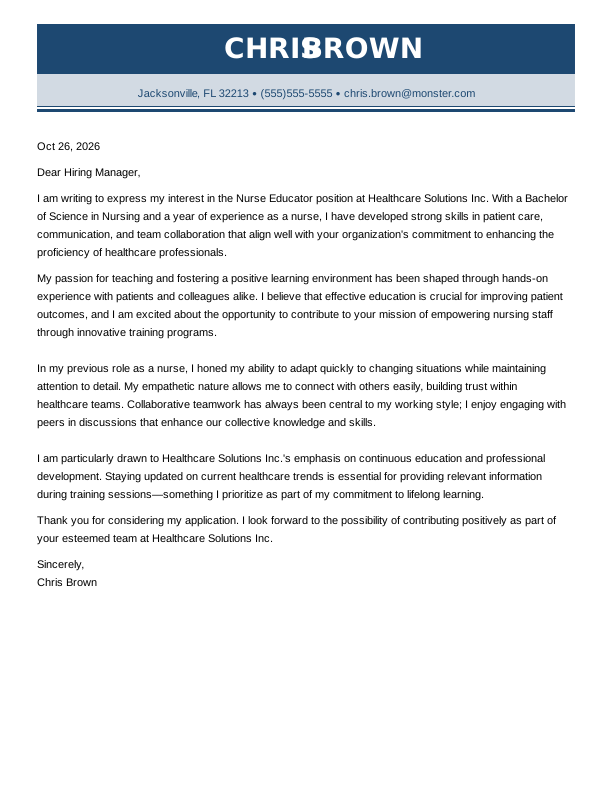
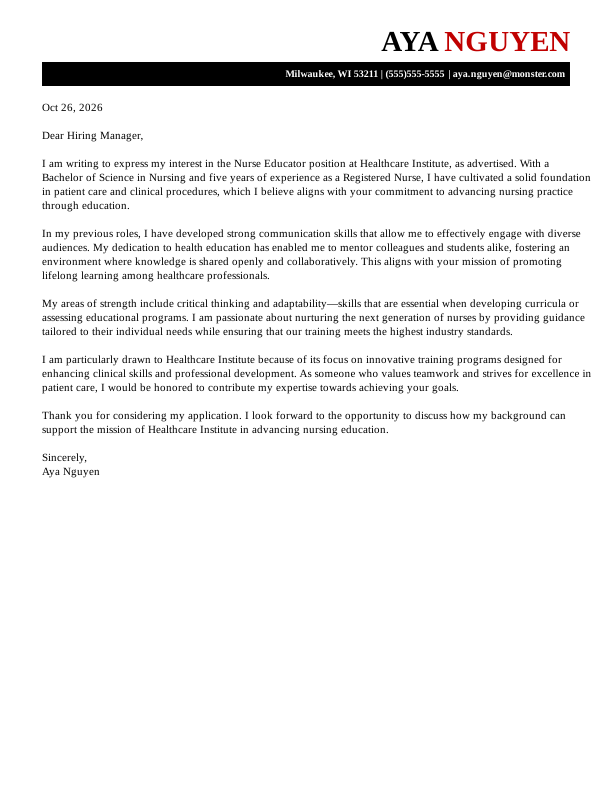
Nurse Educator Entry-Level Cover Letter
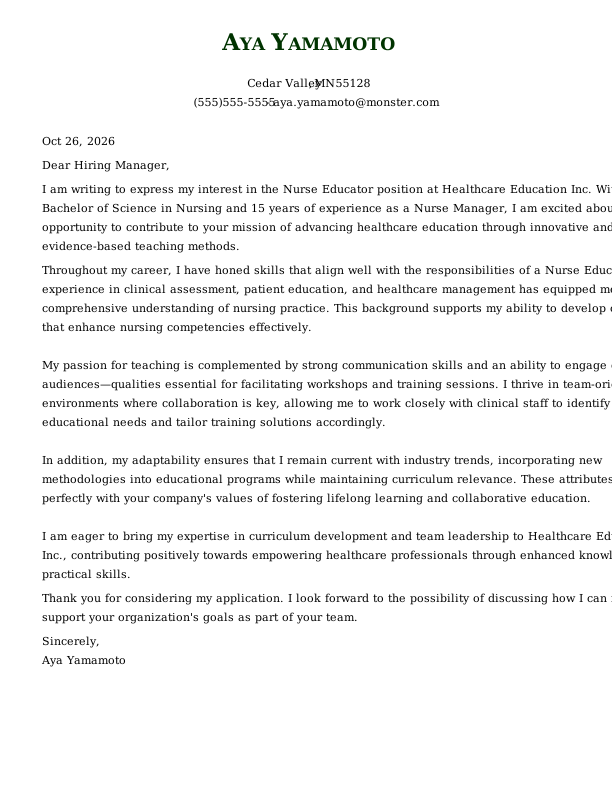
Nurse Educator Mid-Level Cover Letter
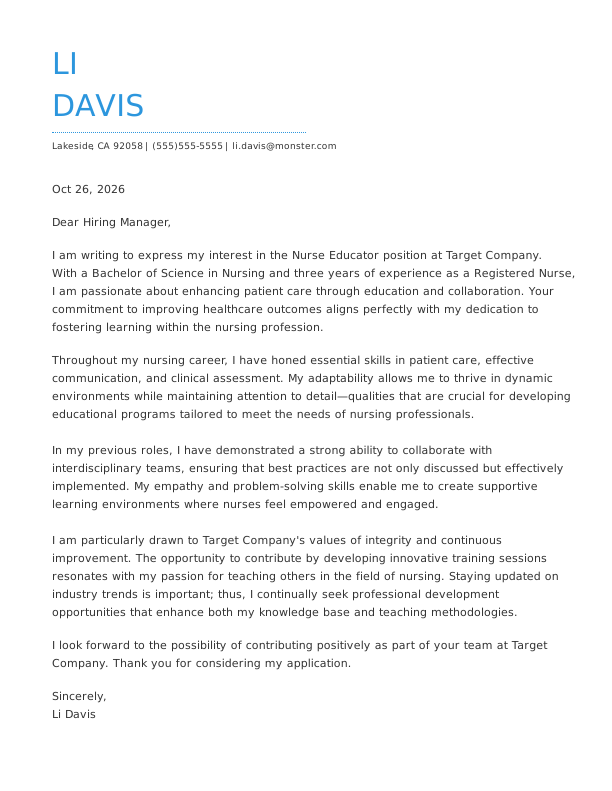
Nurse Educator Experienced Cover Letter
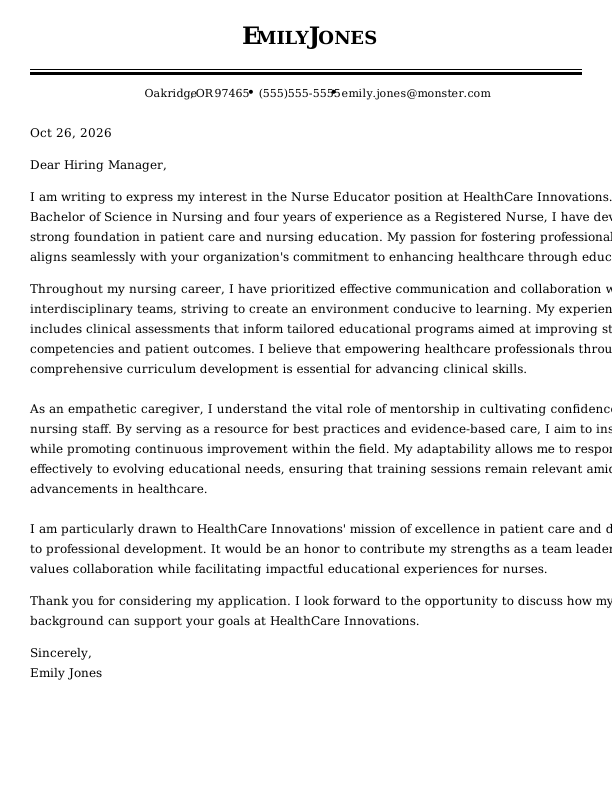
Nurse Educator Entry-Level Cover Letter
Nurse Educator Mid-Level Cover Letter
Browse Free Cover Letter Templates
- Academic
- Account Manager
- Accountant
- Accounts Payable
- Administrative Assistant
- Admissions Counselor
- Architecture
- Artist
- Assistant Principal
- Babysitter
- Barista
- Bartender
- Bookkeeper
- Brand Ambassador
- Business Analyst
- Business
- Caregiver
- Chef
- Civil Engineering
- Computer Science
- Construction
- Consulting
- Copywriter
- Cosmetology
- Custodian
- Customer Service
- Customer Service Representative
- Data Analyst
- Data Entry
- Dental Assistant
- Dental Hygienist
- Digital Marketing
- Electrical Engineering
- Emt
- Engineering
- Esthetician
- Event Coordinator
- Executive Assistant
- Fashion Designer
- Finance
- Financial Analyst
- Firefighter
- Flight Attendant
- Graphic Designer
- Hair Stylist
- Healthcare
- Hr Generalist
- Investment Banking
- It
- Janitor
- Journalism
- Lab Technician
- Law Clerk
- Lawyer
- Librarian
- Logistics
- Maintenance Worker
- Makeup Artist
- Manager
- Marketing Coordinator
- Marketing
- Marketing Manager
- Massage Therapist
- Mechanic
- Mechanical Engineer
- Medical Assistant
- Non Profit
- Nursing
- Occupational Therapy
- Office Assistant
- Office Manager
- Operations Manager
- Paralegal
- Personal Trainer
- Pharmacist
- Pharmacy Technician
- Photographer
- Physician Assistant
- Pilot
- Police Officer
- Program Manager
- Project Manager
- Property Manager
- Psychology
- Receptionist
- Research Assistant
- Restaurant Manager
- Retail
- Sales
- Sales Manager
- School Counselor
- Security
- Security Officer
- Social Work
- Software Engineer
- Special Education Teacher
- Starbucks
- Substitute Teacher
- Teacher
- Teaching Assistant
Cover Letter Examples for Nurse Educators
Cover letter requirements evolve as you move from new instructor duties to leading curriculum and staff development. Select the template that fits your career stage to highlight your teaching experience and accomplishments effectively.
Entry-Level Nurse Educator Cover Letter
Designed for new instructors, this template helps you highlight relevant clinical experience, coursework, and enthusiasm for teaching when entering the nurse educator field.
Mid-Career Nurse Educator Cover Letter
Tailored for mid-career nurse educators, this template highlights your experience precepting staff, facilitating skills workshops, and designing unit-level educational programs.
Experienced Nurse Educator Cover Letter
Ideal for experienced nurse educators, this template highlights strategic leadership in curriculum design, staff development programs, and clinical quality initiatives.
Nurse Educator Cover Letter Template (Text)
Copy this nurse educator cover letter template, paste it into your document, and swap in your training outcomes, curriculum topics, and facility or school name.
Tao Davis
Milwaukee, WI 53210
(555)555-5555
tao.davis@monster.com
Oct 26, 2026
Dear Hiring Manager,
I am writing to express my interest in the Nurse Educator position at Healthcare Academy, as advertised. With a Bachelor of Science in Nursing and six years of experience as a Registered Nurse, I have developed a comprehensive skill set that aligns well with your commitment to advancing nursing education and fostering professional growth.
Throughout my career, I have consistently demonstrated strong communication skills and an empathetic approach towards patient engagement. My experience in clinical settings has equipped me with the ability to assess patient needs effectively while collaborating with multidisciplinary teams to provide high-quality care. This background enhances my capability to deliver engaging lectures and interactive training sessions for nursing students.
I am passionate about nurturing the next generation of healthcare professionals through innovative teaching methods and supportive mentorship. My detail-oriented nature drives me to create curricula that not only meet educational standards but also address current healthcare trends, ensuring relevance in our ever-evolving field.
In addition, I value adaptability and continuous learning—key attributes that resonate deeply with Healthcare Academy’s mission. I believe these qualities are essential for fostering a positive learning environment where diverse learners can thrive.
Thank you for considering my application. I look forward to the opportunity to contribute positively to your team and support the mission of elevating nursing education at Healthcare Academy.
Sincerely,
Tao Davis
How to Write a Nurse Educator Cover Letter
Writing a strong cover letter is all about showing how your clinical background and teaching skills create real results for learners and healthcare teams. Follow the steps below to craft a tailored, engaging letter that clearly highlights your value as an educator.
1. Research & Prepare
Before writing your letter, take time to learn about the organization’s current educational initiatives, clinical goals, and technologies. Understanding these details allows you to connect your background directly to their daily operational needs.
When gathering information prior to drafting, focus on these key resources:
- Pull the required education scope and documentation tools from the job posting.
- Review the hospital’s annual report or quality dashboard updates for current safety and training priorities.
- Search CMS Quality Measures or state health department reports for topics tied to their patient outcomes that you can address in your letter.
2. Hook the Reader
Grab the reader’s attention immediately by focusing on your proven ability to deliver results. Open with an impactful sentence that connects your passion for nursing education directly to positive outcomes.
Here are a few strong ways to introduce your background:
- Clinical teaching outcomes: “Redesigned skills checkoffs on med-surg floor using OSCE-style stations and improved competency pass rates from 78% to 93% in three months.”
- Education systems and data: “Built an annual preceptor refresh for ICU RNs using NCLEX-style case stems and tracked item-level gaps on lactate sepsis pathways across 120 learners.”
- Interdisciplinary credibility: “After partnering with respiratory therapy on your ventilator bundle rollout, led two simulation days that cut suction-related VAP events by 20% per quarter.”
3. Tell Your Professional Story
Describe specific instructional methods you have used and highlight quantifiable results to build credibility.
Consider these examples of how to frame your achievements with clear metrics:
- Raised NCLEX-style test pass rates from 72% to 86% for 38 new graduate RN learners after completing weekly simulation cycles.
- Reduced medication documentation errors by 24% in a six-week skills refresh by adding targeted coaching on high-alert meds and return demonstrations.
- Delivered quarterly wound-care education to 120 staff members while cutting average competency validation time from 45 minutes to 30 minutes per learner.
4. Showcase Your Skills
Describe specific scenarios where your guidance directly helped learners grow. Illustrate how you facilitate hands-on labs, design coursework, or provide constructive feedback during clinical debriefs.
These practical examples give hiring managers a clear picture of your instructional style in action:
- Teaching and skills validation: “Coached new med-surg nurses through sterile dressing changes, then used return-demonstration checklists to correct technique before they practiced independently.”
- Clinical education tools: “Built a learning module in LMS format with scenario-based questions and updated it after identifying gaps during skills lab refreshers.”
- Coaching and feedback: “After observing unsafe handoff wording, spoke privately with the nurse using respectful coaching language and role-played the corrected script until it felt natural.”
5. Explain Any Special Circumstances
If you have relevant background details to clarify, address them briefly and positively. Keep your explanation to one or two straightforward sentences that focus on your active credentials and readiness to teach.
Use these examples to guide your explanation:
- “After a six-month break from full-time work, I completed my required CE and returned to classroom instruction using NCLEX-style item writing workshops.”
- “Pivoting from bedside nursing into education by finishing my AONE membership and leading simulation sessions with high-fidelity manikin debriefs.”
- “Relocated from Texas to Florida in May, and my compact RN license is active while I maintain current credentials for BLS and ACLS instructor renewal.”
6. End With a Professional Goodbye
Conclude your cover letter with a polite closing paragraph that expresses enthusiasm and outlines clear next steps. Thank the hiring manager for their time and indicate your eagerness to discuss how your background aligns with their team’s educational goals.
For instance, you might state: “I would welcome the opportunity to discuss how my clinical background and passion for mentorship can support your nursing education program. Thank you for your time and consideration.”
End with a warm, standard sign-off such as “Sincerely” or “Best regards,” followed by your full name.
4 Tips for Formatting Your Cover Letter
A well-organized, visually clean layout allows readers to navigate your background effortlessly, immediately spotting your clinical expertise, teaching experience, and core credentials.

Address the Hiring Manager Directly
Address your cover letter directly to the person managing the hiring process, such as the Director of Nursing Education or the Clinical Nurse Specialist. If the name isn’t listed in the job posting, “Dear Hiring Manager” or “Dear Nursing Selection Committee” are professional and warm alternatives.

Match Your Header to Your Resume
Keep your branding consistent by using the exact same header style, font, and contact layout across both your cover letter and resume. Including your nursing credentials next to your name ensures the reviewer immediately recognizes your professional background as they transition between documents.

Use Bullet Points for Key Achievements
Break up dense text by using bullet points to draw attention to your top educational outcomes. Bullet points help busy reviewers quickly scan your highest-impact achievements without missing critical details.

Balance Spacing & Margins
Ensure your document feels accessible and easy on the eyes by maintaining standard margins between 0.75 and 1 inch. Set your line spacing between 1.0 and 1.15, and always leave an empty line between paragraphs so the layout remains clean and balanced.
Key Takeaways
- Highlight specific teaching experiences and curriculum design achievements to demonstrate your clinical instruction capabilities.
- Include concrete metrics such as pass rates and competency scores to provide tangible evidence of learner success.
- Tailor your message to reflect whether the role focuses on hospital clinical onboarding or academic nursing education.
More Cover Letter Examples
- Art Teacher
- Certified Nursing Assistant
- Education
- Labor And Delivery Nurse
- LVN
- Nurse Practitioner
- Nursing Student
- Pediatric Nurse
- Registered Nurse
- Teacher Assistant
Browse Monster’s Resume Templates
Monster also has hundreds of ATS-friendly resume templates for all career levels and industries. Create a matching resume to help you land the interview.
- Aesthetic Nurse
- Certified Nursing Assistant
- Dialysis Nurse
- Director Of Nursing
- Entry-Level Nurse
- Er Nurse
- Family Nurse Practitioner
- Home Health Nurse
- Hospice Nurse
- Icu Nurse
- Labor And Delivery Nurse
- Licensed Practical Nurse
- Lvn
- Mds Coordinator
- Med-Surg Nurse
- New Grad Nurse
- Nurse Case Manager
- Nurse Educator
- Nurse Manager
- Nurse Practitioner
- Nursing Home
- Nursing Instructor
- Nursing
- Nursing Student
- Oncology Nurse
- Operating Room Nurse
- Pacu Nurse
- Pediatric Nurse
- Psychiatric Nurse Practitioner
- Psychiatric Nurse
- Registered Nurse
- Travel Nursing
- Travel Rn
- Utilization Review Nurse
Frequently Asked Questions
Last Update:
Do I really need a cover letter?
Including a cover letter for a nurse educator role is strongly recommended because it allows you to explain your teaching philosophy and clinical background beyond standard resume bullets.
It is particularly helpful if you are transitioning into education or highlighting specialized clinical instruction experience for a target facility.
How long should my cover letter be?
Your nurse educator cover letter should be one page long, typically between 250 and 400 words. Keeping your letter to three or four concise paragraphs ensures hiring managers can quickly digest your key qualifications and educational impact.
Should my cover letter match my resume?
Matching your cover letter to your resume is important for creating a cohesive, professional visual presentation across your entire application package.
Use identical header layouts, font styles, and colors, while ensuring the text elaborates on key achievements rather than repeating resume items verbatim.
What should I include in my cover letter header?
You should include in your cover letter header your full contact details, current date, and recipient information, matching the formatting used on your resume. Be sure to feature your highest nursing credentials, such as MSN, RN, or CNE, right next to your name.
Should I mention salary expectations in my cover letter?
You should generally avoid mentioning salary expectations in your cover letter unless the employer specifically requests them in the job posting. If a salary range is required, state a realistic range grounded in local healthcare benchmarks to demonstrate professional awareness while maintaining room for future negotiations.

Megan Dawkins is a career industry editor who empowers job seekers to take control of their career paths using Monster’s comprehensive job search and resume tools. She specializes in helping job seekers navigate the flexible job market.
See More From Megan DawkinsExplore Related Career Advice







How to Write a Cover Letter for Internal Positions or Promotions (Examples & Tips)

Updated:
Apr 23, 2026
|
19 min read


Cover Letter vs Resume: What’s the Difference & Do You Need Both?

Updated:
Apr 23, 2026
|
18 min read