


Free Biology Cover Letter Templates & Examples
A strong biology cover letter highlights how you conduct research, interpret data, and explain your findings. Our cover letter examples and writing tips help you connect your scientific training and practical experience to the lab, field, or research role you’re pursuing.
Real-World Cover Letters That Get Results
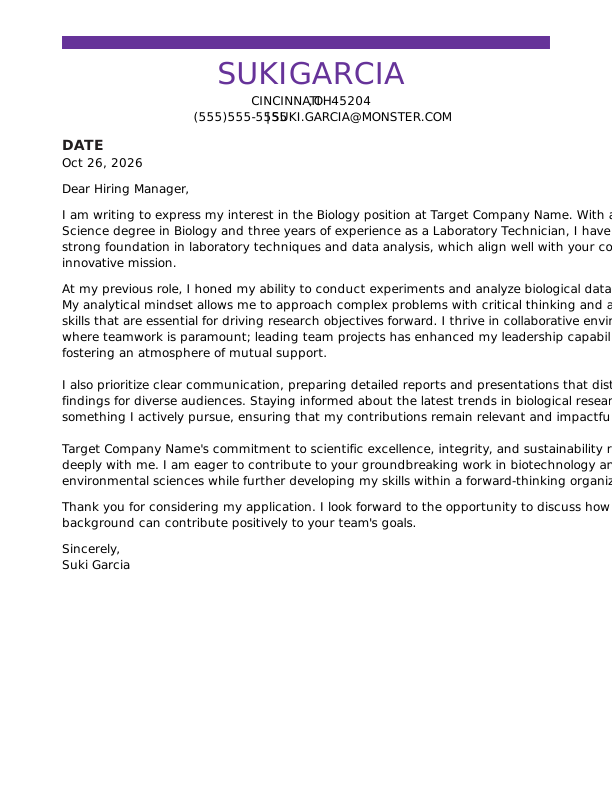
 Free
Biology Entry-Level Cover Letter
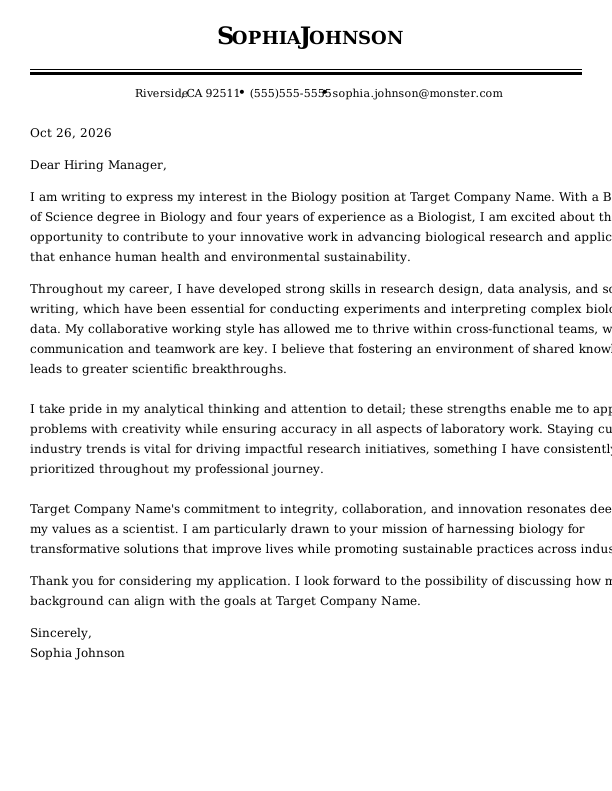
Biology Mid-Level Cover Letter
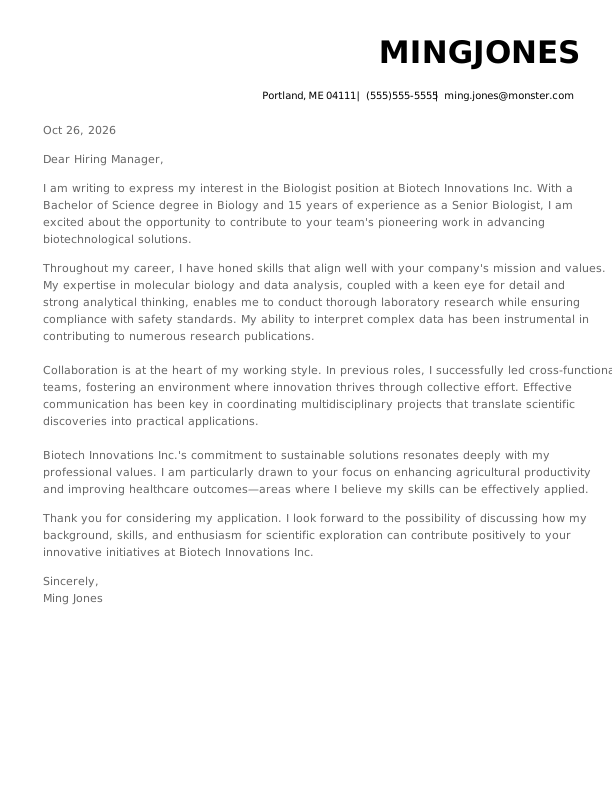
Biology Experienced Cover Letter
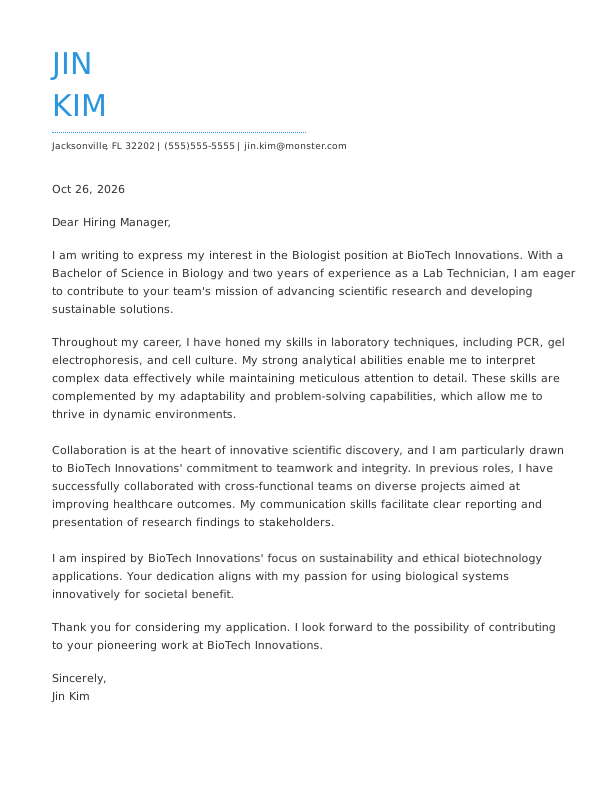
Biology Entry-Level Cover Letter
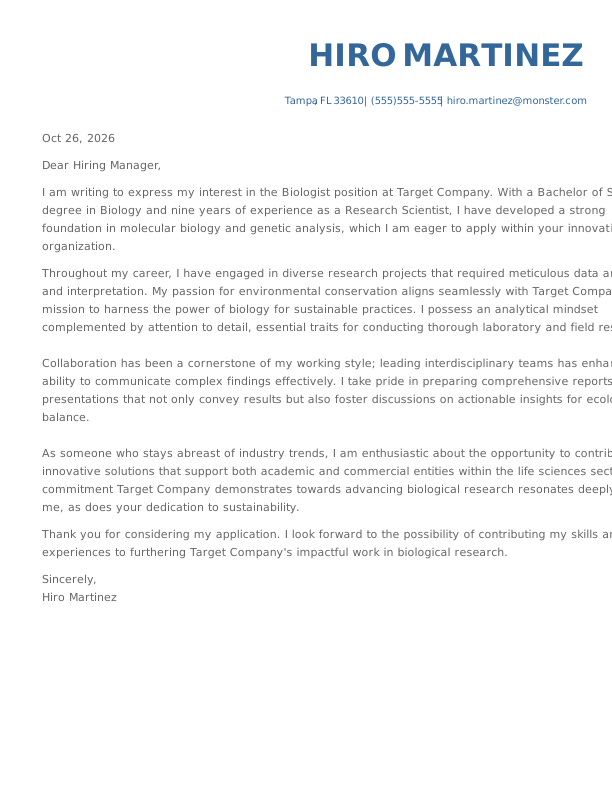
Biology Mid-Level Cover Letter
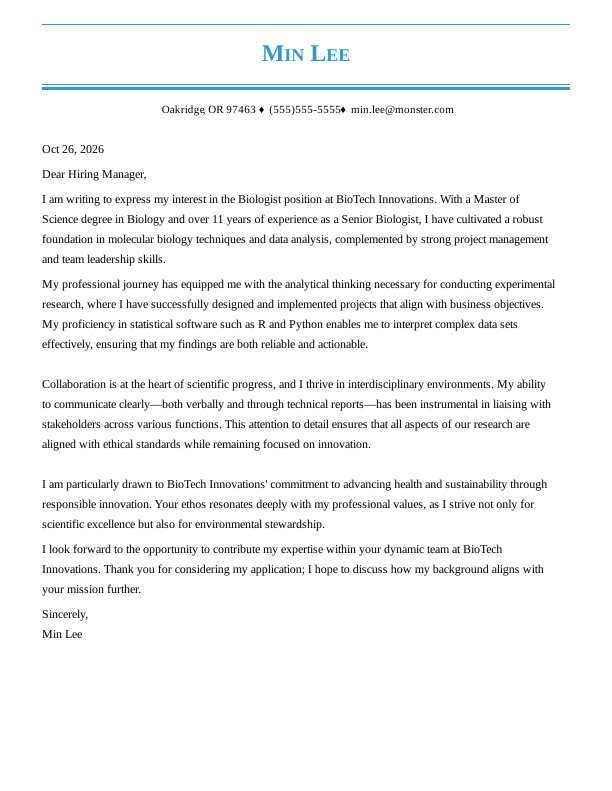
Biology Experienced Cover Letter
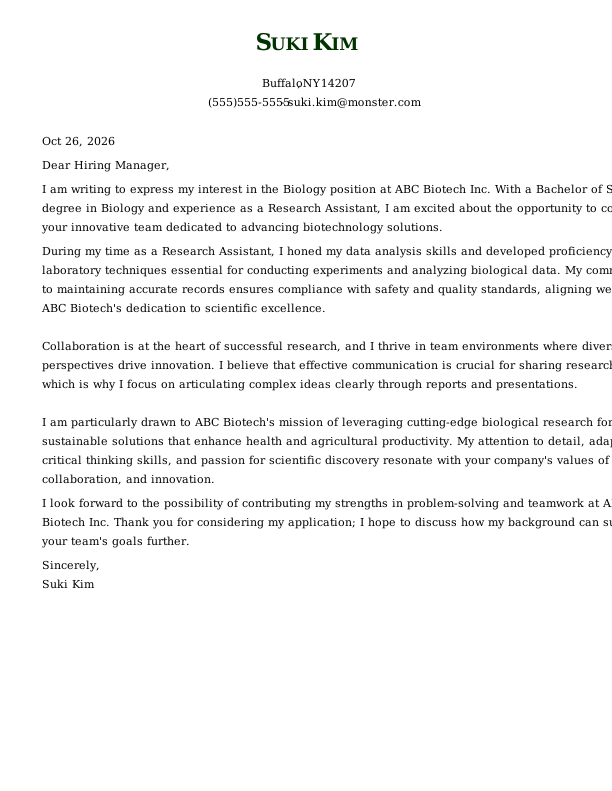
Biology Entry-Level Cover Letter
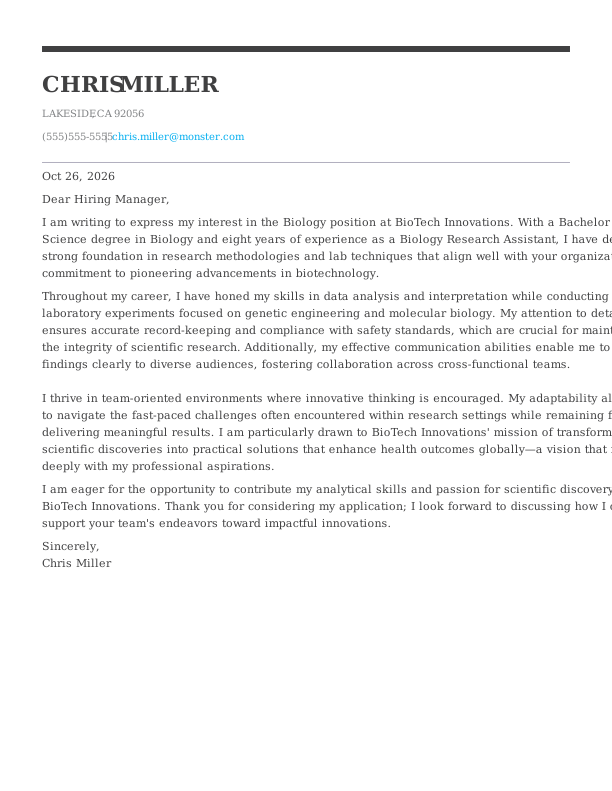
Biology Mid-Level Cover Letter
Browse Free Cover Letter Templates
- Academic
- Account Manager
- Accountant
- Accounts Payable
- Administrative Assistant
- Admissions Counselor
- Architecture
- Artist
- Assistant Principal
- Babysitter
- Barista
- Bartender
- Bookkeeper
- Brand Ambassador
- Business Analyst
- Business
- Caregiver
- Chef
- Civil Engineering
- Computer Science
- Construction
- Consulting
- Copywriter
- Cosmetology
- Custodian
- Customer Service
- Customer Service Representative
- Data Analyst
- Data Entry
- Dental Assistant
- Dental Hygienist
- Digital Marketing
- Electrical Engineering
- Emt
- Engineering
- Esthetician
- Event Coordinator
- Executive Assistant
- Fashion Designer
- Finance
- Financial Analyst
- Firefighter
- Flight Attendant
- Graphic Designer
- Hair Stylist
- Healthcare
- Hr Generalist
- Investment Banking
- It
- Janitor
- Journalism
- Lab Technician
- Law Clerk
- Lawyer
- Librarian
- Logistics
- Maintenance Worker
- Makeup Artist
- Manager
- Marketing Coordinator
- Marketing
- Marketing Manager
- Massage Therapist
- Mechanic
- Mechanical Engineer
- Medical Assistant
- Non Profit
- Nursing
- Occupational Therapy
- Office Assistant
- Office Manager
- Operations Manager
- Paralegal
- Personal Trainer
- Pharmacist
- Pharmacy Technician
- Photographer
- Physician Assistant
- Pilot
- Police Officer
- Program Manager
- Project Manager
- Property Manager
- Psychology
- Receptionist
- Research Assistant
- Restaurant Manager
- Retail
- Sales
- Sales Manager
- School Counselor
- Security
- Security Officer
- Social Work
- Software Engineer
- Special Education Teacher
- Starbucks
- Substitute Teacher
- Teacher
- Teaching Assistant
Cover Letter Examples for Biologists
Cover letter expectations evolve as your biology career progresses, from developing practical research skills to planning studies and guiding projects. Choose the template that matches your experience level to highlight relevant training, methods, and accomplishments from your laboratory, field, or analytical work.
Entry-Level Biology Cover Letter
Designed for applicants moving into biology roles, this example shows how to connect scientific education and early laboratory experience to research responsibilities.
Mid-Career Biology Cover Letter
For biology professionals with several years of experience, this example shows how to highlight your research skills, scientific communication, and contributions to collaborative projects.
Experienced Biology Cover Letter
Best suited for biologists with an extensive research background, this example shows how to present your specialist knowledge, project leadership, and contributions to scientific work.
Biology Cover Letter Template (Text)
Copy this biology cover letter template, paste it into your document, and swap in your research focus, lab techniques, and target institution.
Tao Wang
Portland, ME 04110
(555)555-5555
tao.wang@monster.com
Oct 26, 2026
Dear Hiring Manager,
I am writing to express my interest in the Biology position at BioCorp Inc., as advertised. With a Bachelor of Science degree in Biology and five years of experience as a Biological Technician, I am eager to contribute my skills and strengths to your innovative team.
BioCorp Inc.’s mission to pioneer breakthroughs in biological research aligns with my passion for scientific inquiry and commitment to sustainability. My background has equipped me with proficiency in laboratory techniques, data analysis, and effective communication. These skills have been honed through hands-on experience conducting research, analyzing results, and preparing technical reports within collaborative environments.
I excel at adapting quickly to evolving challenges while maintaining attention to detail—a critical asset when ensuring compliance with safety standards. My ability to critically assess data has consistently informed successful project outcomes.
Joining BioCorp Inc. represents an opportunity not only for professional growth but also for meaningful contribution towards advancing health sciences through biotechnology solutions. I look forward to bringing my collaborative spirit and problem-solving aptitude into the fold of your esteemed organization.
Thank you for considering my application. I am enthusiastic about the possibility of discussing how my skills can support BioCorp Inc.’s objectives further.
Sincerely,
Tao Wang
How to Write a Biology Cover Letter
To write a biology cover letter, turn your research experience into clear details about the questions you explored, methods you used, and findings you helped produce. Follow the steps below to connect that work to the position and explain your contribution.
1. Research & Prepare
Before writing, review the job posting and the employer’s research pages to learn about its projects and the work you’d support. Use those details to choose relevant examples from your background, whether the role involves laboratory experiments, ecological surveys, or biological data analysis.
As you prepare, look for these details:
- Note the methods, instruments, software, and sample types mentioned in the posting.
- Read project summaries or recent publications to understand the research focus.
- Identify examples from your coursework or employment that relate to the role’s responsibilities.
2. Hook the Reader
Begin with research experience that connects to the position. You could mention a study you supported, a method you’ve used, or a question you helped investigate. If you’re early in your career, draw on a dissertation, field course, or laboratory placement and make your role clear.
Consider an opening like one of these:
- Laboratory experience: “During my undergraduate research project, I prepared samples, ran PCR assays under supervision, and recorded results for a study of plant genetics.”
- Fieldwork: “I’ve supported monthly freshwater surveys across four sites, collecting samples and maintaining field records for the research team.”
- Data analysis: “As a laboratory technician, I’ve organized experimental datasets and prepared figures that help researchers compare findings across study groups.”
3. Tell Your Professional Story
Build on your opening with an example of how you investigated a question, improved a process, or helped complete a study. Explain what you did and how it supported the research, making your contribution clear if you worked with others. Include accurate figures when they clarify the scale or outcome without suggesting that only positive findings count as useful work.
Adapt examples like these using your own details and figures:
- “Processed 120 water samples over a six-week survey and maintained collection records so the team could compare results by site.”
- “Reduced missing sample information from 12 records per month to 3 by introducing a checklist for collection dates, locations, and storage details.”
- “Analyzed data from three treatment groups and prepared figures that helped the team identify which findings needed further investigation.”
4. Showcase Your Skills
Connect the posting’s requirements to examples of how you work. For a laboratory role, you might explain how you followed a protocol or investigated an unexpected result. For fieldwork or analysis, describe how you checked records, applied consistent methods, or communicated findings, keeping your level of independence clear.
These examples show how to describe scientific skills in practice:
- Laboratory methods: “When experimental controls produced unexpected results, I documented the issue and reviewed the procedure with my supervisor before repeating the assay.”
- Data analysis: “I used R to check missing values, summarize measurements, and create figures, documenting each step so another researcher could follow the analysis.”
- Scientific communication: “I prepared a short presentation explaining our methods, findings, and limitations for colleagues outside the project’s specialty.”
5. Explain Any Special Circumstances
If you’re changing research areas, returning after a break, or moving from study into employment, briefly explain the connection between your background and the role. Focus on relevant methods, completed learning, or availability without feeling you need to justify every change. Mention recent projects only when you’ve actually completed the work.
For situations that need context, you could write:
- “I’m moving from environmental monitoring into laboratory research, bringing experience with sample handling, accurate records, and biological data.”
- “After a career break, I completed an R course and used a public ecology dataset to refresh my analysis skills.”
- “I’m completing my research placement in December and will be available for a full-time position afterward.”
6. End With a Professional Goodbye
Thank the reader and express interest in discussing the role. For example: “Thank you for considering my application. I’d welcome the opportunity to discuss how my laboratory and data analysis experience could support your research.” Finish with “Sincerely” or “Best regards,” followed by your full name.
4 Tips for Formatting Your Cover Letter
Organize your biology cover letter so the reader can quickly find your research experience, relevant methods, and qualifications. Short paragraphs and consistent spacing make technical details easier to follow. Keep the layout readable and give each example enough context without crowding the page.

Use a Professional Font & Layout
Choose one readable font, such as Arial, Calibri, Georgia, or Verdana, at 10–12 points. Keep the layout simple, with clear paragraph breaks and minimal decoration. Check any scientific names, symbols, or subscripts after saving the document to make sure they display correctly.

Address the Hiring Manager Directly
Look for the contact named in the posting, such as a principal investigator, laboratory manager, or research supervisor. Use “Dear” followed by the person’s full name and verified title where appropriate. If no contact appears, “Dear Hiring Manager” or “Dear Selection Committee” works well.

Match Your Header to Your Resume
Use the same header, font, and contact details on your letter and resume or CV. Include your name, phone number, and professional email address. Add a relevant research profile link if it provides useful information about publications or projects.

Balance Spacing & Margins
Use margins between 0.75 and 1 inch, with single to 1.15 line spacing and a blank line between paragraphs. If the letter feels crowded, shorten less relevant descriptions rather than shrinking the font. Aim for a page the reader can scan comfortably on screen or in print.
Key Takeaways
- Match your research examples to the role’s methods, subject area, and responsibilities, making your own contribution clear.
- Explain how you collect, check, analyze, or communicate evidence, including limitations and unexpected findings when relevant.
- Use accurate details about sample numbers, study duration, or process improvements to give context without overstating what the results show.
More Cover Letter Examples
- Cashier
- Clinical Research Coordinator
- Customer Success Manager
- Medical
- Medical Receptionist
- Medical Scribe
- Patient Care Technician
- Phlebotomist
- Retail Customer Service
- Surgical Tech
Browse Monster’s Resume Templates
Monster also has hundreds of ATS-friendly resume templates for all career levels and industries. Create a matching resume to help you land the interview.
- Cardiac Sonographer
- Caregiver
- Caretaker
- Certified Medical Assistant
- Chiropractic Assistant
- Clinical Data Specialist
- Clinical Research Associate
- Dietitian
- Direct Support Professional
- Ekg Technician
- Health Information Technician
- Healthcare Administration
- Healthcare
- Healthcare Support
- Healthcare Technology
- Home Health Care
- Lab Technician
- Lactation Consultant
- Medical Administrative Assistant
- Medical Assistant
- Medical Billing
- Medical Coder
- Medical Courier
- Medical Interpreter
- Medical Office Manager
- Medical Office
- Medical Receptionist
- Medical
- Medical School
- Medical Science Liaison
- Medical Scribe
- Medical Secretary
- Medical Technologist
- Medical Transcriptionist
- Mri Technologist
- Ophthalmic Technician
- Optician
- Patient Access Representative
- Patient Care Coordinator
- Patient Care Technician
- Patient Service Representative
- Patient Transporter
- Phlebotomist
- Physical Therapist Assistant
- Private Caregiver
- Radiologic Technologist
- Sonographer
- Surgical Tech
- Unit Secretary
Frequently Asked Questions
Last Update:
Do I really need a cover letter?
A biology cover letter helps explain how your research experience relates to the position. You can describe your contribution to a study, discuss a method you’ve used, or explain your interest in the research area. This is especially useful when your degree or previous job title doesn’t fully describe the scientific work you’ve done.
How long should my cover letter be?
A biology cover letter will usually fit within one page and around 250–400 words. Focus on a relevant project or two, giving enough detail to explain your methods and contribution without reproducing a research report. Follow the application instructions first, since an academic or specialist research position may request a longer letter covering additional topics.
Should my cover letter match my resume?
Your biology cover letter should match your resume or CV in its basic formatting and factual details, including dates, qualifications, and project information. Use the letter to explain connections that a list of experience may leave unclear. For instance, describe how a field project developed the sampling and record-keeping skills you’d use in the advertised role.
What should I include in my cover letter header?
Include your full name, phone number, professional email address, and city and state in your biology cover letter header. A relevant research profile or publication link can help if it adds context to your application. Place the date and available recipient details below the header for a formal letter, and keep your contact information consistent across the application.
Should I mention salary expectations in my cover letter?
Include salary expectations in your biology cover letter only if the application instructions ask for them. When requested, provide a range informed by the position’s duties, location, and your experience, and clarify whether it refers to base salary. For a fixed-pay research appointment or fellowship, check the advertised terms before adding a separate salary request to your letter.

Toni Frana is a Certified Professional Resume Writer (CPRW), member of the Professional Association of Resume Writers & Career Coaches, and career expert who empowers job seekers to take control of their career paths using Monster’s comprehensive job search and resume tools.
See More From Toni FranaExplore Related Career Advice







How to Write a Cover Letter for Internal Positions or Promotions (Examples & Tips)

Updated:
Apr 23, 2026
|
19 min read


Cover Letter vs Resume: What’s the Difference & Do You Need Both?

Updated:
Apr 23, 2026
|
18 min read