


Free Patient Care Technician Cover Letter Templates & Examples
A strong patient care technician cover letter should show compassionate bedside support and a reliable focus on safety, vital sign monitoring, and clear communication with nurses and patients. Our free cover letter templates and step-by-step guidance help you highlight your strengths so hiring managers can quickly see the value you bring to every shift.
Real-World Cover Letters That Get Results
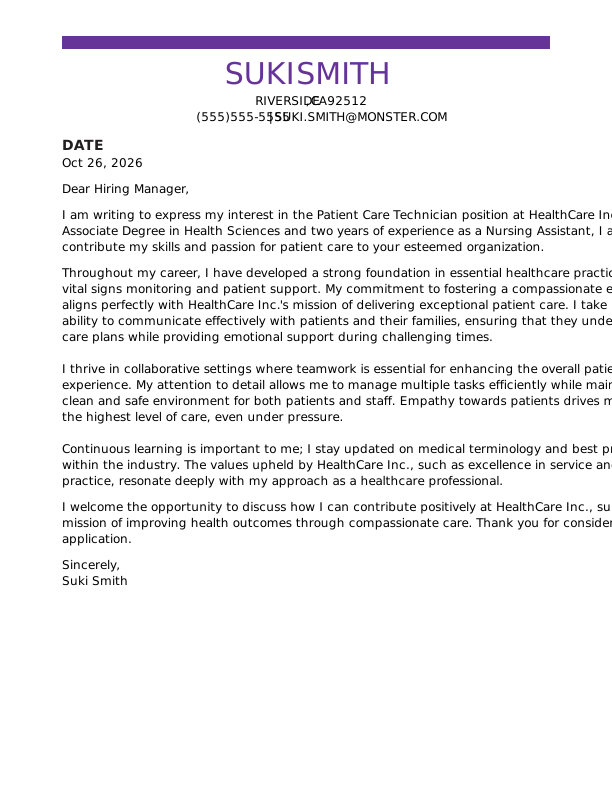
 Free
Patient Care Technician Entry-Level Cover Letter
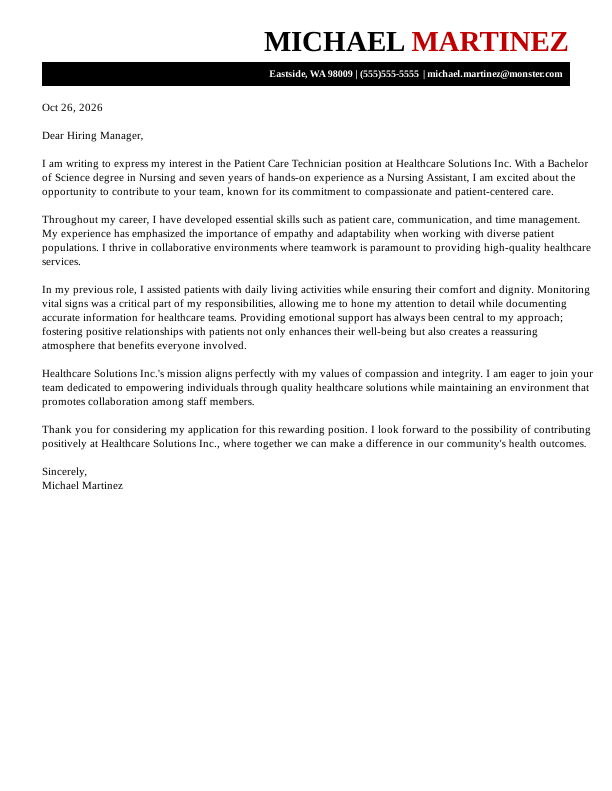
Patient Care Technician Mid-Level Cover Letter
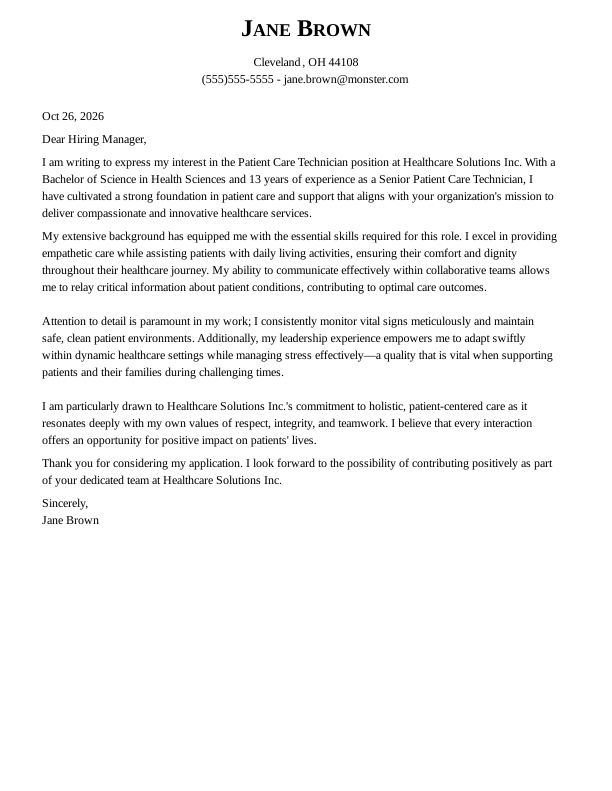
Patient Care Technician Experienced Cover Letter
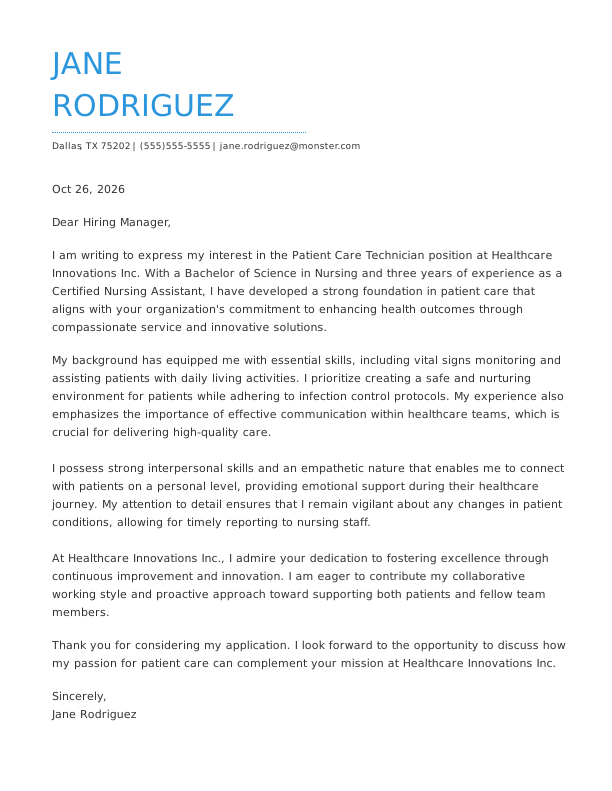
Patient Care Technician Entry-Level Cover Letter
Patient Care Technician Mid-Level Cover Letter
Patient Care Technician Experienced Cover Letter
Patient Care Technician Entry-Level Cover Letter
Patient Care Technician Mid-Level Cover Letter
Browse Free Cover Letter Templates
- Academic
- Account Manager
- Accountant
- Accounts Payable
- Administrative Assistant
- Admissions Counselor
- Architecture
- Artist
- Assistant Principal
- Babysitter
- Barista
- Bartender
- Bookkeeper
- Brand Ambassador
- Business Analyst
- Business
- Caregiver
- Chef
- Civil Engineering
- Computer Science
- Construction
- Consulting
- Copywriter
- Cosmetology
- Custodian
- Customer Service
- Customer Service Representative
- Data Analyst
- Data Entry
- Dental Assistant
- Dental Hygienist
- Digital Marketing
- Electrical Engineering
- Emt
- Engineering
- Esthetician
- Event Coordinator
- Executive Assistant
- Fashion Designer
- Finance
- Financial Analyst
- Firefighter
- Flight Attendant
- Graphic Designer
- Hair Stylist
- Healthcare
- Hr Generalist
- Investment Banking
- It
- Janitor
- Journalism
- Lab Technician
- Law Clerk
- Lawyer
- Librarian
- Logistics
- Maintenance Worker
- Makeup Artist
- Manager
- Marketing Coordinator
- Marketing
- Marketing Manager
- Massage Therapist
- Mechanic
- Mechanical Engineer
- Medical Assistant
- Non Profit
- Nursing
- Occupational Therapy
- Office Assistant
- Office Manager
- Operations Manager
- Paralegal
- Personal Trainer
- Pharmacist
- Pharmacy Technician
- Photographer
- Physician Assistant
- Pilot
- Police Officer
- Program Manager
- Project Manager
- Property Manager
- Psychology
- Receptionist
- Research Assistant
- Restaurant Manager
- Retail
- Sales
- Sales Manager
- School Counselor
- Security
- Security Officer
- Social Work
- Software Engineer
- Special Education Teacher
- Starbucks
- Substitute Teacher
- Teacher
- Teaching Assistant
Cover Letter Examples for Patient Care Technicians
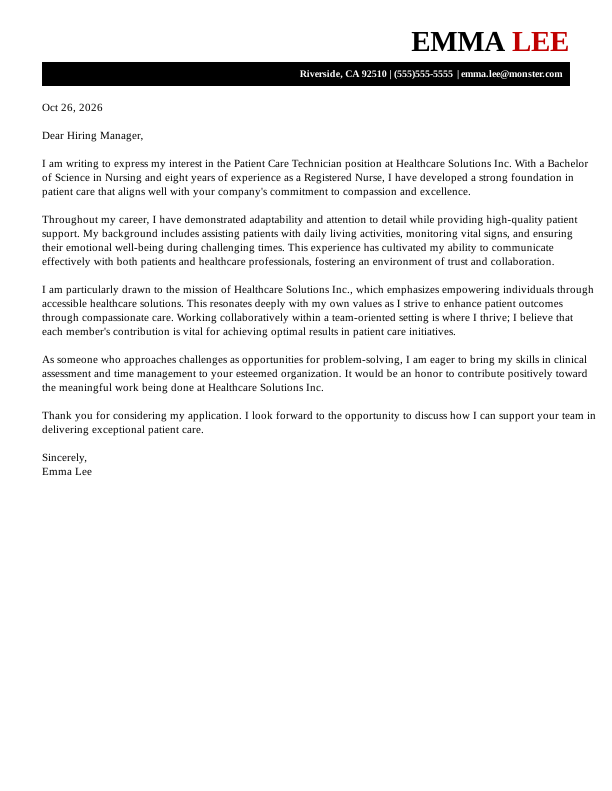
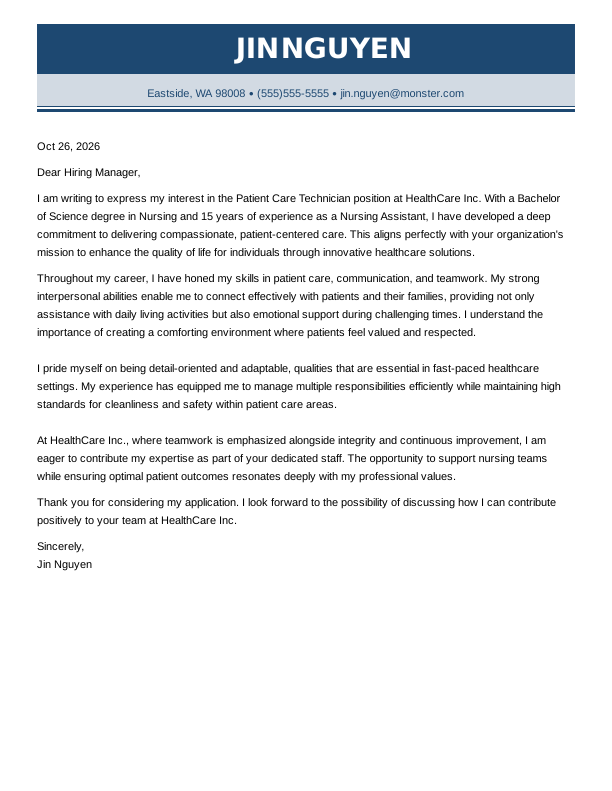
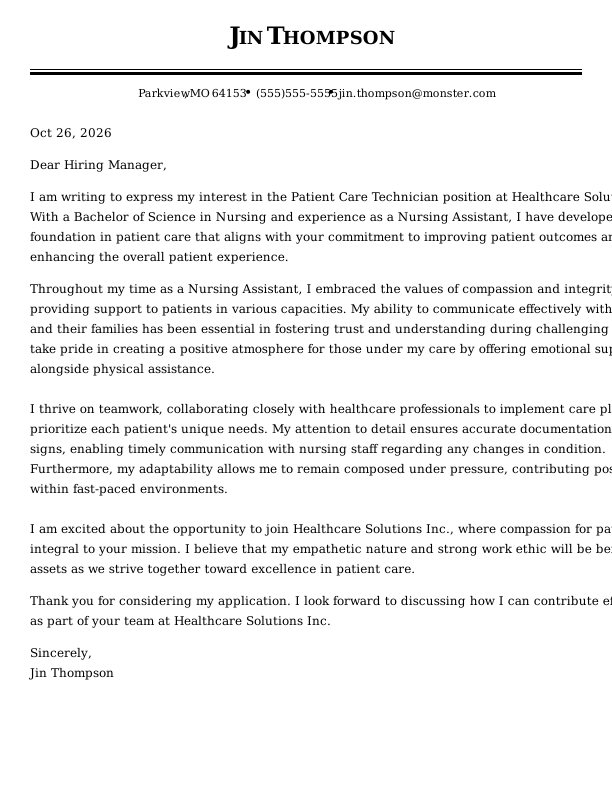
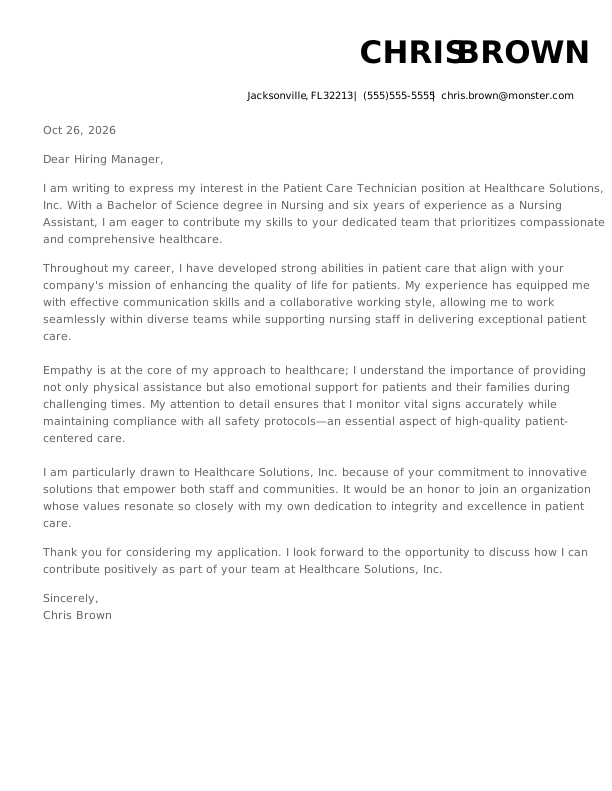
Cover letter expectations evolve as a patient care technician’s career progresses, especially as you move from basic bedside support to more complex patient needs. Choose the template that matches your experience level so you can highlight relevant training, certifications, and hands-on accomplishments.
Entry-Level Patient Care Technician Cover Letter
Designed for recent healthcare graduates and career changers, this template demonstrates how to present clinical training, basic life support knowledge, and foundational patient assistance skills with confidence when applying for initial healthcare roles.
Mid-Career Patient Care Technician Cover Letter
Tailored for technicians with several years of clinical experience, this template shows how to highlight vital signs tracking, daily living assistance, electronic health record documentation, and dependable collaboration with nursing staff.
Experienced Patient Care Technician Cover Letter
Ideal for senior patient care technicians and shift leads, this template emphasizes long-term patient care oversight, emergency response support, team coordination, patient safety protocols, and new staff mentorship.
Patient Care Technician Cover Letter Template (Text)
Paste this patient care technician cover letter template into your document, then customize it by swapping in your clinical skills, shift experience, and employer name.
Tao Liu
Pinehill, TX 75760
(555)555-5555
tao.liu@monster.com
Oct 26, 2026
Dear Hiring Manager,
I am writing to express my interest in the patient care technician position at Healthcare Innovations Inc. With a Bachelor of Science in Nursing and four years of experience as a certified nursing assistant, I am excited about the opportunity to contribute to your team, which is dedicated to transforming patient care through innovative solutions and compassionate service.
Throughout my career, I have developed a strong foundation in patient care, emphasizing empathy and adaptability. My experience has honed my ability to assist patients with daily living activities while ensuring their comfort and emotional well-being. I take pride in maintaining high standards of cleanliness and organization within patient care areas, aligning with Healthcare Innovations’ commitment to safety and quality.
Collaboration is at the heart of effective healthcare delivery, which aligns perfectly with my working style as a team-oriented professional. I believe that fostering positive relationships within the healthcare environment not only enhances patient outcomes but also supports colleagues in providing exceptional care. My strong communication skills enable me to work closely with nursing staff and effectively contribute to implementing comprehensive patient care plans.
I am particularly drawn to Healthcare Innovations Inc.’s mission of prioritizing patient well-being through cutting-edge technology combined with compassionate service. I am eager for the opportunity to bring my skills in problem-solving, time management, and basic life support (BLS) certification into your dynamic team.
Thank you for considering my application. I look forward to the possibility of discussing how I can contribute positively at Healthcare Innovations Inc.
Sincerely,
Tao Liu
How to Write a Patient Care Technician Cover Letter
Writing an effective patient care technician cover letter requires showing clinical managers that you understand bedside care, accurate vital sign tracking, and clear team communication. Follow these steps to tailor your experience directly to a specific unit’s needs.
1. Research & Prepare
Before writing, research the healthcare facility’s primary patient population, unit structure, and electronic health record system. Finding out whether the floor specializes in fast-paced surgical recovery, intensive telemetry monitoring, or longer rehabilitation stays allows you to highlight the exact clinical skills that matter most to the nurse manager.
Gather actionable context by exploring these key information sources:
- Review the job description to confirm required state certifications, shift commitments, and specialized equipment competencies.
- Check the hospital or clinic website to understand its unit specialties, safety initiatives, and patient care philosophies.
- Review public clinical quality measures or regional healthcare standards to align your language with current patient safety priorities.
2. Hook the Reader
Start your letter with an engaging opening sentence that demonstrates your ability to keep patients safe and comfortable during busy shifts. Avoid generic openers like “I am writing to apply for the open patient care technician position.” Instead, grab the hiring manager’s attention by leading with a concrete bedside accomplishment or safety win.
Choose an opening line tailored to your experience using these example approaches:
- Telemetry and alarm safety: “On a busy medical-surgical unit, I reviewed monitor alarms during each shift using standardized SBAR handoffs, helping reduce missed critical values from 6 to 1 per month.”
- Rapid clinical response: “I organized vital sign rounds every two hours for high-acuity patients, alerting the charge nurse within 60 seconds whenever blood pressure readings dropped below baseline.”
- Interdisciplinary care coordination: “Working alongside nursing and therapy teams on a dedicated stroke floor, I completed preparation tasks quickly to keep transfer timelines on schedule for 9 out of 10 patients.”
3. Tell Your Professional Story
Use the body of your letter to give the hiring team a clear picture of your day-to-day performance on the floor. While your resume lists past employers and credentials, your cover letter explains how you assist patients, support nursing staff, and prevent clinical oversights. Using specific numbers makes your accomplishments far more believable.
Incorporate concrete benchmarks like these to illustrate your impact:
- Completed 18 to 22 room turns per shift while maintaining full infection-control compliance across more than 30 daily admissions.
- Reduced average call-light response times from 12 minutes to 6 minutes by coordinating patient transport and requests directly with floor nurses.
- Assisted with vital signs and EKG setup for 20 patients daily, cutting charting time by 25% through consistent, timely documentation.
4. Showcase Your Skills
Rather than using broad self-descriptors like “caring” or “hardworking,” illustrate how your skills resolve real clinical challenges. Showing the exact moments where your monitoring, patient communication, or equipment handling protected a patient builds trust with the employer.
Connect your practical abilities directly to daily bedside needs using these examples:
- Vital signs monitoring: “I checked blood pressure and oxygen levels during shift changes, immediately notifying the primary nurse when readings trended below normal limits.”
- Patient communication: “I sat at eye level to explain upcoming tests clearly, staying with anxious patients until they felt comfortable with each step of their care plan.”
- Medical equipment maintenance: “I inspected and sanitized vital sign monitors and blood glucose meters between every patient room to prevent cross-contamination and ensure accurate readings.”
5. Explain Any Special Circumstances
If you have an employment gap, are transitioning into healthcare, or recently relocated, address it briefly in one or two direct sentences. Focus your explanation on your active certifications, current clinical coursework, and readiness to take on floor shifts so the hiring manager knows your skills are fresh.
Frame your circumstances clearly using these straightforward approaches:
- Addressing an employment gap: “During a six-month career break, I kept my clinical skills current by completing a basic life support renewal and volunteering regularly at a community clinic.”
- Transitioning positions: “I am transitioning from retail into healthcare, pairing my customer de-escalation and communication skills with supervised clinical hours and hands-on EKG training.”
- Handling relocation: “After relocating to the area last fall, I transferred my state registry credentials and am fully available for immediate day, night, or weekend shifts.”
6. End With a Professional Goodbye
Conclude your letter with a polite, confident statement that invites the hiring manager to contact you for an interview. Keep your closing concise, thank the reader for their time, and express enthusiasm for discussing your clinical experience in detail.
Structure your final paragraph using this clear approach:
- Offer a clear next step: “I would welcome the opportunity to discuss how my bedside skills, vitals monitoring, and focus on safety can support your unit’s patient care goals.”
- Express gratitude: “Thank you for your time and consideration.”
- End with a clean sign-off: “Best regards,” followed by your full name.
4 Tips for Formatting Your Cover Letter
When you apply for a patient care technician position, nurse managers often scan your application quickly between shift handoffs, patient rounds, and clinical emergencies. They look rapidly for your credentials, bedside experience, and availability. A clean visual presentation with consistent spacing and logical organization makes your qualifications easy to spot and proves that you take pride in clear, reliable clinical documentation.

Keep It to One Page
Keep your cover letter to a single page, ideally between 250 and 400 words spread across three to four short paragraphs. Concise writing ensures that busy clinical supervisors can evaluate your nursing assistant credentials, patient safety track record, and call-light response outcomes quickly without wading through unnecessary text.

Use a Professional Font & Layout
Select standard, highly legible fonts such as Arial, Calibri, Helvetica, or Georgia in 10–12 pt size. Maintain clean 1-inch margins and use the exact same header design as your resume so your entire application package presents a unified, professional appearance.

Address the Hiring Manager Directly
Check the job posting, facility staff directory, or professional networking profiles to identify the specific nurse manager, clinical supervisor, or healthcare recruiter. If you cannot find an individual name, address your letter to “Dear Hiring Manager” or “Dear Nursing Selection Committee,” and avoid outdated phrases like “To Whom It May Concern.”

Balance Spacing & Margins
Set line spacing between 1.0 and 1.15, leaving a full blank line between paragraphs to keep the layout clean and readable. Use uniform margins between 0.75 and 1 inch so your letter looks well-proportioned on screens and printed copies.
Key Takeaways
- Prioritize patient safety and responsiveness by sharing a specific situation where you noticed an abnormal vital sign and alerted the nursing team immediately.
- Include concrete performance metrics like call-light response times, room turnover rates, or charting efficiency gains to prove your impact on shift workflow.
- Tailor your letter to the healthcare setting by focusing on rapid intake for emergency floors, routine comfort care for long-term facilities, or schedule throughput for outpatient clinics.
More Cover Letter Examples
- Biology
- Certified Nursing Assistant
- Clinical Research Coordinator
- Labor And Delivery Nurse
- LVN
- Medical
- Medical Receptionist
- Medical Scribe
- Nurse Educator
- Nurse Practitioner
- Nursing Student
- Pediatric Nurse
- Phlebotomist
- Registered Nurse
- Surgical Tech
Browse Monster’s Resume Templates
Monster also has hundreds of ATS-friendly resume templates for all career levels and industries. Create a matching resume to help you land the interview.
- Cardiac Sonographer
- Caregiver
- Caretaker
- Certified Medical Assistant
- Chiropractic Assistant
- Clinical Data Specialist
- Clinical Research Associate
- Dietitian
- Direct Support Professional
- Ekg Technician
- Health Information Technician
- Healthcare Administration
- Healthcare
- Healthcare Support
- Healthcare Technology
- Home Health Care
- Lab Technician
- Lactation Consultant
- Medical Administrative Assistant
- Medical Assistant
- Medical Billing
- Medical Coder
- Medical Courier
- Medical Interpreter
- Medical Office Manager
- Medical Office
- Medical Receptionist
- Medical
- Medical School
- Medical Science Liaison
- Medical Scribe
- Medical Secretary
- Medical Technologist
- Medical Transcriptionist
- Mri Technologist
- Ophthalmic Technician
- Optician
- Patient Access Representative
- Patient Care Coordinator
- Patient Care Technician
- Patient Service Representative
- Patient Transporter
- Phlebotomist
- Physical Therapist Assistant
- Private Caregiver
- Radiologic Technologist
- Sonographer
- Surgical Tech
- Unit Secretary
Frequently Asked Questions
Last Update:
Do I really need a cover letter?
Submitting a cover letter with your patient care technician application is strongly recommended, even when the job posting lists it as optional. A resume outlines certifications and clinical hours, but a cover letter explains how you interact with patients, support nurses during emergencies, and maintain floor safety. It also provides space to explain career transitions, clinical rotations, or employment gaps.
How long should my cover letter be?
A patient care technician cover letter should stay within one page, targeting between 250 and 400 words. Nurse managers review applications quickly between patient care duties, so direct, concise writing works best. Divide your text into three or four short paragraphs that focus strictly on your hands-on care skills, vital sign monitoring, and shift reliability without adding unnecessary filler.
Should my cover letter match my resume?
Your patient care technician cover letter should match your resume’s visual formatting to present a polished, cohesive application package. Use the same font styles, margin sizes, color choices, and contact header across both documents. Instead of repeating your resume bullet points, use your cover letter to expand on a specific patient care win or explain why you want to join this particular hospital unit.
Should I mention salary expectations in my cover letter?
You should only mention salary expectations in a patient care technician cover letter if the job posting explicitly requests them. If required, state a flexible pay range based on local healthcare market research for your certification level and shift availability. Mention briefly that you are open to discussing total compensation, including healthcare benefits and shift differentials, during the interview process.
How do I write a cover letter for an internal position?
To write an internal patient care technician cover letter, highlight your existing knowledge of the hospital’s electronic charting system, patient admission routines, and unit isolation protocols. Mention how you successfully reduced call-light wait times, assisted during critical patient transfers, or supported fellow techs in your current role. Express your readiness to take on new unit responsibilities while completing all required internal transfer steps.

Kirsten Chorpenning is a career advice writer who empowers job seekers to take control of their career paths using Monster’s comprehensive job search and resume tools. She specializes in helping job seekers find rewarding jobs in today’s dynamic work environment.
See More From Kirsten ChorpenningExplore Related Career Advice







How to Write a Cover Letter for Internal Positions or Promotions (Examples & Tips)
Updated:
Apr 23, 2026
|
19 min read


Cover Letter vs Resume: What’s the Difference & Do You Need Both?

Updated:
Apr 23, 2026
|
18 min read