


Free Surgical Tech Cover Letter Templates & Examples
A strong surgical tech cover letter shows your commitment to operating room preparation, sterile procedures, and patient safety. Use our tailored examples and clear guides to highlight your clinical background and land your next role.
Real-World Cover Letters That Get Results
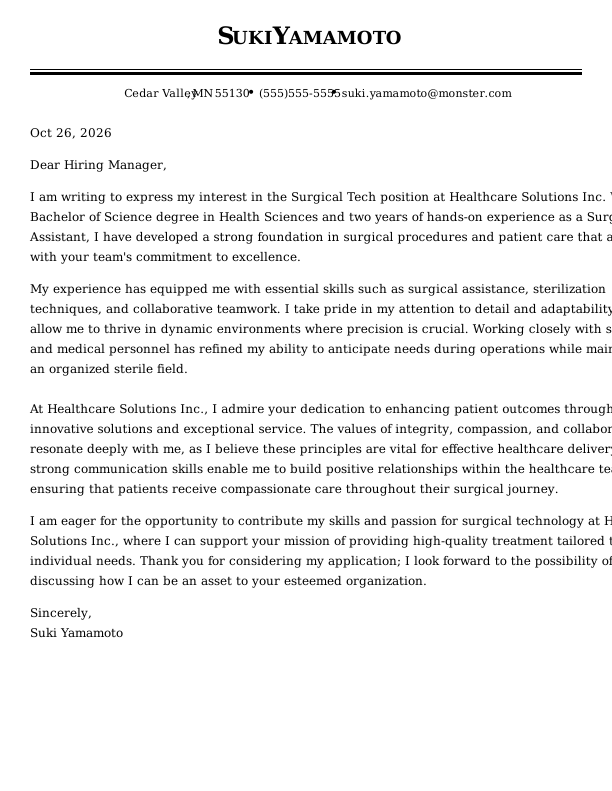
 Free
Surgical Tech Entry-Level Cover Letter
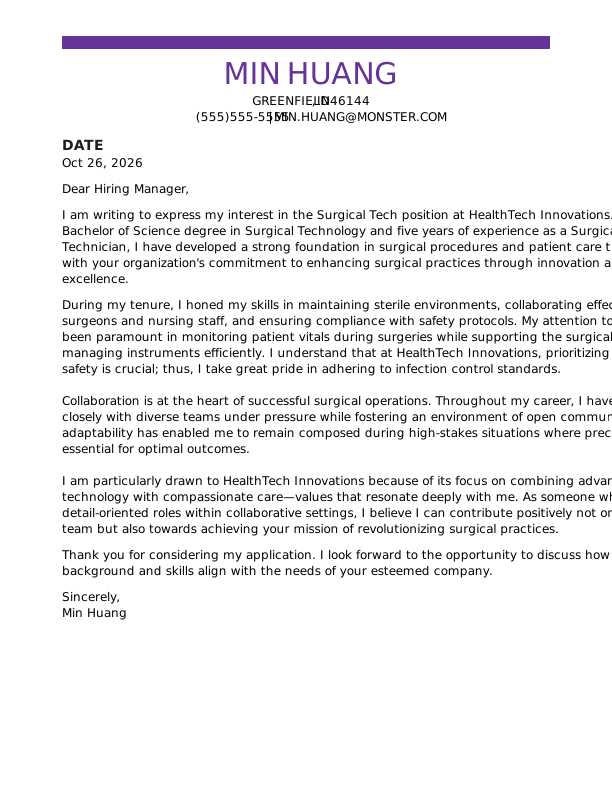
Surgical Tech Mid-Level Cover Letter
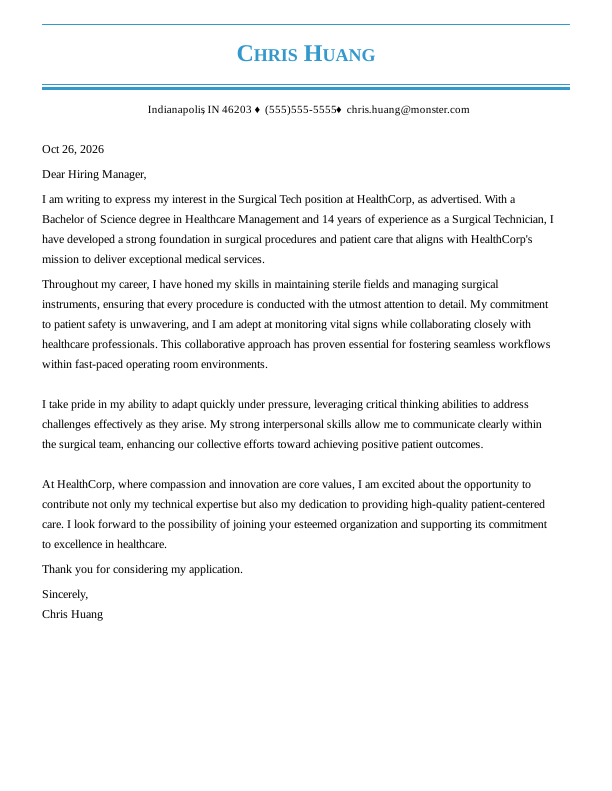
Surgical Tech Experienced Cover Letter
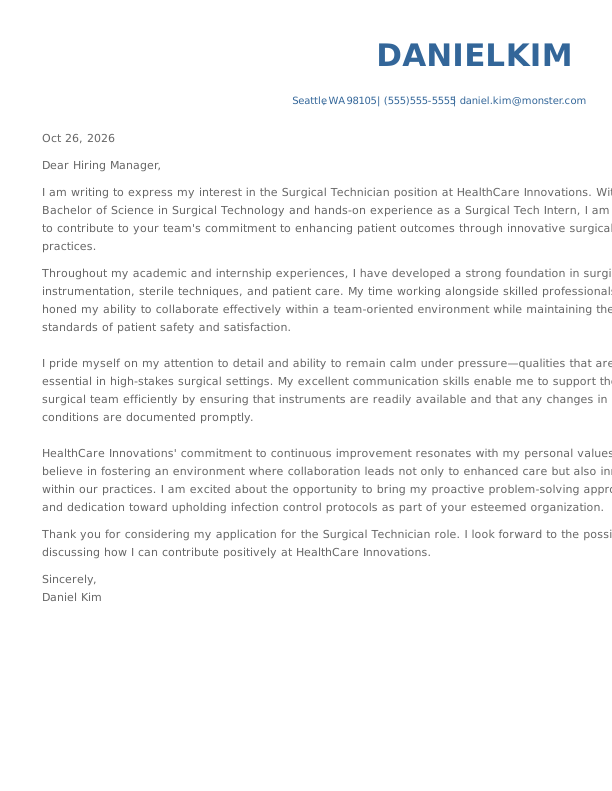
Surgical Tech Entry-Level Cover Letter
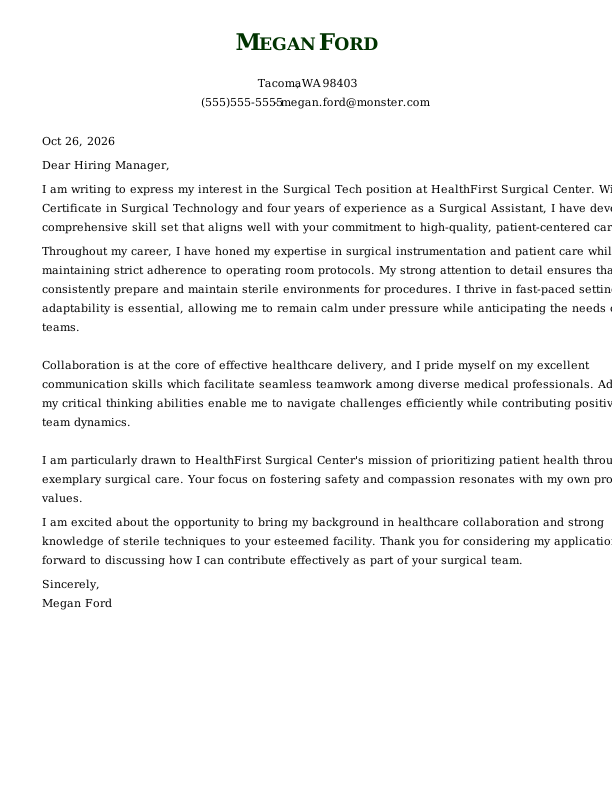
Surgical Tech Mid-Level Cover Letter
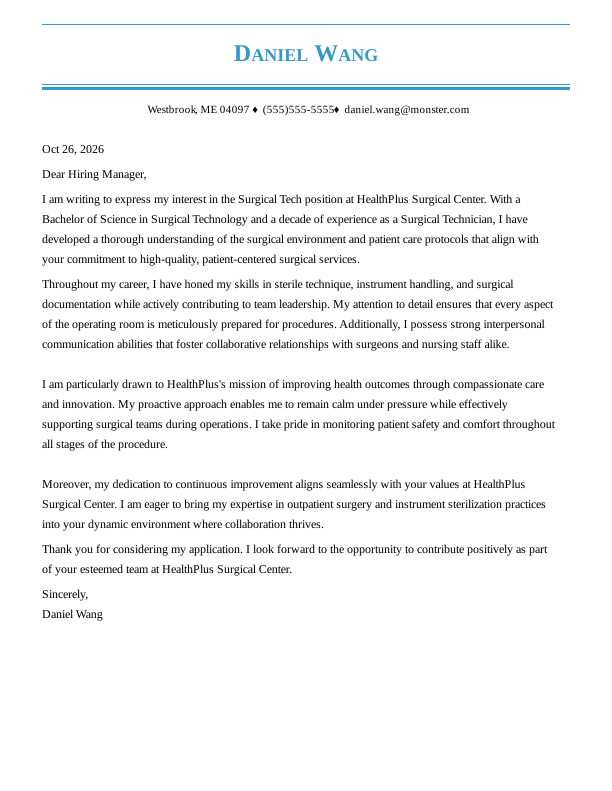
Surgical Tech Experienced Cover Letter
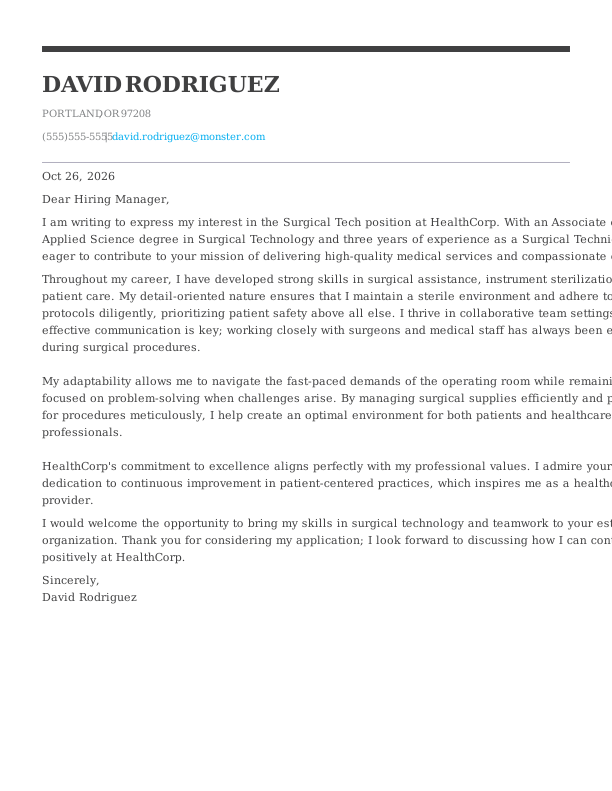
Surgical Tech Entry-Level Cover Letter
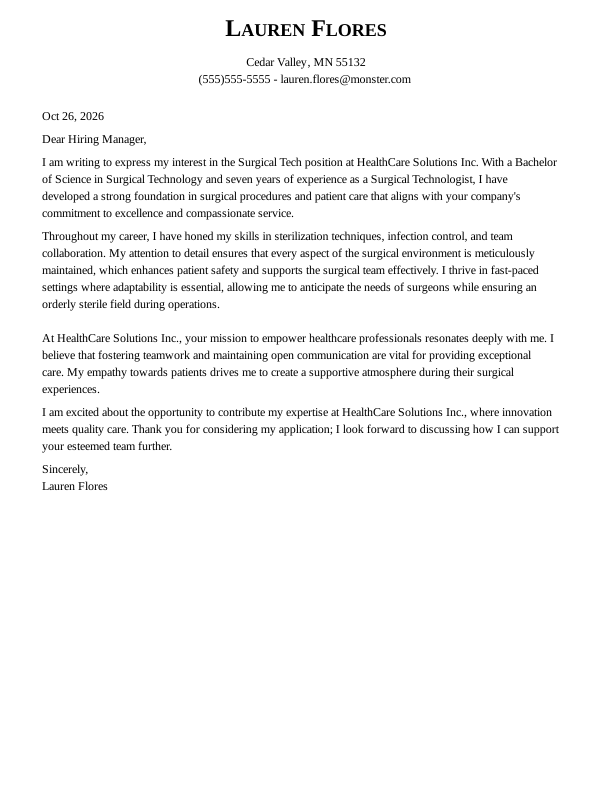
Surgical Tech Mid-Level Cover Letter
Browse Free Cover Letter Templates
- Academic
- Account Manager
- Accountant
- Accounts Payable
- Administrative Assistant
- Admissions Counselor
- Architecture
- Artist
- Assistant Principal
- Babysitter
- Barista
- Bartender
- Bookkeeper
- Brand Ambassador
- Business Analyst
- Business
- Caregiver
- Chef
- Civil Engineering
- Computer Science
- Construction
- Consulting
- Copywriter
- Cosmetology
- Custodian
- Customer Service
- Customer Service Representative
- Data Analyst
- Data Entry
- Dental Assistant
- Dental Hygienist
- Digital Marketing
- Electrical Engineering
- Emt
- Engineering
- Esthetician
- Event Coordinator
- Executive Assistant
- Fashion Designer
- Finance
- Financial Analyst
- Firefighter
- Flight Attendant
- Graphic Designer
- Hair Stylist
- Healthcare
- Hr Generalist
- Investment Banking
- It
- Janitor
- Journalism
- Lab Technician
- Law Clerk
- Lawyer
- Librarian
- Logistics
- Maintenance Worker
- Makeup Artist
- Manager
- Marketing Coordinator
- Marketing
- Marketing Manager
- Massage Therapist
- Mechanic
- Mechanical Engineer
- Medical Assistant
- Non Profit
- Nursing
- Occupational Therapy
- Office Assistant
- Office Manager
- Operations Manager
- Paralegal
- Personal Trainer
- Pharmacist
- Pharmacy Technician
- Photographer
- Physician Assistant
- Pilot
- Police Officer
- Program Manager
- Project Manager
- Property Manager
- Psychology
- Receptionist
- Research Assistant
- Restaurant Manager
- Retail
- Sales
- Sales Manager
- School Counselor
- Security
- Security Officer
- Social Work
- Software Engineer
- Special Education Teacher
- Starbucks
- Substitute Teacher
- Teacher
- Teaching Assistant
Cover Letter Examples for Surgical Techs
Cover letter expectations change as a surgical tech’s career progresses from learning core procedures to supporting more complex cases. Choose the template that matches your experience level to spotlight relevant training, specialties, and responsibilities you have handled.
Entry-Level Surgical Tech Cover Letter
Ideal for recent graduates and career starters, this template helps you outline your educational background, core technical training, and enthusiasm for supporting surgical teams effectively.
Mid-Career Surgical Tech Cover Letter
Designed for professionals with a few years of experience, this option focuses on your growing mastery of surgical procedures, adaptability in fast-paced environments, and dependable team collaboration.
Experienced Surgical Tech Cover Letter
Suited for seasoned surgical technologists, this template lets you highlight advanced clinical skills, leadership in operating room workflows, and commitment to maintaining exemplary safety standards.
Surgical Tech Cover Letter Template (Text)
Copy this surgical tech cover letter template, paste it into your document, and swap in your certifications and recent OR experience for the job you want.
Emily Miller
Los Angeles, CA 90018
(555)555-5555
emily.miller@monster.com
Oct 26, 2026
Dear Hiring Manager,
I am writing to express my interest in the Surgical Tech position at Surgical Innovations Inc. With a Bachelor of Science in Surgical Technology and six years of experience as a Surgical Technologist, I am eager to contribute to your mission of enhancing patient outcomes through innovative surgical solutions.
Throughout my career, I have developed a strong foundation in surgical instrumentation and patient care. My detail-oriented approach ensures that I consistently maintain a sterile environment and prepare all necessary instruments for procedures. My commitment to patient safety is unwavering, as I understand the critical role that precision plays in successful surgeries.
In addition to my technical skills, I pride myself on possessing strong interpersonal communication abilities that facilitate effective teamwork within high-pressure settings. My adaptability allows me to respond swiftly to the dynamic nature of surgical operations while ensuring compliance with health regulations and protocols.
At Surgical Innovations Inc., where innovation and integrity are prioritized, I believe my background aligns well with your values. I am particularly drawn to your commitment to empowering healthcare professionals with advanced tools that enhance surgical procedures.
I look forward to the opportunity to discuss how my experience and dedication can support your team in delivering exceptional care at Surgical Innovations Inc. Thank you for considering my application.
Sincerely,
Emily Miller
How to Write a Surgical Tech Cover Letter
Writing a strong surgical tech cover letter means turning your hands-on operating room experience into a clear narrative. Follow these simple steps to organize your background, highlight your skills, and craft a tailored letter that gets noticed.
1. Research & Prepare
Before drafting your letter, review the surgical specialties and perioperative tools the facility uses daily. Learn about their documentation systems, compliance metrics, and surgical priorities so you can speak directly to their actual workflow and needs.
Start your research process by focusing on these key details:
- Review the hospital’s surgical services page and note which specialties or programs they highlight as priorities.
- Search the FDA MAUDE database for recent recalls tied to surgical instruments used in that specialty.
- Check the facility’s recent surgical volume reports to understand their most frequent procedures.
2. Hook the Reader
Skip generic opening lines and lead with a strong example of your sterile workflow or instrument readiness. Showing how you maintain focus during busy cases immediately proves you can handle the demands of the operating room.
Use these examples to open your letter with impact:
- Sterile workflow improvement: “During a unit initiative to reduce OR delays, I reorganized sterile supply staging around the core tray so we cut case start time by 9 minutes without compromising counts.”
- Case-specific technical choice: “On total joint days, I supported the surgeon’s workflow by prepping implant trays with dual-syringe irrigation and verifying lot numbers while circulating tracked specimen labels in real time.”
- Equipment readiness check: “Before complex cases, I perform functional tests on specialty instrumentation and power tools to avoid intraoperative delays.”
3. Tell Your Professional Story
Use your cover letter to explain career accomplishments, such as how you handle live procedures. Detail specific numbers and metric benchmarks to show managers your case volume, setup accuracy, and timing under pressure.
Highlight your achievements using clear metrics like these:
- Reduced room turnover time by 12 minutes by streamlining instrument counts and positioning before incision-ready status.
- Assisted in an average of 6 procedures per shift while supporting safe counts with zero retained-item discrepancies over 90 days.
- Maintained 100% accuracy on sterile field setup across 150+ complex orthopedic and general surgery cases.
4. Showcase Your Skills
Instead of listing vague traits, connect required job duties directly to real moments in the operating room. Show how you maintain sterility, verify counts, and support the surgical team during critical steps in a procedure.
Demonstrate your practical expertise with these examples:
- Surgical instrument handling: “I counted instruments and verified counts with my partner during turnover, then reconciled discrepancies by re-checking trays without breaking workflow.”
- Team communication: “I anticipated the surgeon’s next step and handed off supplies early while confirming allergies and procedure details with the circulating nurse.”
- Aseptic technique maintenance: “I monitored the sterile field constantly, rapidly correcting potential contamination breaches before surgical prep began.”
5. Explain Any Special Circumstances
Briefly explain any employment gaps, career pivots, or recent moves in one or two direct sentences. Focus on active certifications, simulation practice, or clinical rotations to show you remain ready for hands-on OR work.
Address your situation clearly using these straightforward approaches:
- “I am pivoting from ER patient care into surgical technology by completing an accredited Surgical Technology program and logging supervised scrub rotations in general surgery and orthopedics.”
- “I relocated to Austin last October, so I transferred my certification documentation and have been working under current facility policies while using the hospital’s OR scheduling system.”
- “I maintained active CST credentials during a brief career pause by participating in advanced sterile processing workshops and continuing education modules.”
6. End With a Professional Goodbye
Wrap up your letter with a brief, professional call to action and a clear thank-you. Keep your closing to two or three short sentences so busy hiring managers can review it quickly and follow up. Reiterate your enthusiasm for joining the team, and share your primary contact details and availability for an upcoming interview.
4 Tips for Formatting Your Cover Letter
Hiring managers scan surgical tech cover letters in under a minute. Clear presentation, organized sections, and high scannability help your CST credential, sterile workflow experience, and scrub background stand out immediately, creating a polished, professional impression during a fast review.

Keep It to One Page
Keep your cover letter between 250 and 400 words across three to four concise paragraphs. Surgical services managers review applications quickly, so highlight your CST credential, operating room background, and a key achievement right away without extra filler.

Address the Hiring Manager Directly
Find the surgical services supervisor or OR manager using the job listing, facility directory, or professional networking sites. If no contact is listed, address your letter to “Dear Hiring Manager” instead of using outdated greetings like “To Whom It May Concern.”

Match Your Header to Your Resume
Use identical fonts, contact information, and credential titles across your cover letter and resume header. Matching branding creates a seamless look, so hiring teams can focus on your surgical skills instead of searching for matching applicant records.

Save & Send as a PDF
Export your cover letter as a PDF to preserve text formatting across different screens and applicant tracking systems. Use a clean, clear file naming structure such as Firstname_Lastname_Cover_Letter.pdf before sending your application to the recruiter.
Top-Paying States for Surgical Tech Roles
Knowing what surgical techs earn across the country helps you compare job offers and plan your next move. Salary ranges vary by location, experience, and whether you work in a hospital OR versus outpatient surgery centers. The U.S. Bureau of Labor Statistics (BLS) provides nationwide salary data for surgical technologists, which can be a useful starting point when budgeting for your career.
Keep in mind that specialty areas, scheduling like nights or weekends, and additional certifications may affect what you actually take home.
| Alabama | $49,440 |
| Alaska | $75,930 |
| Arizona | $69,300 |
| Arkansas | $55,840 |
| California | $83,240 |
| Connecticut | $77,760 |
| Delaware | $61,160 |
| District of Columbia | $69,950 |
| Florida | $59,840 |
| Georgia | $61,610 |
| Hawaii | $71,350 |
| Idaho | $63,630 |
| Illinois | $70,320 |
| Indiana | $62,610 |
| Iowa | $54,950 |
| Kansas | $57,120 |
| Kentucky | $53,280 |
| Louisiana | $53,990 |
| Maine | $63,120 |
| Maryland | $67,190 |
| Massachusetts | $77,630 |
| Michigan | $61,710 |
| Minnesota | $77,190 |
| Mississippi | $50,560 |
| Missouri | $63,250 |
| Montana | $59,240 |
| Nebraska | $63,040 |
| Nevada | $74,330 |
| New Hampshire | $67,430 |
| New Jersey | $71,270 |
| New Mexico | $56,720 |
| New York | $75,950 |
| North Carolina | $58,670 |
| North Dakota | $58,600 |
| Ohio | $61,600 |
| Oklahoma | $57,050 |
| Oregon | $78,460 |
| Pennsylvania | $64,840 |
| Rhode Island | $67,360 |
| South Carolina | $56,900 |
| South Dakota | $53,430 |
| Tennessee | $58,170 |
| Texas | $62,940 |
| Utah | $66,370 |
| Vermont | $63,860 |
| Virginia | $67,890 |
| Washington | $74,880 |
| West Virginia | $49,560 |
| Wisconsin | $67,710 |
| Wyoming | $57,890 |
| Puerto Rico | $28,330 |
Key Takeaways
- Demonstrate your commitment to sterile technique by describing a specific time you prevented contamination in the operating room.
- Highlight measurable results such as accurate instrument counts, on-time case starts, and fast turnover times.
- Tailor your cover letter to the setting, whether that is a fast-paced hospital, an outpatient center, or a specialized surgical team.
More Cover Letter Examples
- Biology
- Certified Nursing Assistant
- Clinical Research Coordinator
- Labor And Delivery Nurse
- LVN
- Medical
- Medical Receptionist
- Medical Scribe
- Nurse Educator
- Nurse Practitioner
- Nursing Student
- Patient Care Technician
- Pediatric Nurse
- Phlebotomist
- Registered Nurse
Browse Monster’s Resume Templates
Monster also has hundreds of ATS-friendly resume templates for all career levels and industries. Create a matching resume to help you land the interview.
- Cardiac Sonographer
- Caregiver
- Caretaker
- Certified Medical Assistant
- Chiropractic Assistant
- Clinical Data Specialist
- Clinical Research Associate
- Dietitian
- Direct Support Professional
- Ekg Technician
- Health Information Technician
- Healthcare Administration
- Healthcare
- Healthcare Support
- Healthcare Technology
- Home Health Care
- Lab Technician
- Lactation Consultant
- Medical Administrative Assistant
- Medical Assistant
- Medical Billing
- Medical Coder
- Medical Courier
- Medical Interpreter
- Medical Office Manager
- Medical Office
- Medical Receptionist
- Medical
- Medical School
- Medical Science Liaison
- Medical Scribe
- Medical Secretary
- Medical Technologist
- Medical Transcriptionist
- Mri Technologist
- Ophthalmic Technician
- Optician
- Patient Access Representative
- Patient Care Coordinator
- Patient Care Technician
- Patient Service Representative
- Patient Transporter
- Phlebotomist
- Physical Therapist Assistant
- Private Caregiver
- Radiologic Technologist
- Sonographer
- Surgical Tech
- Unit Secretary
Frequently Asked Questions
Last Update:
Do I really need a cover letter?
You really should include a cover letter when applying for a surgical tech position, even if the posting says it is optional. While your resume lists your credentials and work history, a cover letter lets you explain the clinical context behind your experience. It gives you space to highlight your commitment to patient care and show genuine enthusiasm for joining the surgical team.
How long should my cover letter be?
Keep your surgical tech cover letter to a single page, ideally 250-400 words. Surgical unit managers and recruiters review many applications, so keeping it brief helps you make a quick impact. Structure your content into three or four short paragraphs that focus on your strongest clinical skills, key certifications, and relevant accomplishments.
Should my cover letter match my resume?
Your surgical tech cover letter should match your resume visually, but it should feature new details rather than repeating the same bullet points. Use identical fonts, colors, and header styling to create a polished application package. In the content, expand on key achievements or explain what draws you to this specific surgical facility instead of just listing your duties again.
How do I address my cover letter if I don’t know the hiring manager’s name?
If you don’t know the hiring manager’s name, check the job posting, facility directory, or LinkedIn for the OR manager or recruiter. You can also call the surgical department directly to ask. If you still cannot find a name, use a professional greeting like “Dear Hiring Manager” or “Dear Surgical Services Team.”
What should I include in my cover letter header?
In your surgical tech cover letter header, include your full name alongside relevant credentials like CST, your phone number, professional email, and location. Follow with the current date and the recipient’s contact information, including their name, title, and, if available, the hospital or facility name. Ensure the header style matches your resume so both documents share a cohesive look.

Elizabeth Muenzen is a Certified Professional Resume Writer (CPRW) and member of the Professional Association of Resume Writers & Career Coaches who empowers job seekers to take control of their career paths using Monster’s comprehensive job search and resume tools.
See More From Elizabeth MuenzenExplore Related Career Advice







How to Write a Cover Letter for Internal Positions or Promotions (Examples & Tips)

Updated:
Apr 23, 2026
|
19 min read


Cover Letter vs Resume: What’s the Difference & Do You Need Both?
Updated:
Apr 23, 2026
|
18 min read