


Free Clinical Research Coordinator Cover Letter Templates & Examples
A strong cover letter shows you can manage study schedules, handle paperwork accurately, and keep participants safe. Our easy guides and sample letters help you explain your skills and experience clearly to hiring managers.
Real-World Cover Letters That Get Results
 Free
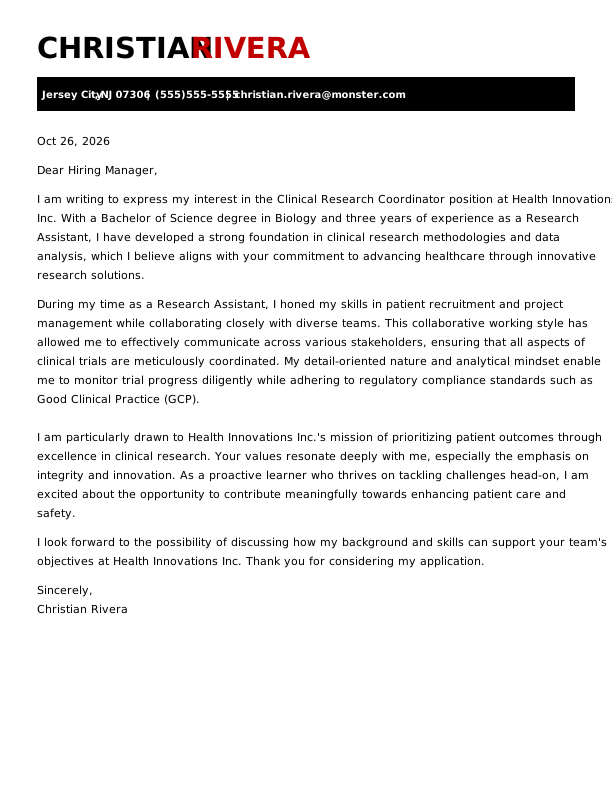
Clinical Research Coordinator Entry-Level Cover Letter
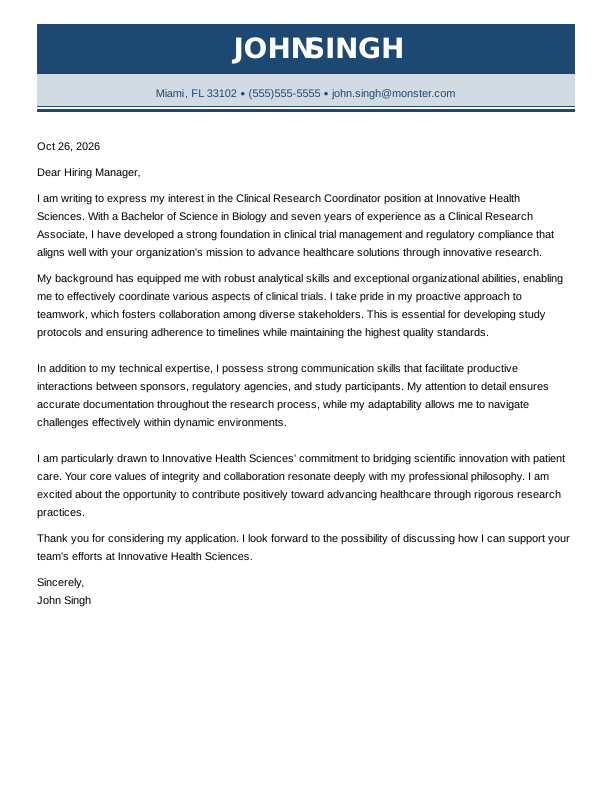
Clinical Research Coordinator Mid-Level Cover Letter
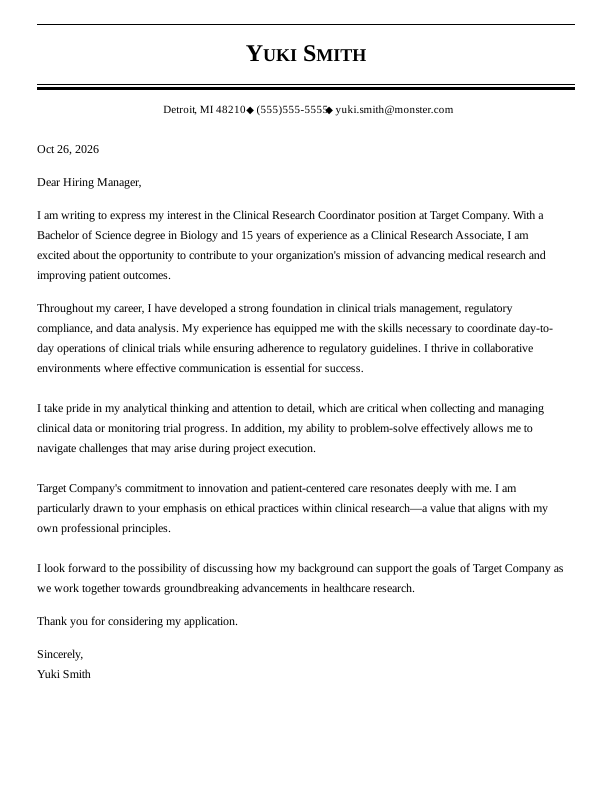
Clinical Research Coordinator Experienced Cover Letter
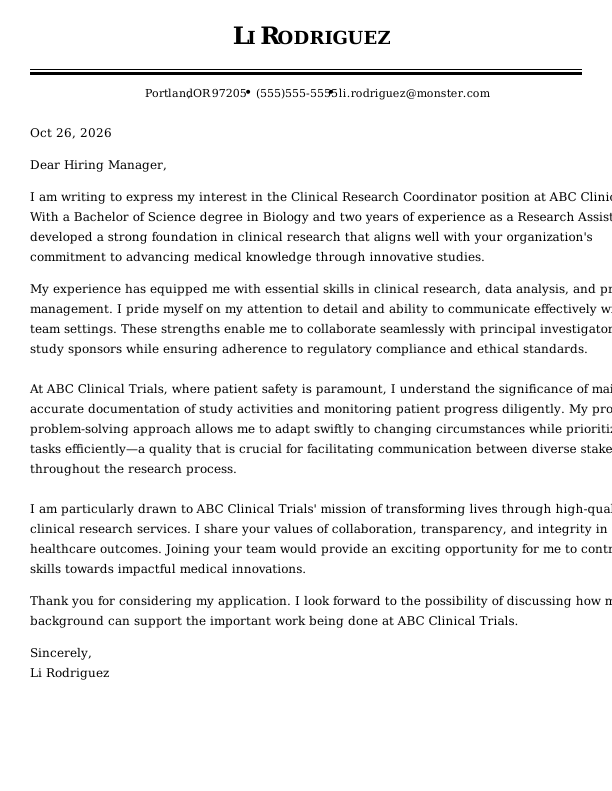
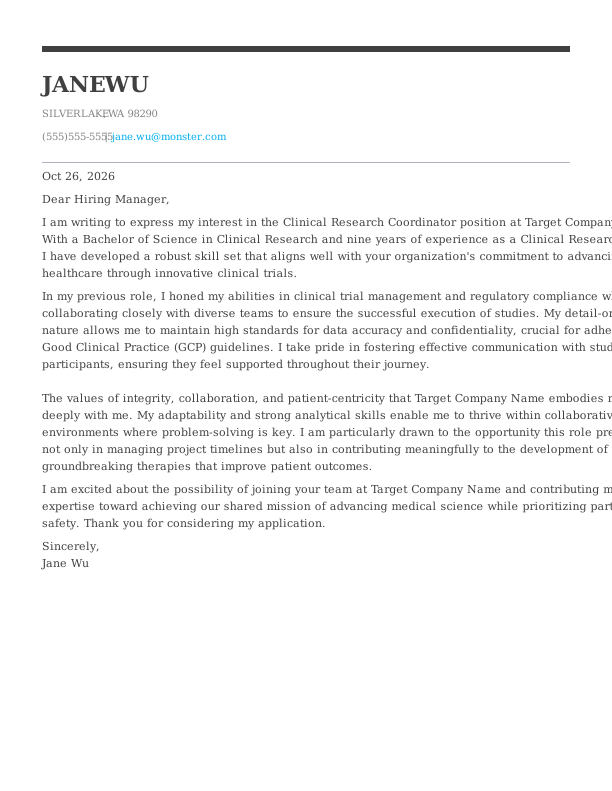
Clinical Research Coordinator Entry-Level Cover Letter
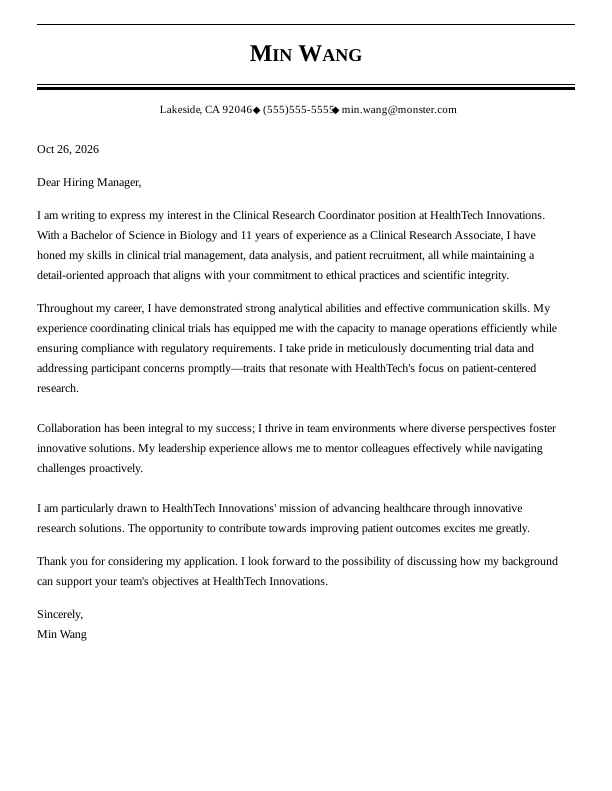
Clinical Research Coordinator Mid-Level Cover Letter
Clinical Research Coordinator Experienced Cover Letter
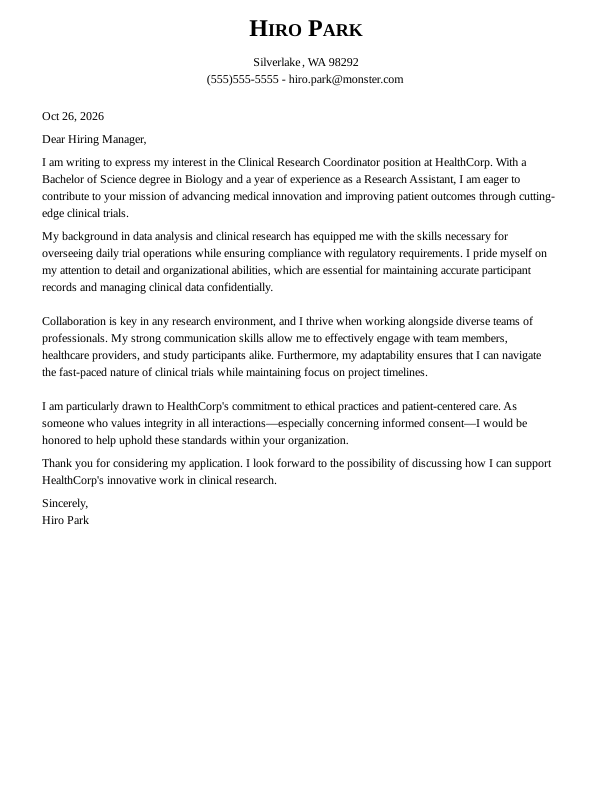
Clinical Research Coordinator Entry-Level Cover Letter
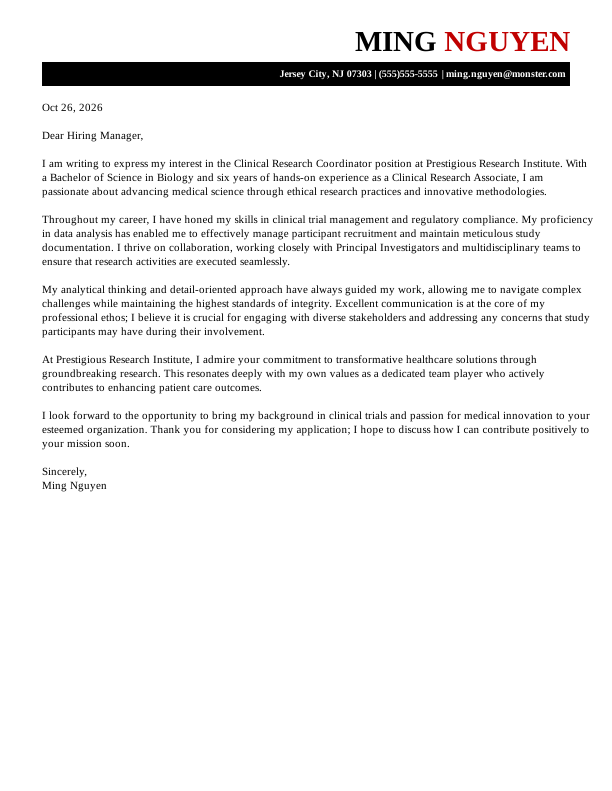
Clinical Research Coordinator Mid-Level Cover Letter
Browse Free Cover Letter Templates
- Academic
- Account Manager
- Accountant
- Accounts Payable
- Administrative Assistant
- Admissions Counselor
- Architecture
- Artist
- Assistant Principal
- Babysitter
- Barista
- Bartender
- Bookkeeper
- Brand Ambassador
- Business Analyst
- Business
- Caregiver
- Chef
- Civil Engineering
- Computer Science
- Construction
- Consulting
- Copywriter
- Cosmetology
- Custodian
- Customer Service
- Customer Service Representative
- Data Analyst
- Data Entry
- Dental Assistant
- Dental Hygienist
- Digital Marketing
- Electrical Engineering
- Emt
- Engineering
- Esthetician
- Event Coordinator
- Executive Assistant
- Fashion Designer
- Finance
- Financial Analyst
- Firefighter
- Flight Attendant
- Graphic Designer
- Hair Stylist
- Healthcare
- Hr Generalist
- Investment Banking
- It
- Janitor
- Journalism
- Lab Technician
- Law Clerk
- Lawyer
- Librarian
- Logistics
- Maintenance Worker
- Makeup Artist
- Manager
- Marketing Coordinator
- Marketing
- Marketing Manager
- Massage Therapist
- Mechanic
- Mechanical Engineer
- Medical Assistant
- Non Profit
- Nursing
- Occupational Therapy
- Office Assistant
- Office Manager
- Operations Manager
- Paralegal
- Personal Trainer
- Pharmacist
- Pharmacy Technician
- Photographer
- Physician Assistant
- Pilot
- Police Officer
- Program Manager
- Project Manager
- Property Manager
- Psychology
- Receptionist
- Research Assistant
- Restaurant Manager
- Retail
- Sales
- Sales Manager
- School Counselor
- Security
- Security Officer
- Social Work
- Software Engineer
- Special Education Teacher
- Starbucks
- Substitute Teacher
- Teacher
- Teaching Assistant
Cover Letter Examples for Clinical Research Coordinators
Cover letter expectations grow as you gain experience. Pick the sample that best matches where you are in your career to showcase your research skills, training, and achievements effectively.
Entry-Level Clinical Research Coordinator Cover Letter
Designed for new grads and career changers, this entry-level example shows you how to highlight relevant skills and hands-on academic training when you are starting out.
Mid-Career Clinical Research Coordinator Cover Letter
Ideal for coordinators with several years of experience, this template focuses on managing everyday study tasks, leading site workflows, and keeping protocols on track.
Experienced Clinical Research Coordinator Cover Letter
Built for senior coordinators, this example highlights leadership in managing trial operations, overseeing complex compliance standards, and guiding research teams.
Clinical Research Coordinator Cover Letter Template (Text)
Copy this clinical research coordinator cover letter text, paste it into your document, and customize it with your study timelines, enrollment metrics, and sponsor names.
Yuki Kim
Eastside, WA 98006
(555)555-5555
yuki.kim@monster.com
Oct 26, 2026
Dear Hiring Manager,
I am writing to express my interest in the Clinical Research Coordinator position at Health Innovations Inc. With a Bachelor of Science degree in Biochemistry and four years of experience as a Clinical Research Associate, I am passionate about advancing healthcare through innovative research and dedicated to ensuring ethical practices within clinical trials.
My background has equipped me with essential skills in clinical trial management, regulatory compliance, and data analysis. I have successfully coordinated various research studies, where my attention to detail and organizational abilities have played a crucial role in maintaining accurate records while monitoring participant safety. My experience has fostered strong problem-solving capabilities, allowing me to proactively address challenges as they arise during the research process.
Collaboration is at the heart of my working style; I thrive when engaging with diverse teams that share a commitment to improving patient outcomes. My effective communication skills enable me to serve as an efficient liaison between principal investigators, study sponsors, and regulatory bodies while ensuring that all parties are informed throughout the study lifecycle.
I am particularly drawn to Health Innovations Inc.’s mission of enhancing global health through groundbreaking research. The opportunity to contribute towards your goal aligns perfectly with my professional values and aspirations.
Thank you for considering my application. I look forward to the possibility of discussing how my background can support your team’s efforts in transforming medical practices through innovative solutions.
Sincerely,
Yuki Kim
How to Write a Clinical Research Coordinator Cover Letter
Writing a great cover letter for a clinical research coordinator role means sharing real examples of your work with study protocols, site schedules, and ethics reviews. Use these simple steps to build a tailored letter that shows hiring managers you have the exact skills they need.
1. Research & Prepare
Before you start typing, spend time learning about the team, their current studies, and their site goals. Check the job posting and clinical trial registries to see what software tools they use and what therapeutic areas they focus on.
Here are a few ways to prepare before you write:
- Review the job posting for the EDC or CTMS name and look for which study phases they prioritize.
- Check the organization’s IRB or human subjects protection page for their review turnaround expectations.
- Search ClinicalTrials.gov for recent trials run by that sponsor at the site and note the therapeutic areas.
2. Hook the Reader
Start your letter with an engaging opening line that grabs the reader’s attention right away. Instead of using standard, repetitive phrases, mention a key achievement or skill that matches their trial needs.
Consider using one of these opening approaches:
- Trial startup focus: “Turned a protocol amendment into an updated delegation log within 48 hours and kept site start-up on track for the next IRB submission.”
- Data integrity and systems: “Reduced query turnaround from 10 days to 3 by standardizing eCRF review in REDCap and reconciling source documents against visit windows before monitoring visits.”
- Regulatory readiness: “When FDA inspection prep began, led our binder audit using GCP checklists, coached investigators on essential documentation, and supported QA with a clean CAPA closeout tracked in Medidata.”
3. Tell Your Professional Story
Your resume lists past job titles, but your cover letter explains how you handle everyday trial challenges. Use specific metrics and milestones to give hiring managers a clear picture of your work habits and reliability.
Here are a few examples of strong achievements to highlight:
- Closed 96% of subject queries within 5 business days by triaging CRFs and coordinating with site staff.
- Reduced protocol deviations by 34% over one year after updating visit checklists and retraining coordinators on inclusion criteria.
- Managed enrollment for up to 8 active studies at once while supporting an average monthly screening volume of 220 participants.
4. Showcase Your Skills
Instead of just listing generic traits like “detail-oriented” or “organized,” connect your core strengths to specific tasks you have completed in past roles.
Show how you apply your skills in real-world clinical settings using clear examples like these:
- GCP and protocol follow-through: “Paused enrollment when a visit window did not match the protocol, then documented the deviation and confirmed next steps with the PI before proceeding.”
- Clinical data entry in EDC: “Double-checked source-to-EDC fields during data review so discrepancies were flagged early for query resolution.”
- Patient and team communication: “Called participants to clarify upcoming procedures and relayed their questions to the study team so everyone was aligned on expectations.”
5. Explain Any Special Circumstances
If you have a career gap, a recent move, or are switching industries, explain it briefly in one or two sentences. Focus on how you kept your research knowledge up to date through certifications or training. You can handle these situations smoothly using lead-ins like these:
- “After eight months out of the role, I maintained my ACRP CRC certification and completed GCP refresher training before returning to enroll patients in an IRB-approved oncology trial.”
- “Pivoting from CRA work into coordinator responsibilities by actively running site logistics in CTMS and coordinating protocol deviations while completing ICH GCP updates.”
- “After relocating to Austin last fall, I transitioned my state regulatory onboarding and have been working in a new EDC setup for multi-site studies under our IRB processes.”
6. End With a Professional Goodbye
Wrap up your letter with a friendly, professional closing that invites further conversation. Thank the reader for their time and suggest a clear next step, such as discussing study goals in an interview.
For example: “I’d be glad to talk through how you manage protocol amendments and participant follow-up at your site.” Then add “Thank you for your time.” Finish with “Best regards” or “Sincerely.”
4 Tips for Formatting Your Cover Letter
Hiring managers often review dozens of applications quickly, so an organized format helps them spot your protocol experience and study qualifications immediately. Clear margins and proper line spacing create a polished visual impression.

Keep It to One Page
A cover letter should always fit on a single page. Aim for 250 to 400 words split across three or four short paragraphs, highlighting your core trial experience, regulatory knowledge, and key achievements.

Match Your Header to Your Resume
Your cover letter header should use the exact same layout, font, and contact information as your resume. Matching your document headers creates a clean, cohesive application package that helps a hiring site instantly connect both pages to the same candidate.

Use Bullet Points for Key Achievements
Use three or four bullet points to spotlight specific metrics, such as participant enrollment numbers, query turnaround times, or successful audit results. This makes your key strengths easy to scan during a quick review.

Save & Send as a PDF
Always save and send your cover letter as a PDF file unless a job posting specifically requests another file type. A PDF locks in your visual layout, font choices, and line spacing so it appears perfectly on any screen or device. Use a clear, professional file name like Firstname_Lastname_Cover_Letter.pdf when submitting your application.
Key Takeaways
- Show your understanding of compliance and safety standards by describing how you resolved a protocol challenge or improved a site workflow.
- Include clear metrics like recruitment numbers and response times to prove your efficiency and impact.
- Tailor your message to the specific employer, whether they are a contract research organization, an academic hospital, or a biotech company.
More Cover Letter Examples
- Biology
- Medical
- Medical Receptionist
- Medical Scribe
- Patient Care Technician
- Phlebotomist
- Public Health
- Social Services
- Surgical Tech
Browse Monster’s Resume Templates
Monster also has hundreds of ATS-friendly resume templates for all career levels and industries. Create a matching resume to help you land the interview.
- Cardiac Sonographer
- Caregiver
- Caretaker
- Certified Medical Assistant
- Chiropractic Assistant
- Clinical Data Specialist
- Clinical Research Associate
- Dietitian
- Direct Support Professional
- Ekg Technician
- Health Information Technician
- Healthcare Administration
- Healthcare
- Healthcare Support
- Healthcare Technology
- Home Health Care
- Lab Technician
- Lactation Consultant
- Medical Administrative Assistant
- Medical Assistant
- Medical Billing
- Medical Coder
- Medical Courier
- Medical Interpreter
- Medical Office Manager
- Medical Office
- Medical Receptionist
- Medical
- Medical School
- Medical Science Liaison
- Medical Scribe
- Medical Secretary
- Medical Technologist
- Medical Transcriptionist
- Mri Technologist
- Ophthalmic Technician
- Optician
- Patient Access Representative
- Patient Care Coordinator
- Patient Care Technician
- Patient Service Representative
- Patient Transporter
- Phlebotomist
- Physical Therapist Assistant
- Private Caregiver
- Radiologic Technologist
- Sonographer
- Surgical Tech
- Unit Secretary
Frequently Asked Questions
Last Update:
Do I really need a cover letter?
While a resume details your work history, a clinical research coordinator cover letter allows you to explain your specific study experience and passion for research in your own words. Including a cover letter shows extra effort and gives hiring managers a clearer sense of your communication skills and professionalism.
How long should my cover letter be?
A clinical research coordinator cover letter should be kept to a single page, ideally between 250 and 400 words. Keeping your text concise ensures hiring managers can quickly spot your top credentials and experience without getting overwhelmed by unnecessary details.
Should my cover letter match my resume?
Matching your clinical research coordinator cover letter to your resume creates a clean, cohesive application package. Using identical fonts, margin sizes, and header styling across both documents presents a unified professional look that hiring managers appreciate.
What should I include in my cover letter header?
In your clinical research coordinator cover letter header, you should include your full name, phone number, email address, city, and state. Below your contact details, add the date, followed by the hiring manager’s name, title, and facility name if available.
How do I write a cover letter for an internal position?
When writing a cover letter for an internal clinical research coordinator role, you should highlight your existing knowledge of the site’s specific processes and team dynamics. Emphasize your past contributions to current studies while explaining how stepping into this role will help advance team goals.

Elizabeth Muenzen is a Certified Professional Resume Writer (CPRW) and member of the Professional Association of Resume Writers & Career Coaches who empowers job seekers to take control of their career paths using Monster’s comprehensive job search and resume tools.
See More From Elizabeth MuenzenExplore Related Career Advice







How to Write a Cover Letter for Internal Positions or Promotions (Examples & Tips)

Updated:
Apr 23, 2026
|
19 min read


Cover Letter vs Resume: What’s the Difference & Do You Need Both?
Updated:
Apr 23, 2026
|
18 min read