


Free Carpenter Cover Letter Templates & Examples
A great carpenter cover letter shows you can read plans accurately, run tools safely, and deliver clean, solid work. Use our free examples and simple tips to highlight your hands-on skills so hiring managers see the real value you bring right away.
Real-World Cover Letters That Get Results
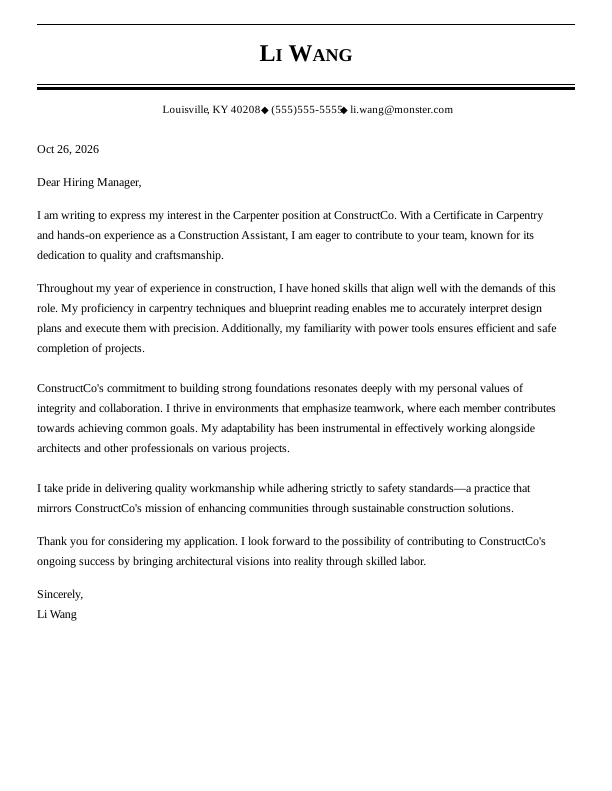
 Free
Carpenter Entry-Level Cover Letter
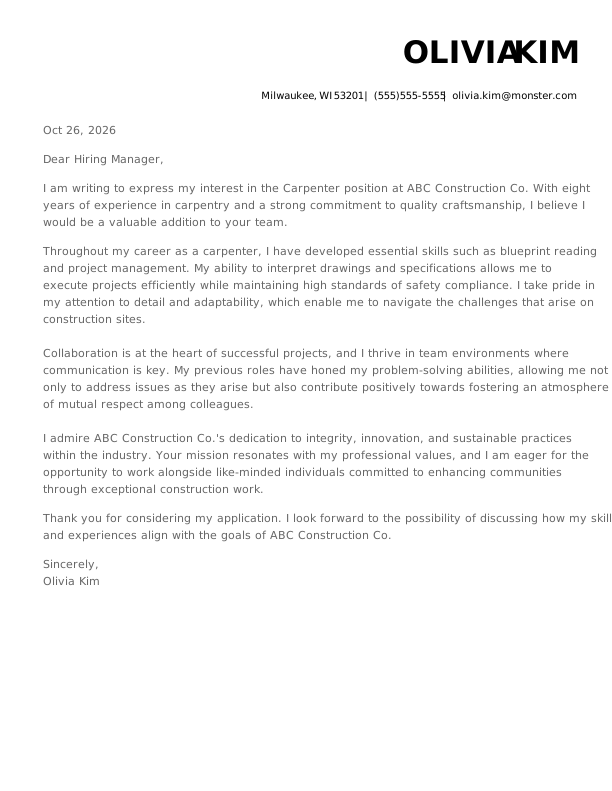
Carpenter Mid-Level Cover Letter
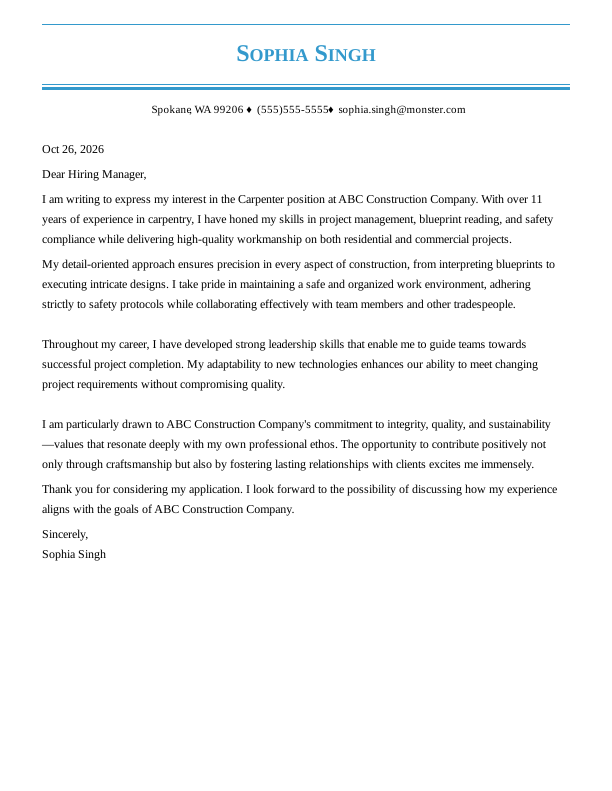
Carpenter Experienced Cover Letter
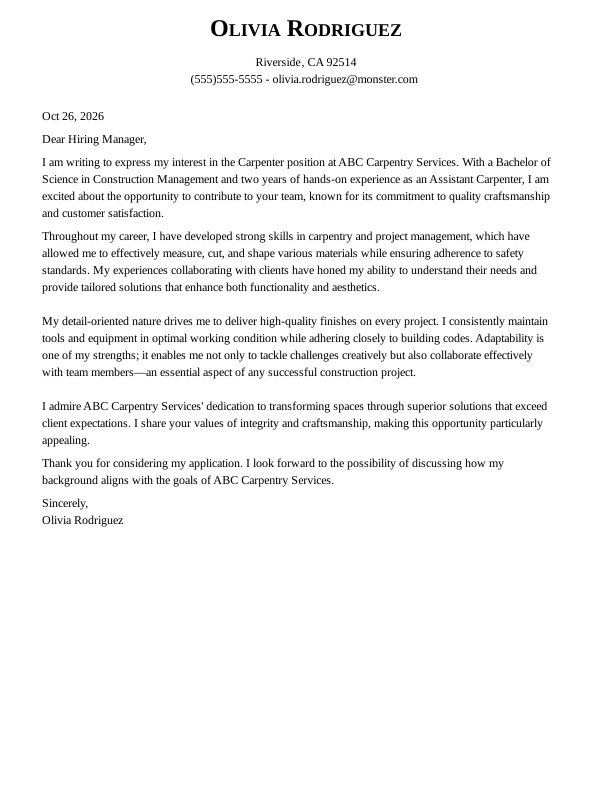
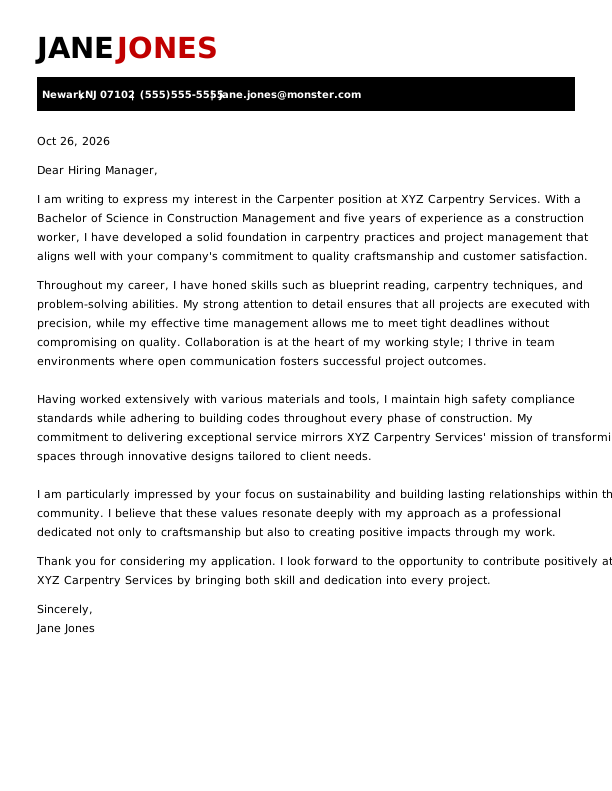
Carpenter Entry-Level Cover Letter
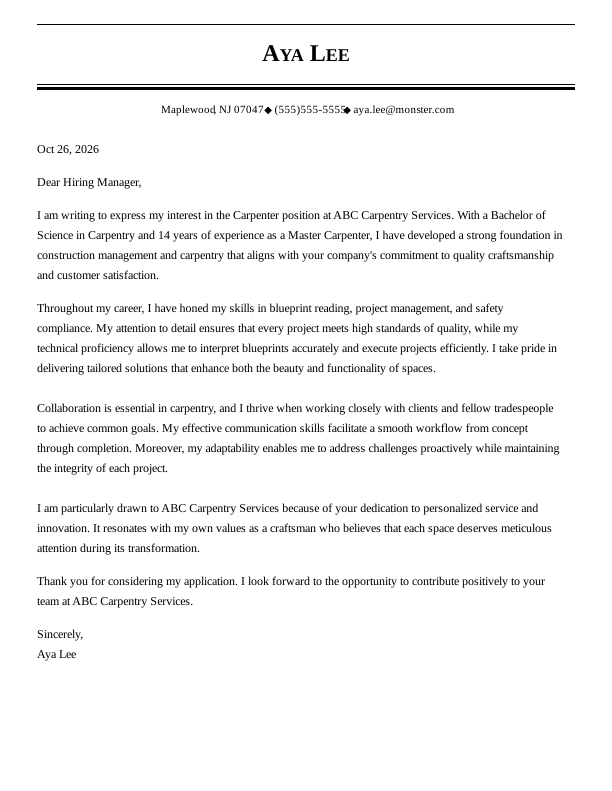
Carpenter Mid-Level Cover Letter
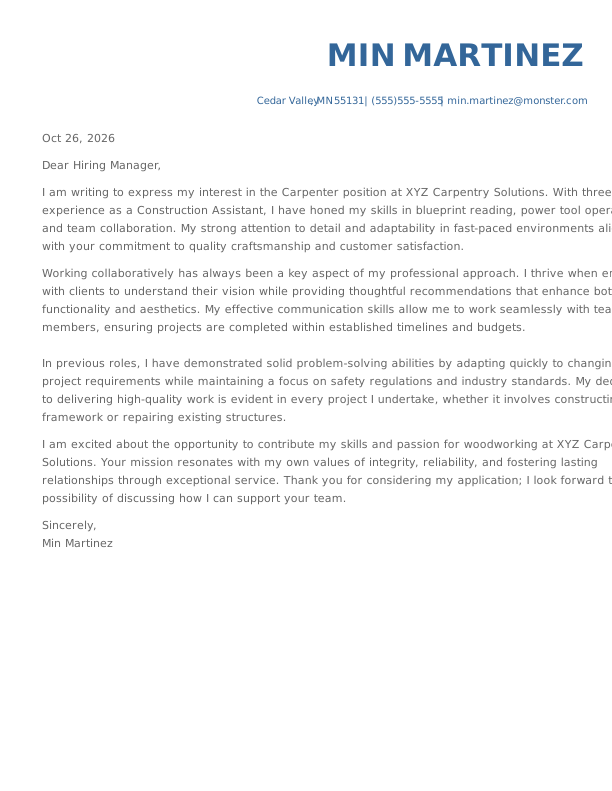
Carpenter Experienced Cover Letter
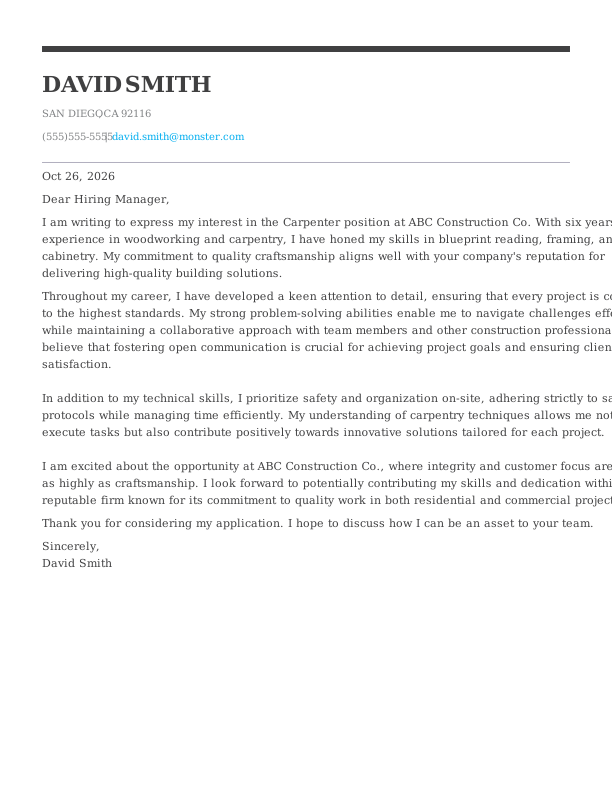
Carpenter Entry-Level Cover Letter
Carpenter Mid-Level Cover Letter
Browse Free Cover Letter Templates
- Academic
- Account Manager
- Accountant
- Accounts Payable
- Administrative Assistant
- Admissions Counselor
- Architecture
- Artist
- Assistant Principal
- Babysitter
- Barista
- Bartender
- Bookkeeper
- Brand Ambassador
- Business Analyst
- Business
- Caregiver
- Chef
- Civil Engineering
- Computer Science
- Construction
- Consulting
- Copywriter
- Cosmetology
- Custodian
- Customer Service
- Customer Service Representative
- Data Analyst
- Data Entry
- Dental Assistant
- Dental Hygienist
- Digital Marketing
- Electrical Engineering
- Emt
- Engineering
- Esthetician
- Event Coordinator
- Executive Assistant
- Fashion Designer
- Finance
- Financial Analyst
- Firefighter
- Flight Attendant
- Graphic Designer
- Hair Stylist
- Healthcare
- Hr Generalist
- Investment Banking
- It
- Janitor
- Journalism
- Lab Technician
- Law Clerk
- Lawyer
- Librarian
- Logistics
- Maintenance Worker
- Makeup Artist
- Manager
- Marketing Coordinator
- Marketing
- Marketing Manager
- Massage Therapist
- Mechanic
- Mechanical Engineer
- Medical Assistant
- Non Profit
- Nursing
- Occupational Therapy
- Office Assistant
- Office Manager
- Operations Manager
- Paralegal
- Personal Trainer
- Pharmacist
- Pharmacy Technician
- Photographer
- Physician Assistant
- Pilot
- Police Officer
- Program Manager
- Project Manager
- Property Manager
- Psychology
- Receptionist
- Research Assistant
- Restaurant Manager
- Retail
- Sales
- Sales Manager
- School Counselor
- Security
- Security Officer
- Social Work
- Software Engineer
- Special Education Teacher
- Starbucks
- Substitute Teacher
- Teacher
- Teaching Assistant
Cover Letter Examples for Carpenters
Cover letter requirements evolve as a carpenter’s career progresses, from learning basic framing and jobsite safety to managing bigger builds. Choose the template that matches your experience level so you can spotlight the right skills, training, and accomplishments for the work you’re ready to lead.
Entry-Level Carpenter Cover Letter
If you’re starting in the trade, this template helps you spotlight foundational carpentry training, essential tool knowledge, and your readiness to learn quickly on active job sites.
Mid-Career Carpenter Cover Letter
Built for carpenters with a few years on the job, this template helps you showcase dependable field experience, steady problem-solving, and your ability to handle diverse projects smoothly.
Experienced Carpenter Cover Letter
Designed for seasoned trade professionals, this template highlights advanced carpentry expertise, crew leadership, and a proven track record of managing quality and safety across complex builds.
Carpenter Cover Letter Template (Text)
Copy this carpenter cover letter template, paste it into your document, and swap in your specific projects, tools, and employer name for the job you want.
Tao Wang
Eastside, WA 98011
(555)555-5555
tao.wang@monster.com
Oct 26, 2026
Dear Hiring Manager,
I am writing to express my interest in the carpenter position at Target Carpentry Co. With a Bachelor of Science in Construction Management and nine years of hands-on experience as a carpenter, I am excited about the opportunity to contribute to your dynamic team known for its high-quality craftsmanship and attention to detail.
Throughout my career, I have honed my skills in blueprint reading and project management while maintaining a strong focus on safety compliance. My ability to interpret technical drawings allows me to deliver projects that meet client specifications effectively. Collaborative by nature, I thrive in team environments where open communication fosters creativity and problem-solving.
In previous roles, I have demonstrated adaptability through various carpentry projects, ensuring that each piece not only meets functional requirements but also enhances aesthetic appeal. My commitment to producing high-quality work aligns well with Target Carpentry Co.’s mission of enhancing living and working spaces while prioritizing integrity and sustainability.
I take pride in leading teams with a strong work ethic, encouraging collaboration among colleagues for successful project completion. By maintaining tools and equipment meticulously, I help cultivate a safe work environment conducive to efficiency.
I am eager for the chance to bring my expertise in custom woodworking and framing solutions to your esteemed company. Thank you for considering my application; I look forward to discussing how my background aligns with the goals of Target Carpentry Co.
Sincerely,
Tao Wang
How to Write a Carpenter Cover Letter
To write an effective carpenter cover letter, you need to turn your everyday jobsite work into clear, relatable stories about accurate cuts, solid builds, and reliable habits. Follow these steps to shape your experience for the specific role you want, making it easy for any contractor or hiring manager to picture you on their crew.
1. Research & Prepare
Before you write a single line, spend a few minutes learning what the contractor or building company actually needs from a carpenter on day one. When you understand the daily challenges of their projects, you can directly connect your own framing, finish, or repair skills to their immediate workload.
Here are a few quick ways to gather useful details about the employer:
- Review the job posting and company website to see whether the work leans toward residential framing, custom interior finish, or commercial installations.
- Look for mentions of specific safety certifications, like OSHA 10 or OSHA 30, that the contractor expects crew members to hold.
- Check recent project announcements, local building permits, or client portfolios to see what kinds of materials and architectural styles they work with most often.
2. Hook the Reader
Grab the hiring manager’s attention right away by showing that you understand how carpentry work gets evaluated in the field. Skip tired openers like “I am writing to apply for the carpenter position.” Instead, kick off your letter with a brief, punchy detail about a recent project, a trade specialty, or your dependable safety record.
Consider opening your letter with an approach like one of these:
- Mention a specific project milestone: “On my last residential remodel, I framed 18 rooms on a tight schedule, maintaining straight, square layouts while coordinating daily with our site lead.”
- Highlight a clear trade focus: “Specializing in finish carpentry, I recently built and fitted 42 custom baseboard layouts using laser alignment and tight miter joints to match existing stain profiles.”
- Demonstrate jobsite efficiency: “During a fast-paced commercial build, I followed daily safety lockouts and kept cut waste under 8% by planning materials directly from the architectural plans.”
3. Tell Your Professional Story
While your resume lists job titles and daily duties, your cover letter lets you describe the real difference you made on site. Quantifiable results help a superintendent or shop owner picture your true work pace and reliability much better than generic phrases like “hard worker.” Whenever you can, back up your claims with practical numbers.
Here are a few examples of how to frame your achievements with clear figures:
- Completed interior trim and detailed millwork for 18 occupied apartments, averaging fewer than six punch-list items per unit during final inspection.
- Helped decrease material rework costs by 22% over three months by double-checking stud layouts and fastening patterns before drywall crews arrived.
- Hung interior doors across a 40-home development, cutting average install time from 2.5 hours to 1.8 hours per door by standardizing hinge mortising and shimming steps.
4. Showcase Your Skills
Carpentry is a visual, physical craft, so describe real moments on the job instead of relying on overused buzzwords like “detail-oriented” or “motivated.” Choose two or three core strengths that match the job description, then explain briefly how you put them to work on a real build.
You can frame your practical strengths using simple, direct examples like these:
- Precise measuring and layout: “I snap chalk lines, verify diagonals, and double-check layout marks before setting floor joists so the framing stays true and square.”
- Proactive tool safety: “I inspect cord conditions, guards, and miter saw blades every morning to catch wear early and prevent kickback risks.”
- Clear jobsite communication: “I walk the homeowner through rough openings and door swing clearances before cutting to make sure everyone agrees on the plan.”
5. Explain Any Special Circumstances
If you have an employment gap, recently relocated, or want to pivot into a new branch of the trade, explain it in one or two honest, straightforward sentences. As a carpenter, you simply want to reassure the employer that your hands-on skills are sharp, your tools are ready, and your certifications are current.
Use one of these everyday examples to address your situation smoothly:
- Addressing a work pause: “During a brief seasonal slowdown, I refreshed my OSHA 30 training and took on private residential trim repairs to keep my tools and skills sharp.”
- Pivoting specialties: “After several years on structural framing crews, I’m focusing on finish carpentry and custom cabinetry, sharpening my skills with high-precision track saws and joinery tools.”
- Relocating: “I recently moved to Washington from Texas and have already verified my local trade credentials so I can step directly onto active commercial job sites.”
6. End With a Professional Goodbye
Close your cover letter by encouraging clear next steps rather than fading out with passive phrases like “I hope to hear from you soon.” Tell the reader that you’re eager to talk through their upcoming builds, thank them for reviewing your application, and sign off cleanly.
You might write something like: “I’d love to discuss how my framing accuracy, finish skills, and focus on safety can help your team hit its deadlines this season. Thank you for your time and consideration.”
Then close with “Sincerely” or “Best regards,” followed by your full name and phone number.
4 Tips for Formatting Your Cover Letter
Hiring managers, general contractors, and site superintendents don’t have time to dig through dense, cluttered paragraphs. A clean, balanced layout ensures your trade specialties, safety credentials, and practical experience stand out immediately, showing that you bring the same order and precision to your paperwork that you bring to the jobsite.
Use these cover letter format tips to ensure your letter is in top shape and easy for hiring managers to scan:

Keep It to One Page
A busy contractor needs to see your qualifications at a glance without flipping pages. Aim for 250 to 400 words split across three or four short, readable paragraphs. This provides plenty of space to cover your primary carpentry specialties, a notable project or two, and essential safety training like OSHA 10 without cluttering the page.

Address the Hiring Manager Directly
Taking a moment to find the name of the project manager, foreman, or hiring contact shows genuine initiative. Look through the job listing, browse the company website, or check professional directories. If you can’t locate a specific name after looking, use a friendly, professional greeting like “Dear Hiring Manager” or “Dear Hiring Team” instead of outdated formal phrasing like “To Whom It May Concern.”

Match Your Header to Your Resume
Use the same header design, font choices, and contact details on your cover letter that you use on your resume. Keeping your name, phone number, email, and trade certifications visually consistent ties both documents together neatly, making your entire application look organized and professional.

Balance Spacing & Margins
Give your text breathing room by using 0.75-inch to 1-inch margins on all sides. Set your line spacing between 1.0 and 1.15, and always insert a blank line between paragraphs rather than indenting them. This open structure makes the document easy to read on a mobile phone in the field and looks crisp when printed for a jobsite interview.
Top-Paying States for Carpenter Roles
Knowing what carpenters earn across the country helps you evaluate job offers, negotiate pay, and plan your next step with confidence. The data below comes from the U.S. Bureau of Labor Statistics (BLS) and reflects the most recent nationwide averages for carpenters.
Keep in mind that your actual earnings can vary based on location, years of experience, and whether you work in residential or commercial construction. Union membership, specialized skills like finish carpentry, and steady project schedules can also affect outcomes.
| Alabama | $48,270 |
| Alaska | $76,870 |
| Arizona | $58,340 |
| Arkansas | $59,390 |
| California | $77,680 |
| Connecticut | $66,010 |
| Delaware | $63,060 |
| District of Columbia | $67,460 |
| Florida | $50,200 |
| Georgia | $50,700 |
| Hawaii | $86,730 |
| Idaho | $53,010 |
| Illinois | $77,940 |
| Indiana | $61,220 |
| Iowa | $55,560 |
| Kansas | $55,920 |
| Kentucky | $52,970 |
| Louisiana | $51,150 |
| Maine | $59,360 |
| Maryland | $63,080 |
| Massachusetts | $77,360 |
| Michigan | $61,620 |
| Minnesota | $69,490 |
| Mississippi | $48,750 |
| Missouri | $64,620 |
| Montana | $58,130 |
| Nebraska | $52,840 |
| Nevada | $68,290 |
| New Hampshire | $61,380 |
| New Jersey | $73,130 |
| New Mexico | $53,560 |
| New York | $73,190 |
| North Carolina | $48,000 |
| North Dakota | $58,780 |
| Ohio | $58,610 |
| Oklahoma | $50,760 |
| Oregon | $67,280 |
| Pennsylvania | $62,660 |
| Rhode Island | $65,760 |
| South Carolina | $51,780 |
| South Dakota | $48,090 |
| Tennessee | $50,900 |
| Texas | $49,320 |
| Utah | $54,620 |
| Vermont | $61,910 |
| Virginia | $53,280 |
| Washington | $77,630 |
| West Virginia | $49,350 |
| Wisconsin | $64,190 |
| Wyoming | $59,570 |
| Guam | $38,380 |
| Puerto Rico | $28,780 |
| Virgin Islands | $53,480 |
Key Takeaways
- Showcase your hands-on accuracy by sharing a specific example where your layout checks or plan reading prevented costly jobsite mistakes.
- Quantify your daily impact with clear numbers like square footage framed, install hours saved, or material waste reduced.
- Tailor your letter directly to the project type, whether that means highlighting fine finish work for residential builders or strict safety compliance for commercial contractors.
More Cover Letter Examples
Browse Monster’s Resume Templates
Monster also has hundreds of ATS-friendly resume templates for all career levels and industries. Create a matching resume to help you land the interview.
- Air Sealing Technician
- Aircraft Mechanic
- Auto Mechanic
- Automotive Technician
- Barber
- Blue Collar
- Boilermaker
- Budtender
- Cable Technician
- Carpenter
- Carpentry
- Cosmetologist
- Crane Operator
- Diesel Mechanic
- Diesel Technician
- Electrician
- Glazier
- Hair Stylist
- Handyman
- Hvac Installer
- Hvac Technician
- Industrial Electrician
- Ironworker
- Journeyman Electrician
- Landscaper
- Lineman
- Machinist
- Millwright
- Painter
- Pipe Fitter
- Plumber
- Roofer
- Solar Installer
- Structural Welder
- Welder
Frequently Asked Questions
Last Update:
Do I really need a cover letter?
Yes, you should include a cover letter for a carpenter job even when it is optional. While your resume lists your past employers and general duties, a cover letter lets you explain the specific projects you’ve built and how you work on site. It shows real initiative and gives you space to explain why you want to work on this company’s job sites.
How long should my cover letter be?
Your carpenter cover letter should be between 250 and 400 words and fit neatly on one page. Superintendents and project managers review applications between jobsite tasks, so keeping your letter to three or four short paragraphs makes it quick to read. Focus entirely on your best carpentry skills, safety training, and the practical value you bring to their upcoming builds.
Should my cover letter match my resume?
Yes, your carpenter cover letter should match your resume’s visual style so both documents look like one clean package. Use the same fonts, margins, and header information across both pages. You do not want to repeat the same bullet points, so use the letter to tell the story behind your best project instead of repeating your job history.
How do I address my cover letter if I don’t know the hiring manager’s name?
If you do not know the hiring manager’s name on your carpenter cover letter, start with a quick search on the contractor’s website or the job posting for the site foreman or superintendent. If you cannot find a specific name, use a polite greeting like “Dear Hiring Manager” or “Dear Construction Team.” Avoid writing “To Whom It May Concern,” since it sounds stiff and outdated.
How do I write a cover letter for an internal position?
When writing a cover letter for an internal carpenter position, highlight your deep familiarity with your company’s tools, safety standards, and daily jobsite workflow. Mention how your dependable work on past projects helped the crew meet deadlines with minimal rework. Then explain that you are ready to take on more leadership, guide newer carpenters, and follow the company’s formal promotion process.

Elizabeth Muenzen is a Certified Professional Resume Writer (CPRW) and member of the Professional Association of Resume Writers & Career Coaches who empowers job seekers to take control of their career paths using Monster’s comprehensive job search and resume tools.
See More From Elizabeth MuenzenExplore Related Career Advice







How to Write a Cover Letter for Internal Positions or Promotions (Examples & Tips)

Updated:
Apr 23, 2026
|
19 min read


Cover Letter vs Resume: What’s the Difference & Do You Need Both?
Updated:
Apr 23, 2026
|
18 min read