


Free Chief of Staff Cover Letter Templates & Examples
A great chief of staff cover letter shows you can balance executive priorities, align cross-functional teams, and turn big-picture strategy into clear results. Use our free examples and practical tips to write a concise, compelling introduction that grabs hiring managers’ attention.
Real-World Cover Letters That Get Results
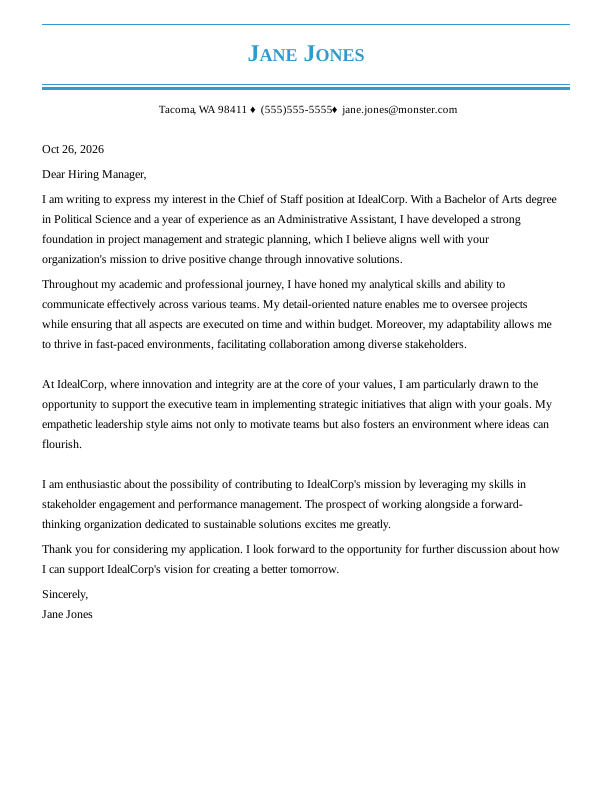
 Free
Chief Of Staff Entry-Level Cover Letter
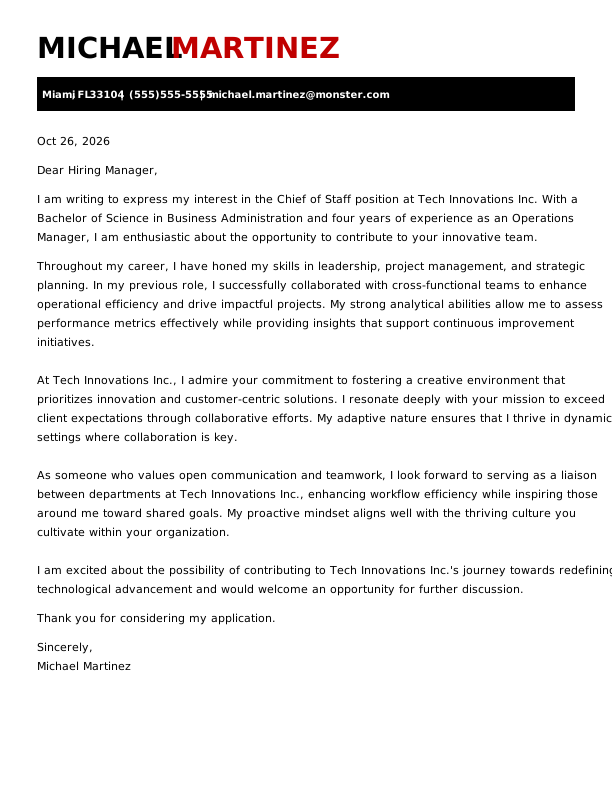
Chief Of Staff Mid-Level Cover Letter
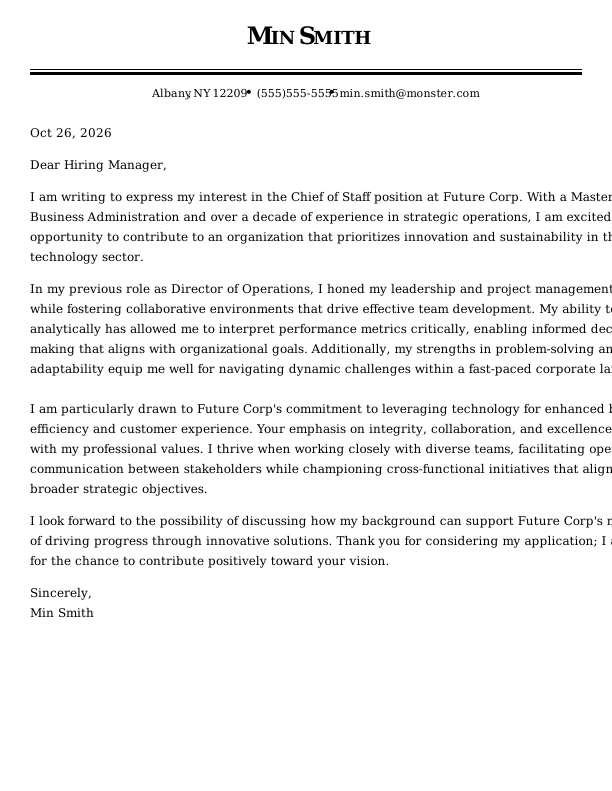
Chief Of Staff Experienced Cover Letter
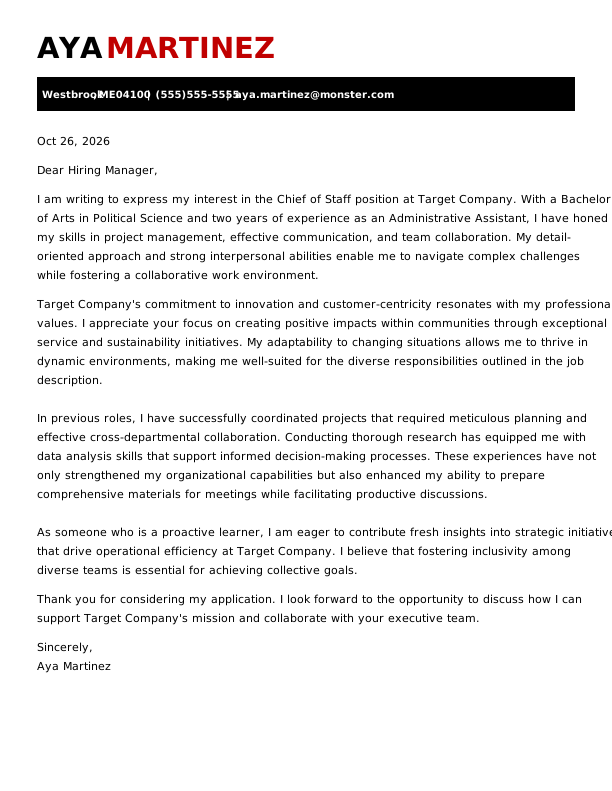
Chief Of Staff Entry-Level Cover Letter
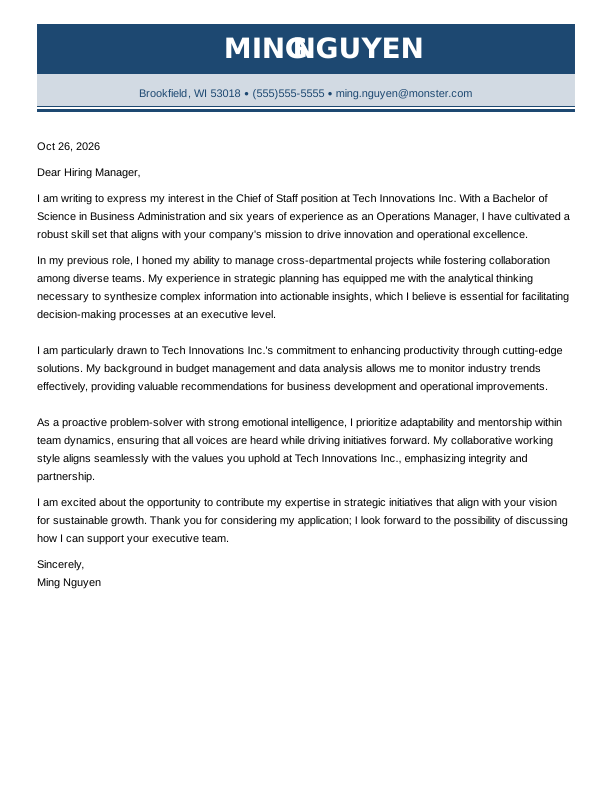
Chief Of Staff Mid-Level Cover Letter
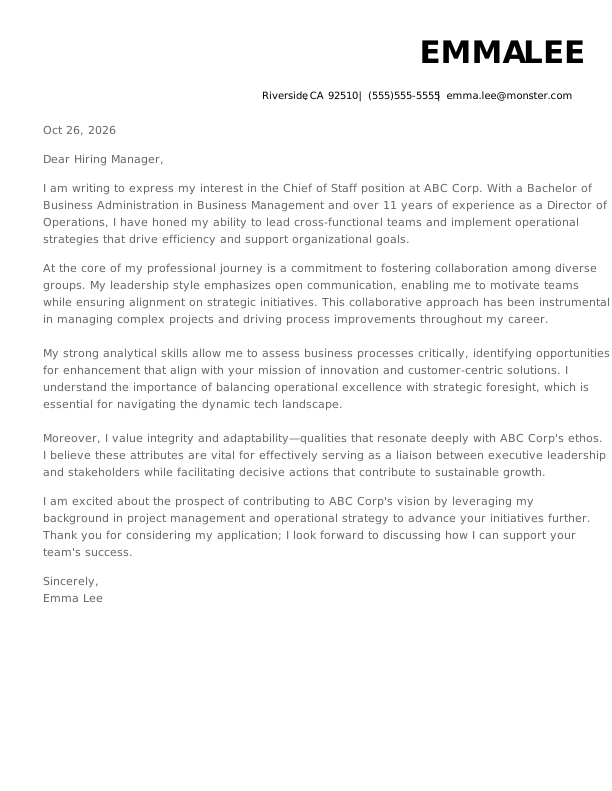
Chief Of Staff Experienced Cover Letter
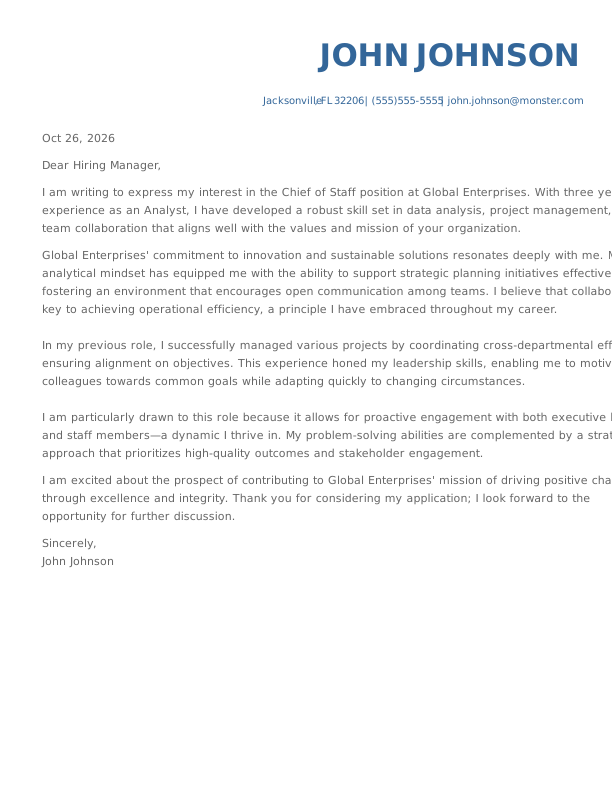
Chief Of Staff Entry-Level Cover Letter
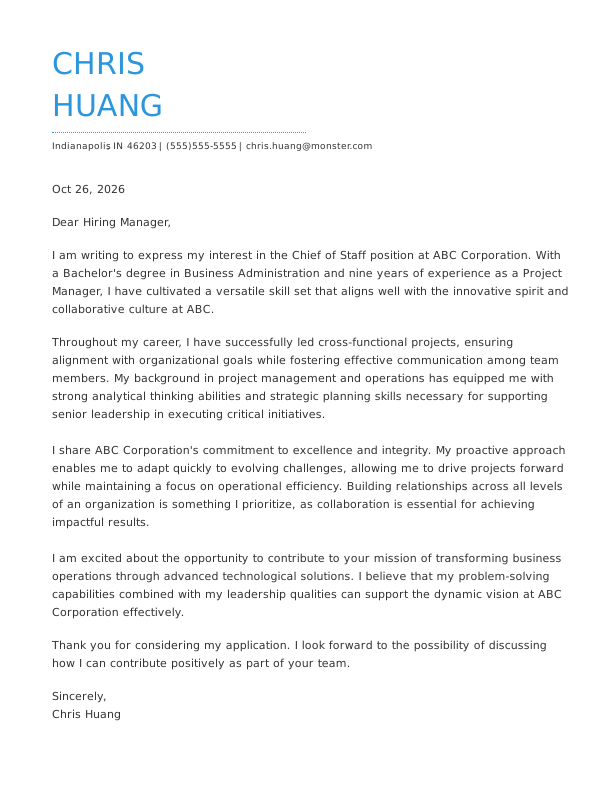
Chief Of Staff Mid-Level Cover Letter
Browse Free Cover Letter Templates
- Academic
- Account Manager
- Accountant
- Accounts Payable
- Administrative Assistant
- Admissions Counselor
- Architecture
- Artist
- Assistant Principal
- Babysitter
- Barista
- Bartender
- Bookkeeper
- Brand Ambassador
- Business Analyst
- Business
- Caregiver
- Chef
- Civil Engineering
- Computer Science
- Construction
- Consulting
- Copywriter
- Cosmetology
- Custodian
- Customer Service
- Customer Service Representative
- Data Analyst
- Data Entry
- Dental Assistant
- Dental Hygienist
- Digital Marketing
- Electrical Engineering
- Emt
- Engineering
- Esthetician
- Event Coordinator
- Executive Assistant
- Fashion Designer
- Finance
- Financial Analyst
- Firefighter
- Flight Attendant
- Graphic Designer
- Hair Stylist
- Healthcare
- Hr Generalist
- Investment Banking
- It
- Janitor
- Journalism
- Lab Technician
- Law Clerk
- Lawyer
- Librarian
- Logistics
- Maintenance Worker
- Makeup Artist
- Manager
- Marketing Coordinator
- Marketing
- Marketing Manager
- Massage Therapist
- Mechanic
- Mechanical Engineer
- Medical Assistant
- Non Profit
- Nursing
- Occupational Therapy
- Office Assistant
- Office Manager
- Operations Manager
- Paralegal
- Personal Trainer
- Pharmacist
- Pharmacy Technician
- Photographer
- Physician Assistant
- Pilot
- Police Officer
- Program Manager
- Project Manager
- Property Manager
- Psychology
- Receptionist
- Research Assistant
- Restaurant Manager
- Retail
- Sales
- Sales Manager
- School Counselor
- Security
- Security Officer
- Social Work
- Software Engineer
- Special Education Teacher
- Starbucks
- Substitute Teacher
- Teacher
- Teaching Assistant
Cover Letter Examples for Chiefs of Staff
Cover letter expectations for a chief of staff change as your career progresses and your responsibilities expand. Choose the template that matches your experience level so you can highlight relevant work like managing executive priorities, coordinating cross-functional teams, and supporting decision-making.
Entry-Level Chief of Staff Cover Letter
If you’re stepping into leadership support or pivoting from an early-career operational role, this template helps you frame foundational coordination, project delivery, and organizational skills strategically.
Mid-Career Chief of Staff Cover Letter
Designed for professionals with several years of management experience, this template highlights your ability to run complex initiatives, bridge departmental gaps, and streamline everyday business workflows.
Experienced Chief of Staff Cover Letter
Tailored for seasoned leaders, this template showcases high-level operational oversight, long-term strategic planning, and the executive diplomacy required to guide organization-wide transformation.
Chief of Staff Cover Letter Template (Text)
Copy this chief of staff cover letter template, paste it into your document, and swap in your project outcomes, leadership metrics, and the organization name.
Ming Singh
Tampa, FL 33606
(555)555-5555
ming.singh@monster.com
Oct 26, 2026
Dear Hiring Manager,
I am writing to express my interest in the chief of staff position at Tech Innovators Inc. With a Bachelor of Science in Business Administration and seven years of experience as an operations manager, I have polished my skills in leadership, strategic planning, and project management—abilities that I believe align with your company’s mission to drive innovation through technology.
Throughout my career, I have cultivated strong analytical skills and a detail-oriented approach that enable me to oversee complex projects with precision. My previous role involved collaborating across departments to streamline operations and improve efficiency—a practice I am eager to continue within Tech Innovators’ dynamic environment. Additionally, my proficiency in data analysis has consistently supported informed decision-making processes at executive levels.
Tech Innovators’ commitment to fostering collaboration resonates deeply with me. As someone who thrives on teamwork and diverse perspectives, I am equipped to serve as a liaison between departments, ensuring effective communication that aligns strategic initiatives with operational activities. My adaptable nature allows me to navigate fast-paced settings while remaining proactive about anticipating challenges and opportunities.
I admire your dedication to creating sustainable tech solutions that enhance user experience through software development and digital transformation. It would be an exciting opportunity for me not only professionally but personally as well—to contribute positively towards empowering businesses through innovative strategies.
Thank you for considering my application; I look forward eagerly to the possibility of contributing strategically alongside Tech Innovators’ talented team.
Sincerely,
Ming Singh
How to Write a Chief of Staff Cover Letter
Writing a strong cover letter comes down to translating your past wins into clear proof that you can handle executive-level priorities. Use these six practical steps to build an engaging, role-ready pitch from scratch.
1. Research & Prepare
Before you write your first sentence, dig into how the executive office operates and where the organization is headed. A chief of staff must fit seamlessly into the principal’s daily workflow, so understanding the leadership team’s current pain points helps you position yourself as an immediate asset.
Here are three key ways to gather useful context before writing:
- Review the job description carefully to pinpoint top operational goals, expected tools, and the main departments you will support.
- Read through recent company announcements, press releases, or shareholder letters to identify major strategic milestones and focus areas.
- Check industry news to see if recent growth, restructuring, or market shifts are driving urgency for this hire.
2. Hook the Reader
Skip generic greetings and generic opening lines like “I am excited to apply.” Instead, open with an immediate example of how you build operational momentum, solve complex challenges, or save leadership valuable time.
Here are a few ways to start your letter with immediate impact:
- Executive operations: “Over the past two years, I redesigned our executive meeting cadence and risk-tracking processes, which cut leadership decision turnaround from 10 days to 4 days.”
- Cross-functional alignment: “When our enterprise software migration stalled, I brought together finance, engineering, and vendor partners to establish phased rollout milestones that kept the project within its $1.2 million budget.”
- Reporting and metrics: “I built our core executive dashboards to streamline month-end financial reviews, reducing reporting escalations by 25% across two consecutive quarters.”
3. Tell Your Professional Story
Your resume outlines your job titles, but your cover letter explains how you make tough calls when competing priorities collide. Ground your story in concrete outcomes so hiring teams can easily picture your day-to-day effectiveness.
Here are three examples of how to frame your operational achievements:
- Ran weekly briefing sessions across five distinct business units, reducing project review cycles from 10 days to 6 days.
- Managed an annual $2.7 million operating plan, tracking spending variances monthly to cut unplanned overhead by 14% year over year.
- Coordinated a company-wide departmental realignment across three divisions, keeping major project milestones within 5% of our schedule targets for two straight months.
4. Showcase Your Skills
Rather than simply listing soft skills like “strategic” or “adaptable,” walk the reader through a specific scenario where you put those qualities into practice. Demonstrating your judgment in high-stakes moments proves you can be trusted as a right hand to leadership.
Consider how these common chief of staff skills look in everyday practice:
- Executive communication: “I turn complex, conflicting department updates into concise one-page briefings so our leadership team can make informed decisions quickly.”
- Cadence and workflow: “I restructured our executive calendar and leadership rhythm in Google Workspace to ensure urgent escalations get handled without pulling attention from long-term initiatives.”
- Cross-team alignment: “I gathered feedback across legal, finance, and product teams to craft balanced recommendation memos that sped up executive sign-offs.”
5. Explain Any Special Circumstances
If you are changing careers, relocating, or returning from a career break, explain your situation in a sentence or two without overcomplicating it. Focus on what you did during that time to stay sharp and ready for executive-level demands.
Here are a few simple ways to address common transitions:
- “During a seven-month professional pause, I stayed active by advising a local nonprofit board on strategic planning and organizing quarterly goal-tracking systems.”
- “I am shifting from operations management into chief of staff work, bringing extensive experience in cross-functional project governance and executive dashboard reporting.”
- “Having recently relocated to Austin, I have quickly established roots in the local business community and am available for immediate onsite executive support.”
6. End With a Professional Goodbye
Wrap up your letter with a polite, confident close that points toward next steps. Keep your closing brief, state your interest in learning more about the team’s upcoming priorities, and thank the reader for their time.
A strong closing paragraph can be as simple as: “I would love the opportunity to discuss how my background in strategic planning and cross-functional leadership can help your executive team achieve its upcoming goals. Thank you for your time and consideration.”
Close with a warm, standard sign-off like “Sincerely” or “Best regards,” followed by your name.
4 Tips for Formatting Your Cover Letter
First impressions matter, especially for a role centered on executive presentation and clear communication. A clean, well-spaced document signals to a hiring team that you understand how to organize complex information and respect a busy reader’s time.

Address the Hiring Manager Directly
Whenever possible, find the name of the hiring executive or talent partner on the job listing, company website, or LinkedIn. Using a specific name shows attention to detail and resourcefulness. If you cannot find a specific contact, use a polite, contemporary greeting like “Dear Hiring Team” or “Dear Hiring Manager” rather than outdated phrasing like “To Whom It May Concern.”

Match Your Header to Your Resume
Use the same contact header, font choices, and styling on your cover letter as you do on your resume. This visual consistency ties your application materials together into a polished, executive-ready package that reviewers can evaluate at a glance.

Balance Spacing & Margins
Keep your document easy on the eyes by using 0.75-inch to 1-inch margins and standard 1.0 to 1.15 line spacing. Always include a clean blank line between paragraphs. Generous white space prevents your letter from looking cluttered and lets busy executives scan your core achievements without fatigue.

Save & Send as a PDF
Export your completed document as a PDF to preserve your margins, line breaks, and fonts across different devices and operating systems. Save the file with a clear, professional name—such as Firstname_Lastname_Cover_Letter.pdf—so it never gets misplaced in an applicant tracking system.
Key Takeaways
- Focus your letter on how you streamline leadership decisions, align team priorities, and keep cross-functional projects running smoothly.
- Use specific metrics and real project examples to show the direct business impact of your operational leadership.
- Tailor your focus to the organization’s current size and stage, whether it needs startup-style speed or corporate-level governance.
More Cover Letter Examples
- Assistant Manager
- Business Manager
- CEO
- Executive
- General Manager
- Hr Manager
- Human Resources
- Management
- Product Management
- Project Coordinator
- Research
- Science
- Scientist
- Team Leader
Browse Monster’s Resume Templates
Monster also has hundreds of ATS-friendly resume templates for all career levels and industries. Create a matching resume to help you land the interview.
- Assistant Project Manager
- Associate Product Manager
- Benefits Specialist
- Business Administration
- Business Development
- Business Management
- Business Manager
- Business Operations
- Business Owner
- Business
- Ceo
- Change Manager
- Chief Of Staff
- Ciso
- Community Outreach Coordinator
- Coo
- Corporate Trainer
- Director Of Operations
- Director
- Entrepreneur
- Executive Director
- Executive Manager
- Executive Recruiter
- Executive
- Freelance
- General Manager
- Healthcare Management
- Hr Analyst
- Hr Business Partner
- Hr Consultant
- Hr Coordinator
- Hr Director
- Hr Manager
- Hr Specialist
- Managing Director
- Onboarding Specialist
- Operations Manager
- Program Coordinator
- Program Director
- Program Manager
- Project Coordinator
- Project Manager
- Recruiter
- Recruiting Coordinator
- Recruitment Coordinator
- Regional Manager
- Risk Management
- Senior Manager
- Senior Program Manager
- Senior Project Manager
- Senior Recruiter
- Small Business Owner
- Supervisor
- Talent Acquisition Specialist
- Team Leader
- Technical Recruiter
- Training Manager
- Vice President
Frequently Asked Questions
Last Update:
Do I really need a cover letter?
You really do need a cover letter for a chief of staff role, even if the application says it’s optional. While a resume shows what you accomplished, a cover letter reveals how you think, communicate, and solve problems alongside senior leaders. It’s your best opportunity to show your strategic perspective, explain your career journey, and prove you can represent the executive office effectively.
How long should my cover letter be?
Your chief of staff cover letter should be three to four short paragraphs that fit comfortably on a single page, totaling roughly 250 to 400 words. Executive hiring teams review materials quickly between meetings, so brief, high-impact writing makes the best impression. Focus on a few standout achievements that prove you can handle high-stakes coordination without overwhelming the reader with unnecessary background details.
Should my cover letter match my resume?
Your cover letter should match your resume in visual style, using identical fonts, margins, colors, and header layouts to create a clean, unified presentation. However, its written content should complement your resume rather than repeat it line for line. Use the letter to explain the strategic context behind a major project, share your leadership philosophy, and describe how you plan to support this specific organization’s priorities.
Should I mention salary expectations in my cover letter?
You should only mention salary expectations in your cover letter if the job posting explicitly asks you to include them. When requested, provide a broad, well-researched salary range based on current industry compensation data for your region and experience level. You can also mention that you are open to discussing the complete package, including performance bonuses, equity, and benefits, during the interview process.
How do I write a cover letter for an internal position?
When writing a cover letter for an internal chief of staff role, you should focus on your proven track record within the organization and your deep understanding of its operating rhythms. Highlight existing cross-departmental relationships, successful internal projects you have led, and specific ways you plan to streamline company-wide workflows. Keep the tone professional, follow the company’s formal application steps, and explain how you will help the leadership team meet its upcoming strategic goals.

Megan Dawkins is a career industry editor who empowers job seekers to take control of their career paths using Monster’s comprehensive job search and resume tools. She specializes in helping job seekers navigate the flexible job market.
See More From Megan DawkinsExplore Related Career Advice







How to Write a Cover Letter for Internal Positions or Promotions (Examples & Tips)

Updated:
Apr 23, 2026
|
19 min read


Cover Letter vs Resume: What’s the Difference & Do You Need Both?

Updated:
Apr 23, 2026
|
18 min read