


Free Occupational Therapist Cover Letter Templates & Examples
A great occupational therapist cover letter shows how you deliver compassionate, client-centered care. By pairing your therapy skills with real-life treatment results, you can prove to employers that you are ready to help patients rebuild independence and reach meaningful daily goals.
Real-World Cover Letters That Get Results
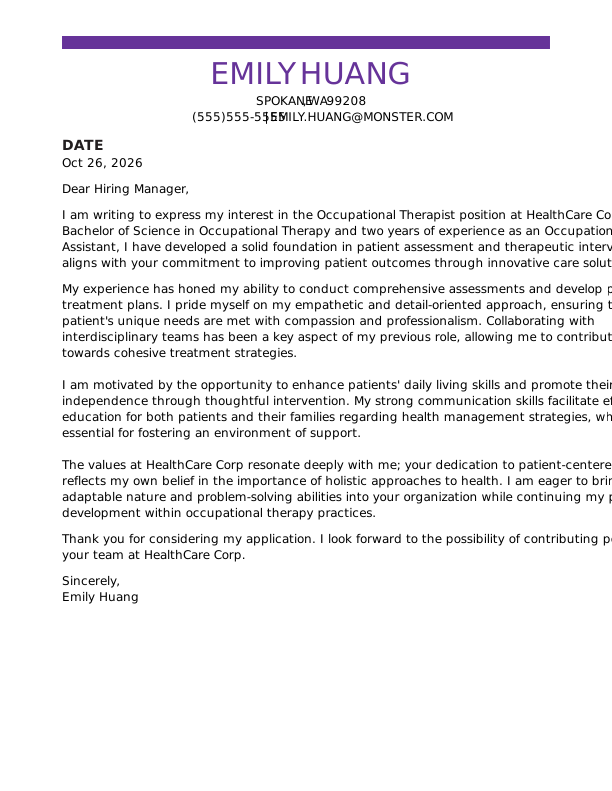
 Free
Occupational Therapist Entry-Level Cover Letter
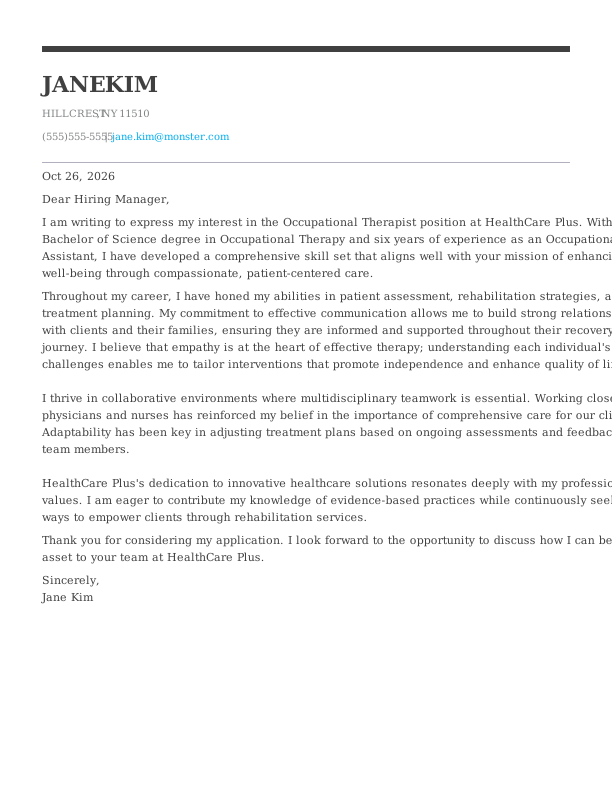
Occupational Therapist Mid-Level Cover Letter
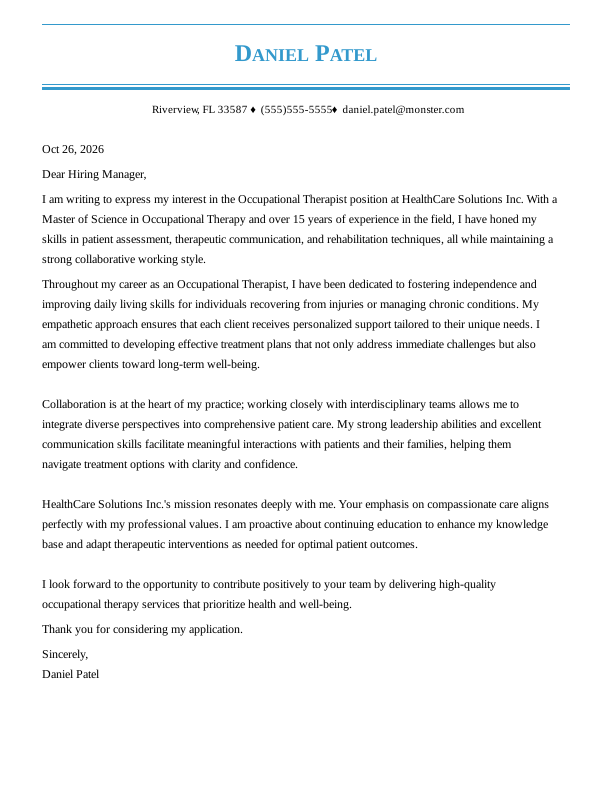
Occupational Therapist Experienced Cover Letter
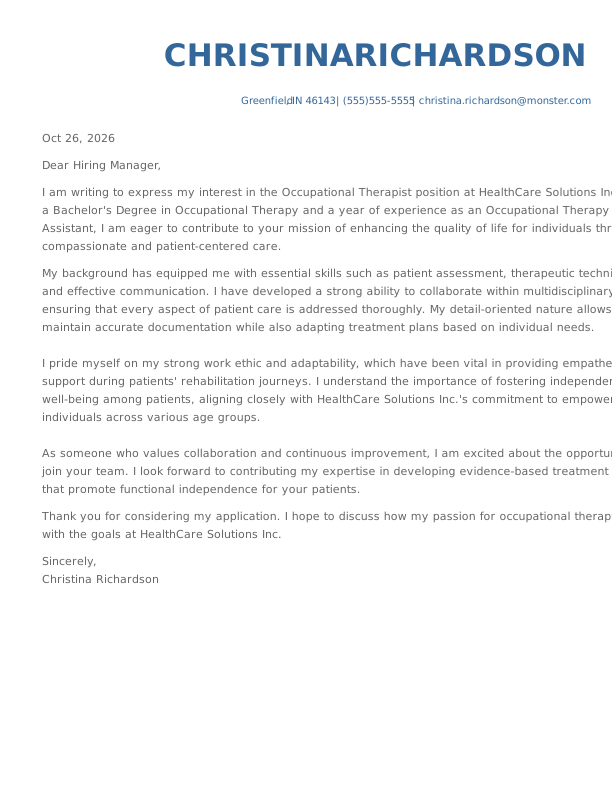
Occupational Therapist Entry-Level Cover Letter
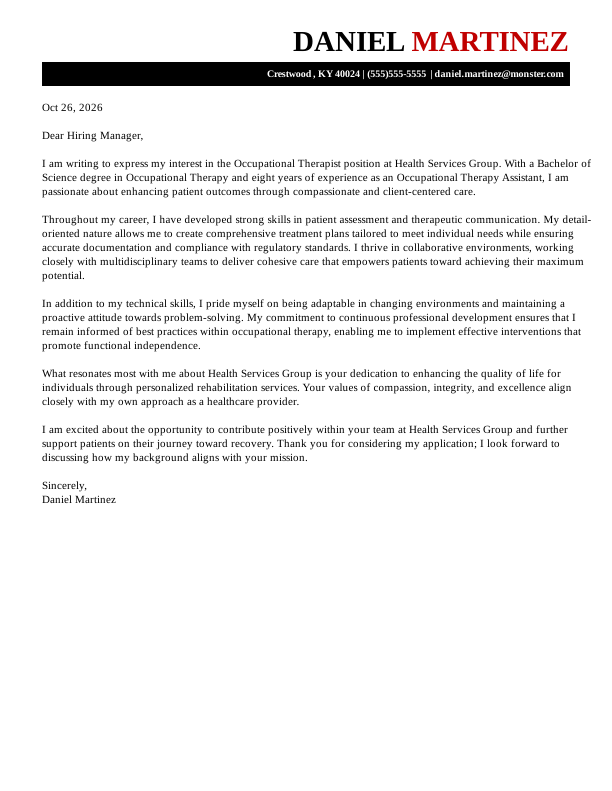
Occupational Therapist Mid-Level Cover Letter
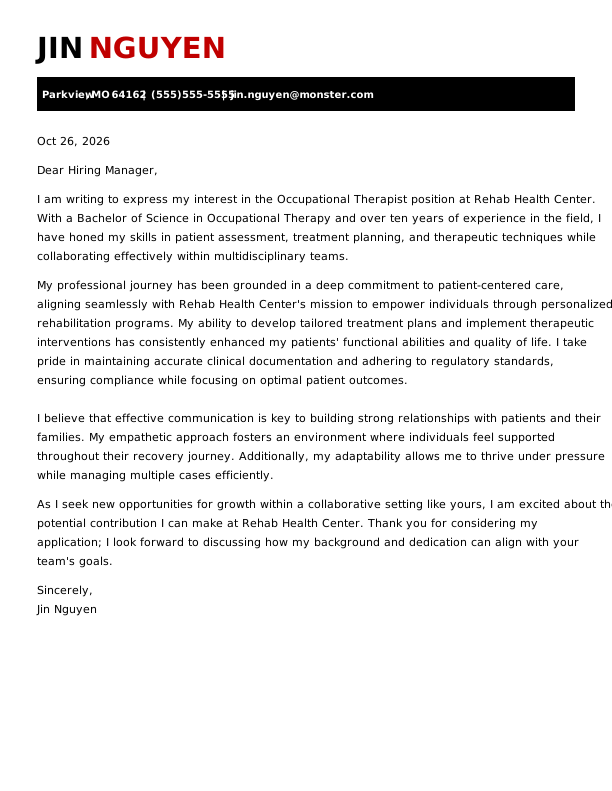
Occupational Therapist Experienced Cover Letter
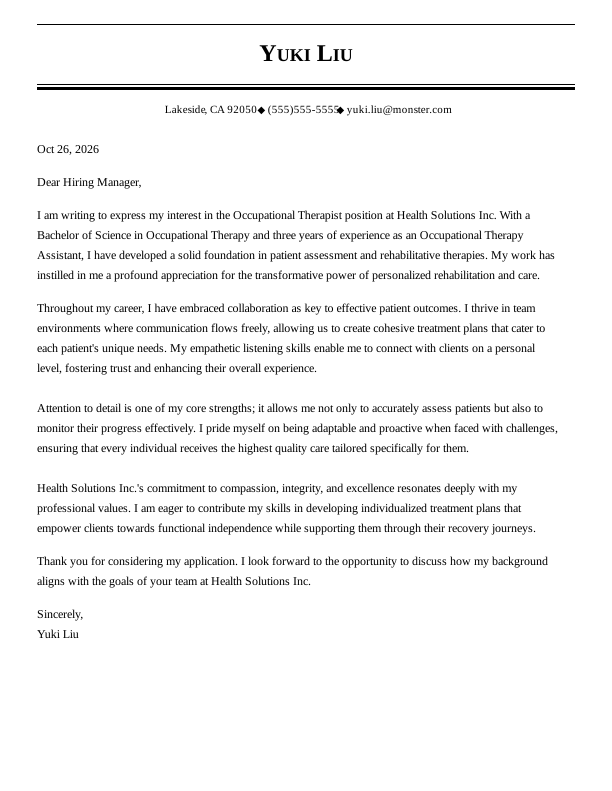
Occupational Therapist Entry-Level Cover Letter
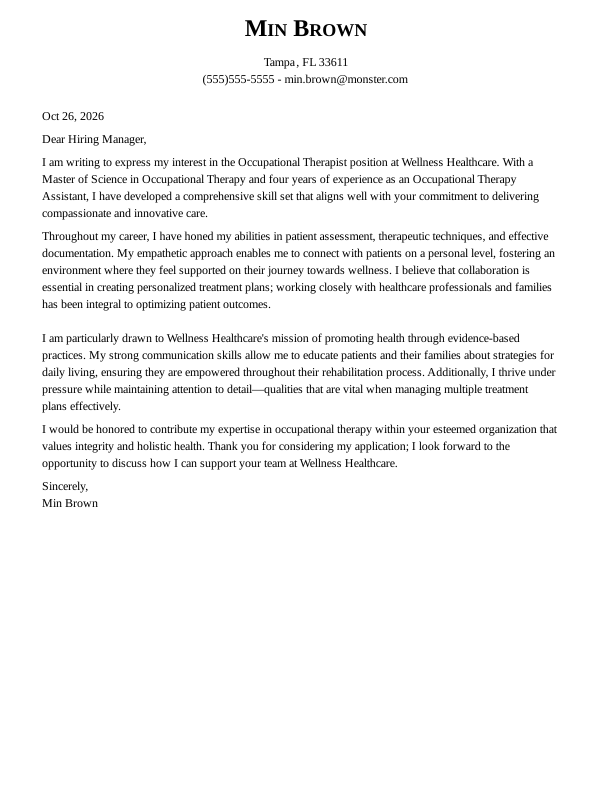
Occupational Therapist Mid-Level Cover Letter
Browse Free Cover Letter Templates
- Academic
- Account Manager
- Accountant
- Accounts Payable
- Administrative Assistant
- Admissions Counselor
- Architecture
- Artist
- Assistant Principal
- Babysitter
- Barista
- Bartender
- Bookkeeper
- Brand Ambassador
- Business Analyst
- Business
- Caregiver
- Chef
- Civil Engineering
- Computer Science
- Construction
- Consulting
- Copywriter
- Cosmetology
- Custodian
- Customer Service
- Customer Service Representative
- Data Analyst
- Data Entry
- Dental Assistant
- Dental Hygienist
- Digital Marketing
- Electrical Engineering
- Emt
- Engineering
- Esthetician
- Event Coordinator
- Executive Assistant
- Fashion Designer
- Finance
- Financial Analyst
- Firefighter
- Flight Attendant
- Graphic Designer
- Hair Stylist
- Healthcare
- Hr Generalist
- Investment Banking
- It
- Janitor
- Journalism
- Lab Technician
- Law Clerk
- Lawyer
- Librarian
- Logistics
- Maintenance Worker
- Makeup Artist
- Manager
- Marketing Coordinator
- Marketing
- Marketing Manager
- Massage Therapist
- Mechanic
- Mechanical Engineer
- Medical Assistant
- Non Profit
- Nursing
- Occupational Therapy
- Office Assistant
- Office Manager
- Operations Manager
- Paralegal
- Personal Trainer
- Pharmacist
- Pharmacy Technician
- Photographer
- Physician Assistant
- Pilot
- Police Officer
- Program Manager
- Project Manager
- Property Manager
- Psychology
- Receptionist
- Research Assistant
- Restaurant Manager
- Retail
- Sales
- Sales Manager
- School Counselor
- Security
- Security Officer
- Social Work
- Software Engineer
- Special Education Teacher
- Starbucks
- Substitute Teacher
- Teacher
- Teaching Assistant
Cover Letter Examples for Occupational Therapists
Cover letter requirements evolve as an occupational therapist advances, especially when your role shifts from supervised clinical training to broader caseload leadership. Choose the template that matches your experience level so you can highlight the most relevant assessments, treatment plans, and outcomes.
Entry-Level Occupational Therapist Cover Letter
If you are entering the field or transitioning from a related clinical background, use this template to highlight your academic foundation, core hands-on training, and passion for client-centered care.
Mid-Career Occupational Therapist Cover Letter
Ideal for clinicians with several years in practice, this template shows how to showcase independent treatment planning, multidisciplinary teamwork, and your ability to manage day-to-day caseload demands effectively.
Experienced Occupational Therapist Cover Letter
Designed for seasoned practitioners, this template focuses on long-term clinical excellence, advanced treatment expertise, interdisciplinary leadership, and your dedication to driving sustainable patient outcomes.
Occupational Therapist Cover Letter Template (Text)
Paste this occupational therapist cover letter template into your document, then copy and customize it by swapping in your caseload outcomes and employer name.
Emily Kim
Riverview, FL 33579
(555)555-5555
emily.kim@monster.com
Oct 26, 2026
Dear Hiring Manager,
I am writing to express my interest in the occupational therapist position at Innovative Healthcare Solutions. With a Bachelor of Science degree in Occupational Therapy and seven years of experience in providing patient-centered care, I am excited about the opportunity to contribute to your team’s mission of enhancing client outcomes through innovative practices.
Throughout my career, I have developed a strong foundation in rehabilitation techniques and assessment skills, allowing me to create tailored treatment plans that address each client’s unique needs. My commitment to fostering effective communication and collaboration has been instrumental in building trusting relationships with clients and their families, ensuring they are well-informed every step of the way.
I thrive in fast-paced environments where adaptability is essential. My proactive approach enables me to navigate challenges effectively while maintaining a focus on delivering compassionate care. Working alongside multidisciplinary teams has reinforced my belief in the power of teamwork when striving for optimal patient outcomes.
At Innovative Healthcare Solutions, I admire your dedication to continuous improvement and individualized treatment strategies. It aligns perfectly with my own values as an occupational therapist who prioritizes functional independence for every client I serve.
I look forward to the possibility of joining your esteemed organization, where I can utilize my skills and passion for improving lives through comprehensive rehabilitative services. Thank you for considering my application; I hope to discuss how I can contribute positively to your team soon.
Sincerely,
Emily Kim
How to Write an Occupational Therapist Cover Letter
Writing a strong occupational therapist cover letter means turning your daily clinical work into a clear, compelling story. Instead of just listing standard duties, you want to show employers how you assess individual needs, guide functional recovery, and help clients regain independence.
Use these six practical steps to shape your therapy background into a letter that stands out.
1. Research & Prepare
Before typing your first sentence, spend some time exploring how the facility operates and what kind of care it prioritizes. Every clinical setting has its own daily rhythm, documentation expectations, and patient population. Showing that you understand an employer’s specific environment tells the hiring team that you can step in and adapt quickly.
Here are a few quick ways to gather useful background details before drafting your letter:
- Read the job posting carefully to identify the setting, primary patient conditions, and specific electronic health record (EHR) platforms mentioned.
- Visit the organization’s website to understand its core clinical specialties, treatment philosophy, and community focus.
- Review practice resources from professional associations like the American Occupational Therapy Association (AOTA) to see current standards for that clinical setting.
2. Hook the Reader
Start your letter with energy and focus. Opening with standard phrasing like “I am writing to apply for the open position” wastes valuable space and sounds just like every other applicant. Instead, grab the reader’s attention by mentioning your clinical passion, primary area of practice, or a meaningful result you have achieved.
Consider these opening examples to see how you can hook a hiring team:
- “Over the past three years in acute rehabilitation, I have focused on helping stroke survivors rebuild daily living skills, consistently improving functional independence scores by 20% before discharge.”
- “As a dedicated occupational therapist specializing in outpatient pediatrics, I love partnering with families to create sensory-rich interventions that help children thrive in both the classroom and at home.”
- “Having spent four years managing complex orthopedic caseloads, I focus on delivering early, individualized mobility plans that help clients safely return to work and daily routines.”
3. Tell Your Professional Story
Use the body of your letter to connect your everyday responsibilities to real, positive patient outcomes. A hiring manager wants to see the person behind the credentials and understand how you solve clinical challenges. Whenever possible, include clear numbers and measurable progress to give your achievements tangible weight.
Here are a few examples showing how to frame your clinical impact clearly:
- Helped 85% of assigned orthopedic patients meet their primary range-of-motion goals within eight weeks through customized home-exercise programs.
- Reduced therapy drop-out rates from 14% to 5% by developing flexible scheduling options and keeping open lines of communication with family caregivers.
- Conducted detailed home-safety evaluations for over 30 older adults each month, helping lower fall-related hospital readmissions by 18%.
4. Showcase Your Skills
Rather than offering a simple laundry list of clinical terms, explain how you put your therapy skills into practice during patient sessions. Pick two or three core strengths that match what the employer needs, and illustrate them with concrete examples.
You can highlight essential therapy skills using natural, scenario-based descriptions like these:
- Assessment & Goal Setting: “I rely on standardized evaluations and candid client conversations to set realistic, meaningful goals that reflect what patients actually want to get back to doing.”
- Treatment Adaptability: “When a patient experiences fatigue or pain during an activity, I quickly adjust the task’s difficulty and adapt therapeutic equipment to keep the session safe and encouraging.”
- Team Collaboration: “I maintain daily communication with physical therapists, speech-language pathologists, and nurses to make sure our care strategies remain consistent and coordinated.”
5. Explain Any Special Circumstances
If you have a gap in your work history, are changing clinical specialties, or are moving to a new city, address it directly in one or two clear sentences. Employers appreciate honesty, but they want to know that your clinical knowledge and licensure are active and up to date. Keep your explanation positive, brief, and forward-looking.
Here are simple ways to address common career situations:
- Career Gap: “Following a planned caregiving leave, I completed 25 hours of continuing education in neurological rehab and fully renewed my state OT license.”
- Specialty Pivot: “After five rewarding years in skilled nursing, I am bringing my deep knowledge of adaptive equipment and functional mobility into home health care.”
- Relocation: “I am relocating to Denver this summer, have already secured my Colorado state therapy license, and am eager to join a collaborative outpatient clinic.”
6. End With a Professional Goodbye
Wrap up your letter with a confident, courteous closing. Reiterate your enthusiasm for the role, suggest an interview to discuss how your background fits their caseload, and thank the reader for their time.
You can close your letter smoothly with a simple paragraph like this: “I would welcome the opportunity to discuss how my clinical experience and patient-first approach can support your therapy team. Thank you for your time and consideration.”
Finish with a professional sign-off such as “Sincerely,” followed by your full name and contact information.
4 Tips for Formatting Your Cover Letter
Hiring managers and therapy directors balance busy patient schedules, which means they may review cover letters during brief breaks between appointments. A clean, well-spaced format makes your letter effortless to skim during a fast initial scan. Thoughtful visual presentation highlights your qualifications right away, while signaling the same organization, precision, and attention to detail you bring to patient documentation.

Use a Professional Font & Layout
Stick with clean, easy-to-read fonts like Arial, Calibri, or Georgia set between 10 and 12 points. Keep your margins set to a standard 1 inch on all sides. It also helps to match the header font and contact layout to your resume so your entire application looks like a single, cohesive package.

Address the Hiring Manager Directly
Whenever you can, find the name of the rehab director, clinic manager, or therapy recruiter and address them directly. Check the job posting, the clinic’s online team directory, or LinkedIn. If a specific contact is not listed anywhere, opening with “Dear Hiring Manager” or “Dear Rehab Team” works well.

Use Bullet Points for Key Achievements
Break up dense blocks of text by using three or four bullet points to highlight your proudest clinical achievements. Highlighting measurable improvements—like functional gain percentages, discharge milestones, or caseload attendance rates—gives the reader clear data points that jump off the page during a quick review.

Balance Spacing & Margins
Keep your line spacing set between single and 1.15, and always leave a blank line between paragraphs. Consistent white space prevents your letter from looking crowded or overwhelming, ensuring that your message reads comfortably on both mobile screens and printed clinical review packets.
Top-Paying States for Occupational Therapist Roles
Knowing what occupational therapists earn helps you compare offers, plan your career path, and negotiate with confidence. Salary figures vary by setting and experience, so it’s smart to use a reliable baseline when you’re evaluating options. The data below comes from the U.S. Bureau of Labor Statistics (BLS) and reflects recent nationwide averages for occupational therapists.
Keep in mind that location, years on the job, caseload specialty, and employer type can affect your pay. For example, roles in hospitals or rehab centers may differ from outpatient practices.
| Alabama | $95,250 |
| Alaska | $101,700 |
| Arizona | $101,360 |
| Arkansas | $100,490 |
| California | $117,120 |
| Connecticut | $101,120 |
| Delaware | $95,610 |
| District of Columbia | $107,690 |
| Florida | $97,230 |
| Georgia | $95,690 |
| Hawaii | $97,120 |
| Idaho | $86,650 |
| Illinois | $96,850 |
| Indiana | $92,800 |
| Iowa | $91,200 |
| Kansas | $93,540 |
| Kentucky | $91,070 |
| Louisiana | $89,320 |
| Maine | $82,940 |
| Maryland | $100,860 |
| Massachusetts | $96,790 |
| Michigan | $86,200 |
| Minnesota | $88,430 |
| Mississippi | $91,120 |
| Missouri | $90,360 |
| Montana | $88,270 |
| Nebraska | $89,730 |
| Nevada | $110,320 |
| New Hampshire | $85,760 |
| New Jersey | $107,600 |
| New Mexico | $102,560 |
| New York | $98,980 |
| North Carolina | $91,970 |
| North Dakota | $82,730 |
| Ohio | $94,480 |
| Oklahoma | $102,140 |
| Oregon | $108,430 |
| Pennsylvania | $93,950 |
| Rhode Island | $96,800 |
| South Carolina | $92,310 |
| South Dakota | $82,560 |
| Tennessee | $93,100 |
| Texas | $103,150 |
| Utah | $92,310 |
| Vermont | $87,840 |
| Virginia | $99,710 |
| Washington | $105,160 |
| West Virginia | $93,100 |
| Wisconsin | $88,780 |
| Wyoming | $90,960 |
| Puerto Rico | $52,720 |
Key Takeaways
- Focus your letter on how you evaluate patient needs and build practical, goal-oriented treatment plans.
- Include clear numbers and measurable functional outcomes to show the real difference your care makes.
- Match your therapy achievements to the employer’s specific clinical setting, whether that is acute rehab, schools, or outpatient care.
More Cover Letter Examples
- Biology
- Clinical Research Coordinator
- Medical
- Medical Receptionist
- Medical Scribe
- Patient Care Technician
- Phlebotomist
- Physical Therapist Assistant
- Physical Therapist
- Physical Therapy
- Respiratory Therapist
- Surgical Tech
Browse Monster’s Resume Templates
Monster also has hundreds of ATS-friendly resume templates for all career levels and industries. Create a matching resume to help you land the interview.
Frequently Asked Questions
Last Update:
Do I really need a cover letter?
Yes, you should include a cover letter for an occupational therapist role even when the job posting lists it as optional. A resume outlines your credentials, but a letter lets you explain your clinical philosophy, show how you connect with patients, and highlight your communication style. It also gives you a dedicated space to explain why you want to join that specific clinic, hospital, or school program.
How long should my cover letter be?
An occupational therapist cover letter should always stay on a single page, ideally between 250 and 400 words. Therapy directors and clinic managers have demanding schedules, so they appreciate clear, focused applications that get straight to the point. Sticking to three or four short, well-structured paragraphs gives you plenty of room to highlight your top clinical skills and patient achievements without overwhelming the reader.
Should my cover letter match my resume?
Yes, your occupational therapist cover letter should match your resume’s visual formatting to create a polished, unified application. Use the same font, font sizes, margins, and contact header on both documents. While the visual design should match, make sure your letter expands on your proudest patient outcomes and personal care philosophy rather than simply repeating the duties already listed on your resume.
Can I use AI to write my cover letter?
You can use AI to help brainstorm, outline, or organize your occupational therapist cover letter, but you must personalize the final draft yourself. AI tools can give you a helpful starting point, but they cannot capture your real-world clinical judgment, specialized treatment approaches, or genuine patient interactions. Take time to revise the text so it reflects your authentic voice, clinical experience, and personal commitment to patient care.
How do I write a cover letter for an internal position?
When writing a cover letter for an internal occupational therapist position, focus on your familiarity with the facility’s documentation workflows, patient population, and interdisciplinary team. Highlight how your day-to-day contributions have improved patient outcomes or team efficiency, such as streamlining discharge handoffs or updating safety protocols. Conclude by outlining how taking on this new role will allow you to support the department’s broader clinical goals.

Kirsten Chorpenning is a career advice writer who empowers job seekers to take control of their career paths using Monster’s comprehensive job search and resume tools. She specializes in helping job seekers find rewarding jobs in today’s dynamic work environment.
See More From Kirsten ChorpenningExplore Related Career Advice







How to Write a Cover Letter for Internal Positions or Promotions (Examples & Tips)
Updated:
Apr 23, 2026
|
19 min read


Cover Letter vs Resume: What’s the Difference & Do You Need Both?

Updated:
Apr 23, 2026
|
18 min read